What repair items belong in a survival kit?
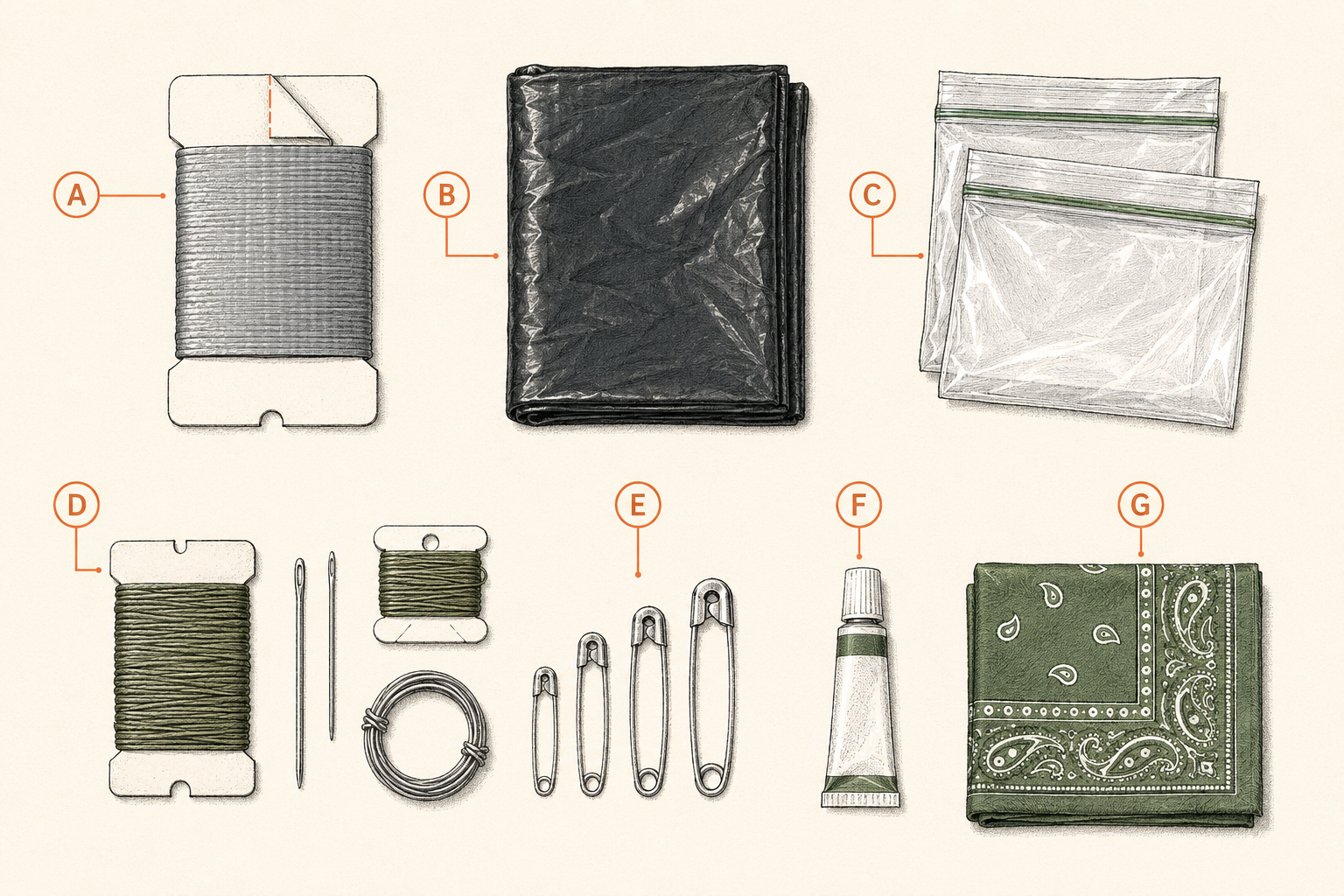
Seven multi-use staples: duct tape, contractor trash bags, zip bags, cordage’s fine tiers (thread, floss, wire), safety pins, super glue, and a bandana. Together they repair gear, improvise missing equipment, and stretch every other chapter’s contents.
This chapter is the kit’s hardware store, and its selection rule is the multiplier test: an item earns space here by having five jobs, not one. That test explains the odd-looking roster (a cotton square? garbage bags?) and it’s why these items appear as supporting cast in nearly every chapter before this one. Gear fails in the field on a schedule of its own; the repair shelf is what turns failures back into equipment.
The packing rule is miniaturization: none of these items ship in kit-size form, so this chapter is also about re-rolling, re-winding, and flat-packing: making the hardware store fit in the corners the tin has left.
Duct tape: the flagship
Duct tape repairs fabric, boots, hoses, tarps, and skin-adjacent problems; it splints, seals, labels, and catches sparks. Carry it re-rolled flat: yards of capability at ounces of weight, in every layer down to the wallet.
The résumé, compressed: gear repair (torn tents, pack straps, delaminating soles wrapped like a mummy), Chapter 20‘s shelter patches and bag-architecture assembly, Chapter 25‘s blister protocol and improvised dressing-retention, splint padding and securing, hose and container sealing in the vehicle chapters, labeling (tape plus marker equals the labels Chapter 41‘s audits love), and, twisted into cord, an emergency lashing that Chapter 22 would grudgingly respect.
The packing craft is the re-roll: fresh tape wound onto a sliver of the old core, a pencil stub, a gift card, or flat onto itself (fold a starter tab; future cold fingers send thanks). Practical loads: 2–3 ft (60–90 cm) flat-wrapped in the tin or wallet, 10–15 ft (3–4.5 m) on a card at pack scale, the honest full roll in vehicles. Buy the real cloth-backed article (bargain tape is shiny disappointment), and note the quiet fact that fabric-adhesive quality peaks in brands sold to tradespeople, not to survivalists.
Contractor bags: architecture in a pocket
The 3-mil, 42-gallon contractor bag is this book’s favorite improvisation blank: poncho, bivvy, mattress, water hauler, dry bag, shade roof, wind wall, latrine liner, and signal panel, at about 2 oz (60 g) each. Three ride in every pack and vehicle kit.
Chapter 20 built the shelter half of the résumé (poncho slits, taped tube-bivvy, leaf-stuffed mattress, duff-filled wind wall); the rest of the list runs: water carriage and rain catchment (Chapter 12), pack liner that outperforms most rain covers, ground sheet and gear tarp, improvised flotation aid stuffed with empty bottles (an assist, never a PFD), solar-warmed wash water (dark plastic plus sun), scent-and-mess isolation for game or garbage, and the grim-but-real sanitation duties of Chapter 34‘s stay-home scenarios.
The spec matters: contractor grade, 3-mil. Kitchen bags tear at the first ambition. Fold them flat (they pack to envelope size), and treat them as consumables: used bags demote to liner duty, and the kit count gets restocked. At their price, generosity is free.
Zip bags: organization that waterproofs
Freezer-grade zip bags are the kit’s cheapest waterproofing, organization, and container system: contents grouped and visible, moisture excluded, and a spare vessel every time you empty one. Several sizes, several of each, everywhere.
The uses catalog: waterproofing anything that hates water (Chapter 21‘s sealed spare, the phone in Chapter 3‘s creek scene, matches, documents), grouping kit modules so cold hands find categories instead of confetti, carrying water in a pinch (double-bagged; Chapter 12), irrigation with a pinholed corner (Chapter 25‘s wound jet), collecting (tinder, berries, evidence of where you cached something), packing out what sanitation demands, and the vacuum trick (zip almost closed, suck the air, seal: flat-packed clothing and dressings).
Freezer grade is the spec (sandwich-weight bags are single-use at best), the doubled bag is the doctrine for anything critical, and a marker on the bag (contents, date) is Chapter 41‘s audit pre-paid. Two gallon-size, four quart-size, and a few small is a pack-scale allocation; the tin gets one small bag as its own liner.
The sewing card: thread, floss, wire
A flat card wound with heavy thread, dental floss, and fine wire, plus three needles and a fold of safety pins, is the kit’s textile repair department: torn packs, split seams, popped buttons, ripped tents, and Chapter 25‘s blister-needle, all at zero practical weight.
The materials ladder: heavy-duty polyester or nylon thread (upholstery/outdoor grade; cotton thread rots and snaps) for clothing and light gear; waxed dental floss as the sleeper champion (stronger than it looks, pre-waxed for grip, and already in the hygiene kit) for pack and boot seams; Chapter 22‘s inner strands for the heavy jobs; fine wire (Chapter 14‘s coil) where thread would melt or abrade. Needles: two sharps and one heavy curved or sail needle (the curved needle is the difference between fixing a mounted seam and disassembling the pack to reach it); a needle threader costs nothing and cold fingers bless it.
Technique floor for the non-sewer: the whip stitch closes most field tears (over-and-over along the edge), an awl or the multitool’s spike pre-holes leather and webbing, and every repair ends with the thread melted or knotted triple. Speed-fix tier: safety pins (below) hold what you’ll sew tonight, and duct tape backs fabric before stitching flappy tears.
Safety pins deserve their own sentence: four sizes from tiny to diaper-class, doing duty as zipper pulls, sling fasteners, blister lancets (flamed first), fishing-hook understudies (Chapter 14 has caught worse), gear hangers, and the clothing repairs that outrun sewing time.
Super glue: the instant fix
Cyanoacrylate glue bonds gear instantly and hard: cracked handles, delaminating soles’ edges, fraying cord tips, split plastic. The single-use mini tubes are the kit form: the big tube welds itself shut on schedule.
Gear uses first, because they’re the everyday value: hard plastics and cracked housings (Chapter 9‘s light bodies, buckle repairs), fletching-and-fine-work bonds, thread-end locking on repairs that must not walk, and (with a baking-soda sprinkle, an old trades trick) a gap-filling weld of respectable strength. Its limits: brittle under flex (bad for fabric except as fray-stop), poor in the cold-wet moment (surfaces want dry and warm), and merciless to fingerprints.
Then the skin question, answered honestly. Cyanoacrylate on minor cuts is a real practice with a real caveat: medical-grade skin adhesives exist (different formulation, flexible, purpose-made) and are the right product for planned kit duty; hardware glue on skin is a field improvisation people use for small clean splits (fingertip cracks, paper-cut class), never for deep, dirty, or gaping wounds, which are Chapter 25‘s clean-cover-evacuate territory.
The bandana: one square yard of options
A large cotton bandana is the kit’s fabric multi-tool: pre-filter, sling, dressing, sweatband, pot holder, sun cover, signal flag (orange, per Chapter 16), char-cloth stock (Chapter 8), and the wrapping that stops the tin from rattling. Two ride at pack scale; one folds into the tin’s lid.
Its jobs sort by chapter: water pre-filtering (Chapter 11‘s bandana-over-intake), first aid (cravat-folded sling, dressing tie, pressure-wrap assistant per Chapter 26‘s improvisations), fire (100% cotton is char-cloth’s raw material), signaling (buy orange and it’s a panel), comfort-and-competence (sweat, sun, dust mask wetted for smoke or dry throat), and camp mechanics (pot lifter, work-surface, gathering sack tied diagonal).
The one spec: 100% cotton, large (the 27 in / 68 cm square class), and per Chapter 21, know that its cotton-ness makes it the tool fabric, not the wearing fabric: it’s brilliant at every job except being your base layer in the rain.
Foil, ties, and the honorable mentions
The shelf’s supporting members: heavy-duty aluminum foil (Chapter 15 built its cooking résumé; add reflector, lure stock, and dry platform), zip ties in three sizes (instant one-way lashings, gear mounts, ad-hoc hinges, zipper surgery), a pencil stub with waterproof paper (navigation notes, Chapter 18‘s pace log, the note left on a windshield), and glow tape scraps on everything droppable.
Zip ties earn a paragraph of respect: they fasten in the dark with mittens, hold until deliberately cut, bundle firewood, mount lights to handlebars and poles, repair pack frames through drilled holes, and make Chapter 24‘s tool-and-material point better than any lecture. Carry a dozen mixed small-and-medium plus two of the fat 18 in (45 cm) class; cut them flush when permanent (proud-cut zip ties draw blood in the dark).
The waterproof notepad closes the shelf for a reason: writing is a survival function nobody lists. Bearings, times, doses given, the note pinned to the abandoned camp (Chapter 16‘s arrow made literate): all of it wants paper that survives rain and a pencil that writes at any temperature, which is exactly what a golf pencil does and pens don’t.
Allocation and the re-pack habit
The repair shelf packs by the miniaturization rule: everything re-rolled, re-wound, or flat-folded to the layer’s scale, and everything restocked the week it’s used. The table Part III will implement:
| Layer | Repair loadout |
|---|---|
| Layer 2 tin | 3 ft (1 m) tape flat-wrapped, small zip bag (as liner), 2 needles + floss card, 4 safety pins, glue mini-tube |
| Layer 3 pack | Tape card 10–15 ft (3–4.5 m), 3 contractor bags, zip bag set, full sewing card, pins, glue ×2, bandana ×2, foil 3 ft (1 m), zip ties, pencil + waterproof pad |
| Vehicle | Full tape roll, 6 contractor bags, the real sewing kit, wire spool, zip-tie assortment, and Chapter 35‘s actual tool roll |
| Home | The junk drawer, promoted and inventoried |
The habit that keeps the shelf real is the same one Chapter 25 taught: consumables consumed are consumables gone. Tape used is tape re-rolled next weekend; the bag that lined a muddy pack gets replaced, not returned. Repair items fail silently by depletion, and the five-minute restock is the whole defense.
Pack This Chapter
- The multiplier test picks the shelf: tape, contractor bags, zip bags, sewing card (thread/floss/wire), safety pins, super glue, bandana: five jobs each, minimum.
- Re-roll everything: tape on cards with a starter tab, thread and wire wound flat, bags folded to envelopes. The hardware store fits in corners.
- Contractor grade (3-mil) or the bag résumé is fiction; freezer grade or the zip bag is single-use.
- Glue for gear always, skin rarely and only trivially; medical adhesive is the planned product. Cotton bandana is the tool fabric, never the base layer.
- Restock the week you use anything; depletion is the shelf’s only real failure mode.
Where Kits Fail
- The full-size roll problem. Duct tape left home for being bulky, when three feet re-rolled weighs nothing. Miniaturize, don’t omit.
- Kitchen bags cosplaying. Thin bags tear at the first shelter job. The 3-mil spec is the item.
- The unsewable kit. Thread with no needle, needle with no threader, and a split pack seam at dusk. The card is one object; pack it complete.
- Glue soup. One uncapped tube and the tin’s contents are a diorama. Its own zip bag, always.
Frequently asked
What are the best survival uses for duct tape?
Gear repair (packs, tents, boots wrapped sole-to-upper), shelter patching and bag-architecture, blister and dressing retention, splint securing, container sealing, labeling, and emergency cordage when twisted. Carry it re-rolled flat: 3 ft (1 m) in a tin, 10–15 ft (3–4.5 m) on a card in a pack.
Why do survival kits include trash bags?
Because a 3-mil contractor bag is a poncho, bivvy shell, ground mattress (leaf-stuffed), water hauler, pack liner, shade roof, wind wall, and dry bag: 2 oz (60 g) each. Kitchen bags do none of this; contractor grade is the entire spec. Three per pack is this book’s standard.
Is super glue safe for cuts?
For tiny, clean, shallow splits (fingertip cracks), cyanoacrylate is a common field fix; medical-grade skin adhesive is the proper product if you’re packing for the purpose. Never glue deep, dirty, or gaping wounds: sealing contamination in is the failure Chapter 25 warns about. Its real kit career is gear repair.
What should a survival sewing kit include?
Two sharp needles plus one heavy curved needle, heavy polyester thread and waxed dental floss wound on a flat card, a needle threader, and graduated safety pins, with fine wire and paracord inner strands as the heavy tiers. That card mends packs, tents, clothing, and boots, and the curved needle reaches seams you can’t disassemble.