How do you practice with a survival kit?
On a schedule, in small doses, with the actual gear: a ten-minute monthly drill, one seasonal skill session, two household rehearsals a year, and one real course annually. Practice converts the kit from purchased objects into owned capability, and it’s the only upgrade in this book that compounds.
The book has been promising this chapter since the introduction, and here’s the thesis in full: under stress, people don’t rise to the occasion; they fall to their training. The unpracticed ferro rod (Chapter 7‘s strike-three-to-strike-nine gap), the unboxed compass, the tourniquet still in shrink wrap: each is a purchase wearing the costume of preparation. Practice is what removes the costume.
The good news is the dose required: this is not a lifestyle, a hobby identity, or a weekend commitment. The whole curriculum below fits in a few hours a year, most of it pleasant, and it’s designed for exactly the person who would rather not: minimal, scheduled, and finished before it gets boring.
The monthly ten: micro-drills
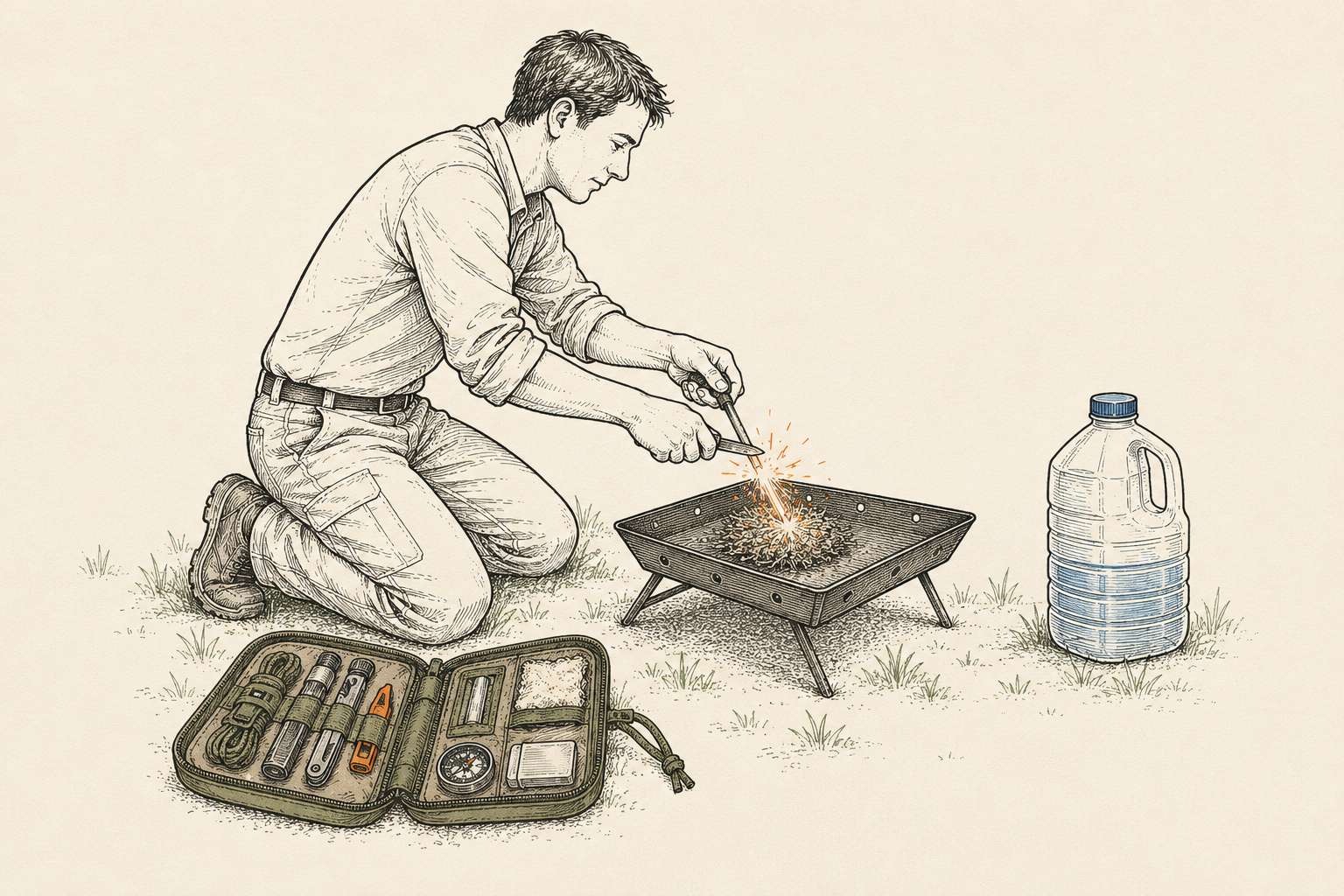
Once a month, ten minutes, one skill with real gear: strike the ferro rod, box the compass and walk a bearing, deploy and repack the bivvy, run the tourniquet drill on a willing leg, find both hotel-style exits at work. Rotate the list; never repeat two months running.
The design logic: skills decay on a curve, and short frequent touches beat rare marathons for keeping motor patterns alive. The rotation menu, drawn from every chapter: fire (one tinder tab, one rod, one flame, timed); knots (Chapter 22‘s five, eyes closed); the mirror aim (a fence post, sixty seconds); the blade-and-strop touch-up; the pack-shuffle (find the bleeding module blind, from your own pack, in under fifteen seconds); the phone drill (airplane mode, offline map, pin, navigate to it); the water drill (one tablet, one liter, labeled and waiting).
The scheduling trick that makes it real: attach the drill to an existing monthly anchor (first coffee of the month, the mortgage payment, the calendar app’s nag), and log one line somewhere (Chapter 41‘s card): skill, date, anything that failed. The log turns drills into data, and failures found on a Tuesday into shopping lists instead of emergencies.
The seasonal session: one real skill
Four times a year, one honest hour: build and sleep-test nothing, but do pitch the tarp both ways, cook a meal on the tablet stove, filter a liter from the pond, or walk a mile by pace count. The seasonal session is where component skills become system skills.
The four sessions, matched to their seasons: spring is water and navigation (filter and tablets on real pond water; the triangulation exercise from a known viewpoint); summer is fire and shelter (the full sequence: site, ground layer, tarp A-frame and lean-to, fire from ferro rod to boiling cup: the whole Chapter 20 assembly, in shorts, with lemonade); fall is the pack shakedown (Chapter 32‘s kit worn on a real hike, every item touched, the sealed spare’s weather-word updated); winter is the cold-weather hour (the car kit’s candle actually lit in the actual car, the stuck-sequence rehearsed on a safe snowbank, gloved knots).
The standard for all four: real gear, real conditions, real humility. Practice is where gear gets to fail cheaply (Chapter 6‘s testing doctrine), where techniques reveal their gaps, and where the calibration between what you own and what you can do gets honest. Bring a household member; skills taught are skills doubled.
The household rehearsals
Twice a year, the family runs its two drills: the five-minute grab (go-bags to the door, pets contained, timed) and the plan walk (meeting points visited, out-of-area contact actually texted, shutoffs touched). Twenty minutes each, and they’re the highest-value practice in the book.
Chapter 33 and 34 designed these; this chapter schedules and coaches them. Coaching notes from households that do it: make the grab drill a game with a stopwatch and a treat at the end (children remember games; lectures evaporate), rotate the “leader” role so teens and elders both run one, inject one twist per drill (lights out this time; one exit “blocked” next time; the drill runs from the shower once, because emergencies don’t check calendars), and end every drill with the two-question debrief: what was slow, and what was missing?
The debrief feeds the system: slow means staging gets fixed (the buried bag, the keyless hook); missing means the kit gets patched (the outgrown shoes, the dead headlamp). Run twice yearly, the rehearsals also automatically audit half the household’s gear, which is Chapter 41 getting its work done for free.
The courses worth taking
Four courses outperform everything a book can print: Stop the Bleed (an hour), CPR/AED (an evening), Wilderness First Aid (a weekend, for anyone who goes past the trailhead), and a hands-on land-navigation or bushcraft day. Take one per year and the kit’s ceiling rises annually.
Why courses beat chapters: hands-on correction, stress inoculation under supervision, and practice on the real props (the packing-gauze trainer, the actual bearing walked with an instructor watching your feet drift). The priority order tracks this book’s own doctrine: bleeding control first (Chapter 26‘s hour, cheap and near-universal), CPR/AED because cardiac events dwarf wilderness drama statistically, WFA when your Chapter 4 audit includes real trail time (it reframes first aid around the “help is hours away” assumption that changes everything), and the navigation/bushcraft day for the skills (fire under rain, land nav off-trail) that books teach worst.
Choosing providers, briefly: national certifying bodies and community programs (fire departments, hospitals, parks, clubs) cover the first two nearly free; for wilderness courses, look for hands-on hours over lecture hours and instructors who make you do it badly and then better. The certificate matters less than the hands.
Testing gear like you mean it
Gear testing is practice’s sibling: every new item gets a first-use session before it’s trusted (Chapter 6‘s rule), every kit gets its shakedown after building (this Part’s builds, worn and worked), and every failure gets logged and fixed rather than remembered vaguely.
The test protocols by category, compressed: consumables get sampled (one tinder tab burned, one ration bar actually eaten: palatability is a spec); mechanicals get cycled (the filter’s flow rate, the headlamp’s modes, the stove’s boil, the zippers under load); wearables get worn (the pouch on a real walk, the pack on real miles: comfort failures are carry failures on a delay); systems get run end-to-end (the tarp pitched with its own cordage, cut to its own lengths: kits fail at the interfaces, and only system tests find interface failures).
The mindset shift that makes testing stick: a failure found in testing is a win: the bargain rod that snapped on the lawn (Chapter 6‘s scenario) is the best two dollars that kit ever spent. Log it, replace it, and thank the process. Gear that has survived your own testing carries a different kind of trust into the field, and that trust is itself a performance enhancer when things go wrong.
The skills beyond the kit
A short list of skills makes every kit smaller: fire craft, knots, navigation, water judgment, first aid, and weather reading. Each one learned deletes gear or upgrades what remains. The endpoint of this book’s method is a smaller bag and a more capable person.
This is the closing argument of the practice chapter and maybe the book: Chapter 22 said an hour of cordage skill equals ten feet of rope; the exchange rate generalizes. The fire-skilled carry fewer backup systems and use cheaper ones confidently. The navigation-skilled carry the same map but never the panic. The first-aid-trained carry the same kit and triple its capability. Weather readers avoid half the scenarios this book equips.
None of that argues against the kit (the whole point of gear is covering the gap between your skills and the day’s demands, and the gap never fully closes): it argues for the ratchet: each season, one skill up, and let the kit evolve accordingly. The heaviest pack in the woods is usually carrying its owner’s inexperience.
Pack This Chapter
- People fall to their training: the unpracticed kit is a costume. The dose is small: monthly ten-minute drills, quarterly hour sessions, two household rehearsals, one course a year.
- Rotate the micro-drills (fire, knots, mirror, compass, blind pack-find, phone nav, tourniquet reps) and log one line per drill.
- Seasonal sessions run systems, not items: the full shelter sequence, real pond water, the worn pack, the winter car hour.
- Courses in order: Stop the Bleed, CPR/AED, Wilderness First Aid, hands-on navigation. Hands beat certificates.
- Test everything once before trusting it; log failures as wins. Skills shrink kits: one skill up per season is the ratchet.
Where Kits Fail
- Purchase mistaken for preparation. The shrink-wrapped tourniquet, the virgin ferro rod. Ownership is not capability.
- The marathon plan. “Someday, a whole weekend of practice” loses to ten minutes monthly, every time. Small and scheduled survives.
- Solo competence. One trained adult, three dependent passengers. Drills include the household or the household is cargo.
- Untested interfaces. Every item works; the system doesn’t (the tarp met its cordage the night it mattered). Shakedowns run end-to-end.
Frequently asked
How often should you practice survival skills?
Monthly for ten minutes (one rotating micro-drill with real gear), quarterly for an hour (one full system: shelter sequence, water work, pack shakedown, winter car drill), twice yearly for household rehearsals, and one hands-on course per year. The schedule matters more than the volume; skills decay between rare marathons.
What survival skills should you learn first?
Bleeding control (a one-hour Stop the Bleed course), fire with your actual carried tools, the five knots, basic compass work, and water treatment discipline. Those five convert nearly every kit in this book from objects into capability, and all five are learnable to working standard in a single season.
How do you test survival gear?
Before trusting it: burn one tinder tab, eat one ration bar, cycle every mechanical (filter flow, headlamp modes, stove boil), wear the wearables on real miles, and run systems end-to-end (the tarp with its own cordage). Log failures and celebrate them: a fault found on the lawn is the cheapest fix this book offers.
Are survival courses worth the money?
The core ones, absolutely: Stop the Bleed and CPR/AED are near-free through community programs and cover the statistically likely emergencies; Wilderness First Aid reframes everything for anyone who hikes; a hands-on navigation day fixes what books teach worst. Prioritize courses with more doing than listening.