How do you plan a survival kit?
Plan a kit by answering five questions before you buy anything: who is it for, where will it live, what season will it face, how long must it carry you, and what’s most likely to go wrong there. The answers pick the components.
Most bad kits skipped the questions and went straight to shopping, which is how a Phoenix commuter ends up owning a snow shovel and no second gallon of water. The questions aren’t paperwork; each one changes the contents. Who sets medications, kid supplies, and how much weight is realistic. Where decides the container and the theft-and-heat exposure. Season drives the swap modules this chapter is about. How long scales water and food. What’s likely is the reality check that ranks a dead phone battery above a bear encounter for almost everyone reading this.
Write the answers down. A kit is a set of decisions, and decisions you can see are decisions you can audit.
The scenario audit
List your actual week: the commute, the trails you walk, the travel you do, the weather your region actually produces. Your kit protects that list, not a fantasy expedition.
The survival-gear world sells for the dramatic scenario, and the dramatic scenario is usually the wrong design target. Look at your last twelve months honestly. How many hours did you spend more than an hour’s walk from a road? How many in a car in open country? How many storms took your power out, and for how long? For most people the audit produces something humbling: the realistic threats are a stranded vehicle, a blackout, a lost afternoon on a day hike, and a regional weather event. Wonderful news, since all four are cheap to prepare for.
The audit also surfaces the risks you’re personally married to. A daily insulin user has a cold-chain problem no gear catalog mentions. A rural commute in January is a different animal from the same miles in June. Two pages of honest notes outperform any amount of gear-forum reading.
The core-plus-module method
Build one core kit that never changes, then add and remove small seasonal modules. Never rebuild the whole kit twice a year; you’ll quit by the third season.
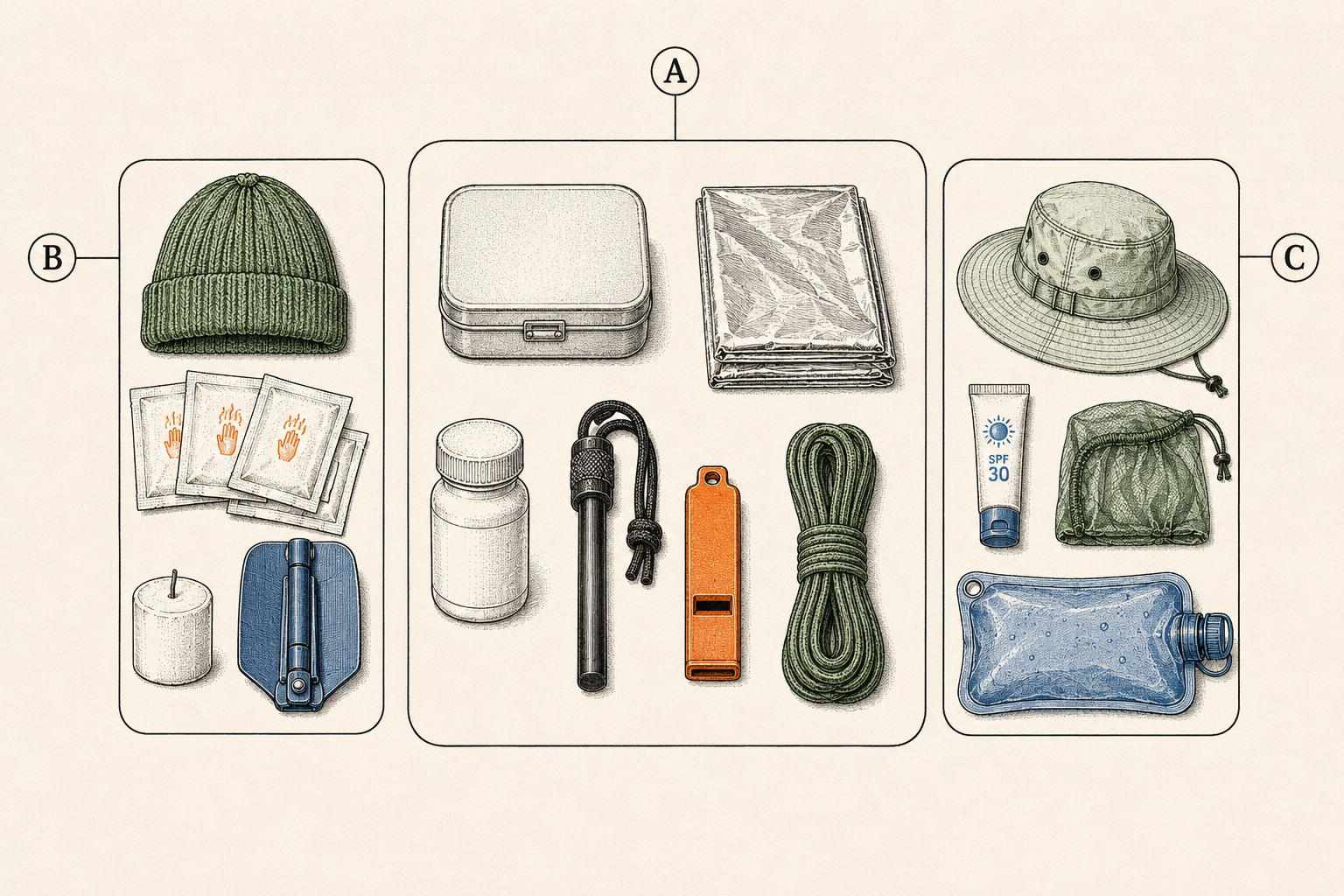
The core is everything season-proof: fire, water treatment, signaling, navigation, first aid, cordage, repair. That’s most of the kit, and it stays sealed and boring year-round. The module is a small stuff sack or pouch that rides alongside: the winter module, the summer module, the fire-season module for the West. Swapping modules takes five minutes on a calendar reminder, which is exactly why it happens. Full seasonal rebuilds take an afternoon, which is exactly why they don’t.
Modules also keep the audit honest. When the winter pouch comes out in April, everything in it gets touched, checked, and dated, and Chapter 41‘s rotation work happens as a side effect of the season change.
The winter module
Winter kits add insulation, heat, and melt capacity: a hat and gloves, chemical warmers, a candle, a metal container for melting snow, and calorie-dense food. Cold turns every other survival problem up and adds two of its own.
The two new problems are water that’s locked up as snow and batteries that fade in the cold. Snow is not drinking water until you spend heat on it (eating snow chills your core to save you a chore; melt it instead, which is why the metal cup or bottle earns its winter seat). Cold sag hits alkaline batteries hardest, one of several reasons Chapter 10 pushes lithium cells for stored kits.
A winter module for a personal kit, small enough to fit a coat pocket:
| Item | Why it’s seasonal |
|---|---|
| Knit cap and liner gloves | Cheapest insulation per ounce you can buy |
| Two chemical hand warmers | Rewarms numb hands enough to work zippers, lighters, knots |
| Candle | Steady flame for warmth, light, and drying tinder |
| Metal cup or single-wall bottle | Snow-melting vessel; plastic can’t sit near flame |
| Extra ration bar | Calories are heat; winter raises the burn rate |
Vehicle winter kits scale this up hard (blanket, shovel, traction aid) and get their own chapter (36).
The hot-weather module
Hot-and-dry flips the priorities: water roughly doubles, shade becomes shelter, and travel moves to the cool hours. The desert module is mostly extra water capacity plus sun protection.
Heat’s arithmetic is unforgiving. Sweat losses of a quart (about a liter) per hour are realistic for a working adult in desert heat, which means no practical kit carries enough water to work through a hot afternoon. So the module’s real contents are partly gear and partly doctrine: carry more capacity than seems polite (collapsible containers weigh nothing empty), protect the water you have from the sun, and change the plan itself: shade up during the peak, move at dawn and dusk, and treat “ration your sweat, not your water” as the operating rule. Drink what you have; hoarding water while dehydrating is a famous way to be found with water remaining.
The gear half is short: brimmed hat, sunscreen, sunglasses, electrolyte powder, and a light long-sleeve layer, because bare skin in desert sun costs more water than it saves in comfort. A mylar blanket, reflective side out, rigs into serviceable shade.
Wet-cold: the sneaky season
Cool-and-wet (coastal winters, mountain shoulder seasons, the whole Pacific Northwest) is the most dangerous ordinary weather there is. The module is rain protection, a synthetic base layer, and doubled fire redundancy.
Chapter 2 already named the mechanism: the 30–50°F (‑1–10°C) band with rain and wind is where most hypothermia actually happens, precisely because nobody treats a 45°F drizzle as an emergency. The wet-cold module fights on two fronts. Keep the water off (real rain shell or poncho, pack liner, dry bag for the insulation layer), and assume you’ll fail (a spare synthetic or wool base layer in a dry bag, because dry clothes next to the skin are the single best recovery move once someone’s soaked).
Fire earns double redundancy here because everything that burns is wet and your fingers will be clumsy. Stormproof matches join the ferro rod and lighter, and the tinder allocation doubles. Nowhere does carried tinder pay for itself like a wet-cold climate.
When you can’t predict
For unknown or mixed conditions, default to the cold-wet loadout and add water capacity. It’s the configuration that covers the most ways to die at the least weight.
Travel, shoulder seasons, and long road trips all produce this problem, and the answer follows from Chapter 2‘s rankings: exposure kills fastest, so protect against the worst plausible exposure and let food and comfort flex. A kit dressed for cold-wet handles a hot day at the cost of some sweat and dead weight. A kit dressed for summer meets one wet 40°F (4°C) night and becomes a story other people tell.
Your July self packs the trunk for your January problem, and July does it badly. It’s a 96°F (36°C) Saturday when you load the vehicle kit, and the wool blanket feels absurd in your hands, so it stays on the garage shelf to make room for the cooler. The next time you think about that decision, it’s dark, the interstate is closed behind a jackknifed trailer, and the car thermometer reads 12°F (‑11°C). Pack for the calendar’s whole year, not for the weather outside the garage.
Duration: the last multiplier
Decide how long the kit must carry you (a night, three days, a week) and scale only water, food, and consumables. The tools don’t multiply; the supplies do.
Duration is the cleanest planning variable because it touches so little. One knife serves a night or a month. What scales is anything you use up: water and treatment capacity, food, batteries, fuel, medications, warmer packets. The standard targets in this book: personal and day kits assume one hard night through a day or two; go-bags assume 72 hours; home kits assume two weeks of infrastructure failure. Those targets come from how real incidents actually run, and each build chapter in Part III states its duration assumption up front so you can stretch it deliberately instead of accidentally.
Pack This Chapter
- Five questions before any purchase: who, where, what season, how long, what’s likely. Write the answers down.
- Audit your real year, not a fantasy one. Stranded cars and blackouts outrank bears for almost everyone.
- Build a season-proof core plus small swap modules; calendar the swap and rotation rides along free.
- Winter adds insulation, heat, and snow-melt capacity. Heat adds water capacity, shade, and dawn-dusk doctrine. Wet-cold adds rain protection, a dry base layer, and doubled fire.
- Unknown conditions: pack cold-wet, add water. Scale consumables to duration; tools don’t multiply.
Where Kits Fail
- Packed to the season outside the window. The July trunk with no blanket meets January. Pack the year, not the day.
- The unmarked module. Seasonal gear mixed loose into the core, so the swap never happens and the audit never touches it. One pouch per season, labeled.
- Snow counted as water. Eating snow spends core heat; no melt vessel means winter water doesn’t exist. Metal container in every cold kit.
- Desert hoarding. Water rationed while its owner sweats into confusion. The water works in you, not in the bottle.
Frequently asked
What should be in a winter survival kit?
Everything in your core kit, plus insulation for head and hands, chemical warmers, a candle, a metal container for melting snow, and extra calories. In a vehicle, add a real blanket, a shovel, and traction aid (Chapter 36). Winter also punishes batteries, so favor lithium cells in cold-stored kits.
How is a desert survival kit different?
Water capacity roughly doubles, and sun protection becomes shelter: brimmed hat, sunscreen, sunglasses, a long-sleeve layer, and something to rig shade. Add electrolyte powder. The bigger change is doctrine: move at dawn and dusk, hole up through the heat, and drink your water instead of rationing it.
Do I need different kits for every season?
No. Keep one sealed core that never changes and swap small seasonal modules alongside it. A winter pouch and a summer pouch, exchanged on a calendar reminder, cover most climates. Full seasonal rebuilds are exactly enough work that people stop doing them by the second year.
How long should a survival kit last?
Match duration to the kit’s job: personal and day kits carry you through a hard night or two, go-bags assume 72 hours, home kits assume two weeks. Only consumables scale with duration (water, food, batteries, medications), so stretching a kit’s duration is cheaper than it sounds.