What goes in an Altoids-style tin survival kit?
Twenty-odd items covering all six functions: fire (ferro rod, matches, tinder, lens), water (tablets, pouch, foil), signaling (whistle, mirror), navigation (button compass), first aid (bandages, strips, ointment), cutting and repair (blades, tape, cordage, sewing), and morale. About 6 oz (170 g) packed, $35–50, sealed with one wrap of tape.
This is the book’s recommended first build, promised since Chapter 1, and it earns that status three ways. It’s cheap enough to build this week. It’s small enough to actually carry, which Part I established as the first spec. And the tin’s fixed volume teaches the whole method in miniature: every item must argue for its space against every other item, which is the discipline that makes all kits good. Build this one before the go-bag; the go-bag will be better for it. Small teacher, big lessons.
The container: a hinged mint tin of the classic 3.7 × 2.3 × 0.8 in (94 × 58 × 21 mm) class, one-piece bottom preferred (Chapter 5‘s seam check, for the boiling résumé), seam taped with electrical tape when done.
The packing list, item by item
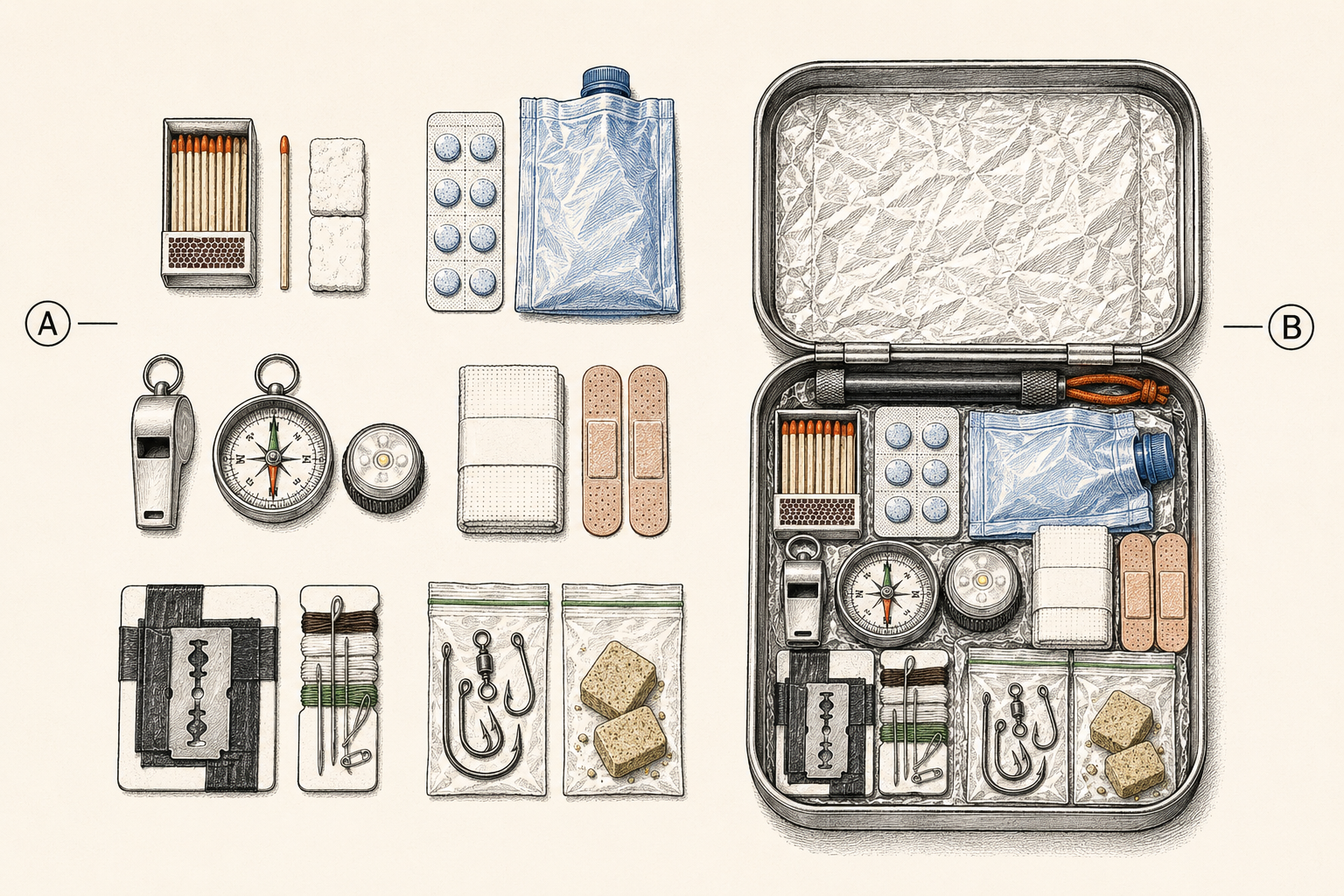
The complete list, grouped by function, with each item’s reasoning compressed to a phrase:
| Function | Item | Why this one |
|---|---|---|
| Fire | Small ferro rod + hacksaw-blade striker | Ageless sparks; striker doubles as mini scraper |
| Fire | 6 stormproof matches + striker strip, in mini zip bag | Cold-hands backup; strip stays dry bagged |
| Fire | 4 tinder tabs | One fire each; they also stuff rattling gaps |
| Fire | Fresnel lens (card size) | Free sunny-day fire; magnifier for splinters |
| Fire/light | Birthday-candle stub | Chapter 8‘s match multiplier, trimmed to fit |
| Water | 10 chlorine dioxide tablets, foil blisters | Ten liters of safe water at zero volume |
| Water | Folding 1 L pouch, fill line marked | Treatment needs a vessel (Ch. 12‘s one-ounce fix) |
| Water/cook | 2 ft (60 cm) heavy-duty foil, folded flat | Cup, lid, reflector, dry platform |
| Signal | Flat micro whistle | If the tin is your only kit, three blasts live here |
| Signal | Polished tin lid (or micro mirror sticker) | Chapter 16‘s aimable flash, pre-installed |
| Navigation | 20 mm button compass | The anti-circle device |
| Light | Button LED, switch taped against pocket-press | Finding things is a survival function after dark |
| First aid | 4 bandages, 4 closure strips, ointment packet, 2 wipes | Clean-close-cover at minimum scale |
| Cutting | 2 utility/scalpel blades, edges taped | Real edges, flattest possible form |
| Repair | 3 ft (1 m) duct tape on card | Chapter 27‘s flagship, miniaturized |
| Repair | Sewing card: 2 needles, floss, 4 safety pins | Fixes clothing, gear, and blisters |
| Cordage | 10 ft (3 m) paracord guts + 20 ft (6 m) line on card | Fine cordage tier; fishing line moonlights |
| Food | 4 hooks + 4 split shot in mini bag, points taped | With the line above: Chapter 14‘s smallest kit |
| Morale | Bouillon cube + 2 sugar packets, re-bagged | Hot salty-sweet water is a real intervention |
| Doc | Micro contact card + folded $20 | Speaks for you; disaster economies run on cash |
Count the functions covered and notice what’s absent (shelter beyond foil, food beyond a cube), because the absences are Chapter 29‘s honest-delegation principle: the tin pairs with a pocket mylar blanket and poncho whenever it’s the day’s whole kit.
Packing order: making it all fit
Packing a tin is stratigraphy: flat things floor and lid, dense things in rows, soft things in gaps. The order below fits everything listed with room to close:
- Floor layer: foil (folded to tin footprint), then the duct-tape card, sewing card, and Fresnel lens stacked flat.
- The rows: ferro rod along the hinge; blades (taped) beside it; compass, LED, and whistle in a row; the folded pouch flat atop the cards.
- Bagged goods: matches, hooks, tablets, and bouillon in their mini bags, standing in the remaining well.
- Gap fill: tinder tabs and the candle stub pressed into every void until nothing shifts.
- The lid check: close it. If it fights, the newest item argues for its life. If it rattles, add a tab.
- Seal: one wrap of electrical tape around the seam, tab folded at the end. Date it inside the lid in marker.
The shake test is the exit exam (silence means done), and the seal date starts Chapter 41‘s clock. Total build time, first attempt: about an hour, most of it the pleasant kind of fiddling.
The build variants
Three honest variants adapt the tin to Chapter 4 audits: the winter tin (more fire, candle upgraded, hand-warmer sachet), the urban tin (blades out, cash and meds in, transit card and USB drive added), and the angler/paddler tin (tackle doubled, contents double-bagged).
The variant discipline: change no more than a third of the base build, or you’ve designed a different kit and should go do that properly. Winter: tinder doubled, second candle, one chemical warmer folded flat, matches upgraded to the fattest stormproof grade that fits. Urban: the checkpoint-hostile items (blades, big lighter) migrate out per Chapter 38, replaced by a day’s medications, more cash, a written contact tree, and a small USB drive with scanned documents (Chapter 33 explains the document doctrine). Water sports: everything already bagged gets double-bagged, the tin itself rides in a zip bag (tape seals resist splash, not immersion), and hooks/line double.
There’s also the heirloom variant nobody plans: the tin you built years ago and kept honest through audits. Tins age into companions, which is sentimental and also the retention mechanism working exactly as designed.
Why the constraint makes it good
The tin’s fixed volume is a forcing function: it converts packing from accumulation into decision-making, and decision-making is the skill this book actually teaches. A tin kit is the method, graduated.
Notice what the constraint did in the build above. It priced every item in space: the second candle costs four tinder tabs; the bigger compass costs the LED. It forced the multipliers (foil that cooks and signals; floss that sews and fishes; tape that repairs and dresses). It banned the vague (nothing enters a tin “just in case” because the case must be named to earn the cubic inch). And it made completion achievable, which psychology says matters: finished kits get carried; eternal projects get shelved. Finish the tin. This week works.
Carry those three habits (space-pricing, multiplier preference, named cases) up to the go-bag and vehicle scales, where volume stops enforcing them for you, and you’ll build big kits like a tin-builder: which is to say, well.
Living with the tin
The tin rides where jackets, daypacks, and gloveboxes go; it opens for practice twice a year and for trouble otherwise; and it gets rebuilt in twenty minutes after any use. The seal is the discipline; the date is the memory. Ten minutes buys a decade.
Placement doctrine, compressed from Chapter 3: coat pocket in season, daypack lid pocket on outings, glovebox on driving days, carry-on only in the urban variant. The tape seal’s psychology bears repeating because it’s the tin’s quiet genius: borrowing from a sealed kit feels like breaking something, which is exactly the friction that keeps contents intact where loose pocket gear evaporates.
Audit ritual (Chapter 41 formalizes it): twice yearly, unseal, touch everything, strike the ferro rod once, light one match, check dates (tablets, ointment, the LED’s cell), replace the spent, reseal, redate. Ten minutes. The tin that gets this ritual works for decades; the tin that doesn’t becomes a time capsule of 2020s adhesive failure.
Pack This Chapter
- The tin covers all six functions in 6 oz (170 g) for $35–50: the book’s recommended first build.
- Pack by stratigraphy: flat stock down, dense rows along the hinge, bagged goods standing, tinder in every gap, tape seal, date inside.
- The shake test is the exit exam; the pairing rule (mylar + poncho alongside) covers the honest absences.
- Variants change a third or less: winter (fire doubled), urban (blades out, cash and meds in), water (everything double-bagged).
- The constraint is the curriculum: space-pricing, multipliers, and named cases are the habits to carry up to bigger builds.
Where Kits Fail
- The unsealed tin. Contents wander, lint invades, and the mirror lid dulls. One wrap of tape is the whole immune system.
- Rattle tolerance. A rattling tin gets left home for being annoying. Tinder tabs are silence that burns.
- The just-in-case item. Unnamed cases don’t earn cubic inches. If you can’t say the scenario, it stays out.
- Time-capsule syndrome. Built once, audited never: dead cell, cracked ointment, 2019 tablets. The ten-minute ritual, twice a year.
Frequently asked
What should go in an Altoids tin survival kit?
Fire (ferro rod, stormproof matches, tinder tabs, Fresnel lens, candle stub), water (purification tablets, folding pouch, foil), signaling (whistle, polished lid), a button compass, minimal first aid, taped utility blades, duct tape and sewing cards, fine cordage and fishing basics, a bouillon cube, cash, and a contact card. About 6 oz (170 g), $35–50.
Can you really fit a useful kit in a mint tin?
Yes, with the honest caveat that it delegates shelter and food upward: pair it with a pocket mylar blanket and poncho on real outings. Within its lane (fire, water treatment, signaling, navigation, minor wounds, repair) a disciplined tin outperforms most commercial kits triple its size.
How do you keep a tin kit from rattling?
Pack in layers (flat stock on the floor, dense items in rows, bagged goods standing) and stuff every remaining void with tinder tabs, which are silence that burns. Close it and shake beside your ear: any sound is an unfixed item that will drive you to abandon the kit by spring.
How often should you check a tin survival kit?
Twice a year: unseal, handle everything, test one spark and one match, check tablet and ointment dates and the button cell, replace what’s spent, reseal, and re-date the lid. Ten minutes on a calendar keeps the tin real; skipped audits turn it into a museum of expired adhesives.