What is the survival rule of threes?
The rule of threes says you can survive roughly three minutes without air, three hours without shelter in severe conditions, three days without water, and three weeks without food. The numbers are approximations by design; the ranking is the lesson.
Every figure in the rule bends with circumstances. A fit person in mild weather can go far longer than three hours unsheltered; a wet person in wind at 40°F (4°C) may not get three. Cold water shortens everything. So don’t treat the rule as physiology trivia. Treat it as a sorting machine: when several needs compete for your attention and your pack space, the rule tells you which one is actually trying to kill you first.
It also tells you what your kit is for. Read the four timelines as a packing order and most kit-design arguments settle themselves. That’s the work this chapter does, one timeline at a time.
Why the order surprises people
Almost everyone ranks food far too high and shelter far too low. In real incidents, exposure ends people in hours while their bodies still carry weeks of stored calories.
Ask someone to pack an emergency bag and food goes in first; it’s the need we feel daily. But hunger, for all its noise, is the slowest threat on the list. Exposure is the quiet, fast one. Lost hikers are found dead of hypothermia with granola bars in their pockets, because the need they felt was not the need that mattered.
There’s a second surprise inside the first: “shelter” mostly doesn’t mean a structure. It means keeping your body’s heat production ahead of its heat loss. A dry insulating layer, a windproof wrap, and something between you and the cold ground are shelter. So is getting out of wet clothes. The three-hour line isn’t about architecture; it’s about staying dry, blocking wind, and insulating yourself from whatever is stealing your warmth.
Three minutes: air and arterial bleeding
The three-minute line covers everything that stops oxygen from reaching your brain: blocked airways, drowning, carbon monoxide, and severe bleeding. These emergencies outrank everything else you will ever pack for.
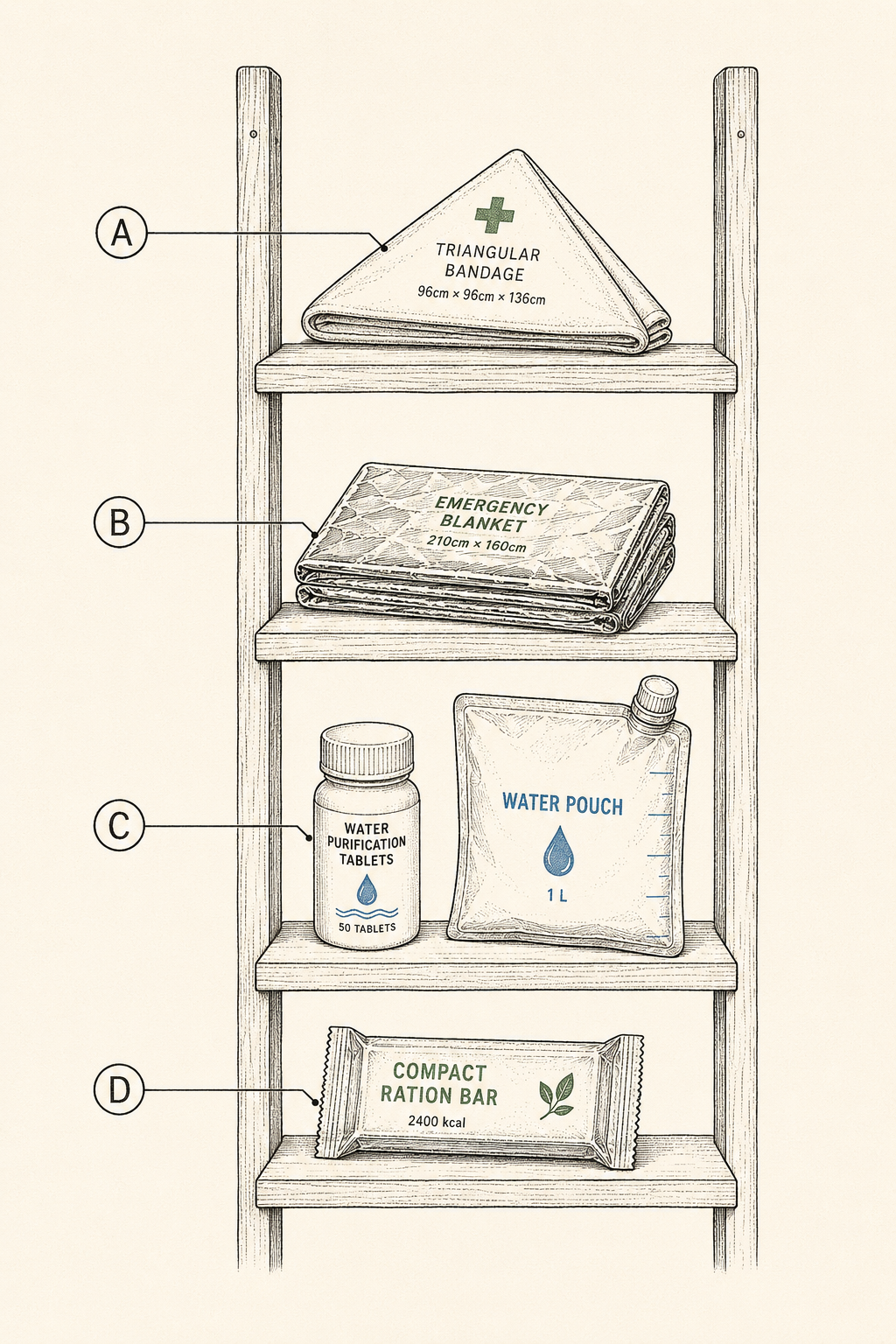
A kit’s role in this window is narrow but real. You can’t pack spare air, but you can pack the items that keep blood where it belongs: pressure dressings and, for larger kits, a real tourniquet. Bleeding control is the fastest-moving piece of this whole subject and it earns its own chapter (Chapter 26). What matters here is placement in your head. If the three-minute clock is running, nothing else in the kit exists.
Carbon monoxide deserves one paragraph of respect, because it shows up in exactly the situations this book prepares you for: engines idling in snowbound cars, stoves burning in closed spaces, generators running near windows.
Three hours: exposure and hypothermia
Hypothermia is a drop in core body temperature below 95°F (35°C), and it is the leading environmental killer of people stranded outdoors. In wind and wet, it can disable you in far less than three hours.
The mechanism is bookkeeping. Your body makes heat constantly; the environment takes it constantly; whenever the taking outruns the making, your core temperature falls. What makes hypothermia dangerous isn’t the cold itself but what the cooling does to your mind on the way down. Judgment degrades early. Victims make baffling choices, wander from marked trails, and famously undress as severe hypothermia scrambles their sense of temperature. The tool you need most, your brain, is the first thing the cold takes.
Learn the progression well enough to recognize it in yourself and others:
| Stage | Core temperature | What you’ll see |
|---|---|---|
| Mild | 90–95°F (32–35°C) | Vigorous shivering, clumsy fingers, withdrawn mood, poor decisions beginning |
| Moderate | 82–90°F (28–32°C) | Shivering slows or stops, slurred speech, stumbling, confusion, “don’t care” apathy |
| Severe | Below 82°F (below 28°C) | Unconsciousness or near it, rigid muscles, slow faint pulse, appears lifeless |
Shivering stopping is the alarm inside the alarm. It doesn’t mean the person warmed up; it means the body is giving up the effort. Treat any stumbling, mumbling, apathetic cold person as an emergency: get them dry, insulated from the ground, out of the wind, and warmed gradually, and get help moving toward you.
You don’t need freezing weather
Most hypothermia cases happen in air temperatures between 30 and 50°F (‑1 and 10°C), not in arctic cold. Add water and wind, and a mild fall afternoon has everything it needs.
This is the single most useful fact in this chapter, because it dismantles the assumption that “exposure” is a winter word. Cool air, wet clothing, and moving wind form the classic triangle. Water pulls heat from a body far faster than air at the same temperature, which is why a swimmer’s hour and a hiker’s rainstorm both count, and why cotton clothing that soaks and stays wet has an evil reputation in this subject.
The kit answer to the whole triangle costs a few dollars and weighs a couple of ounces: something waterproof to block the rain and wind (a poncho, a mylar blanket, even a contractor-grade trash bag) plus the sense to use it before you’re soaked, not after. Chapter 20 and Chapter 21 build out the options.
Where your heat actually goes
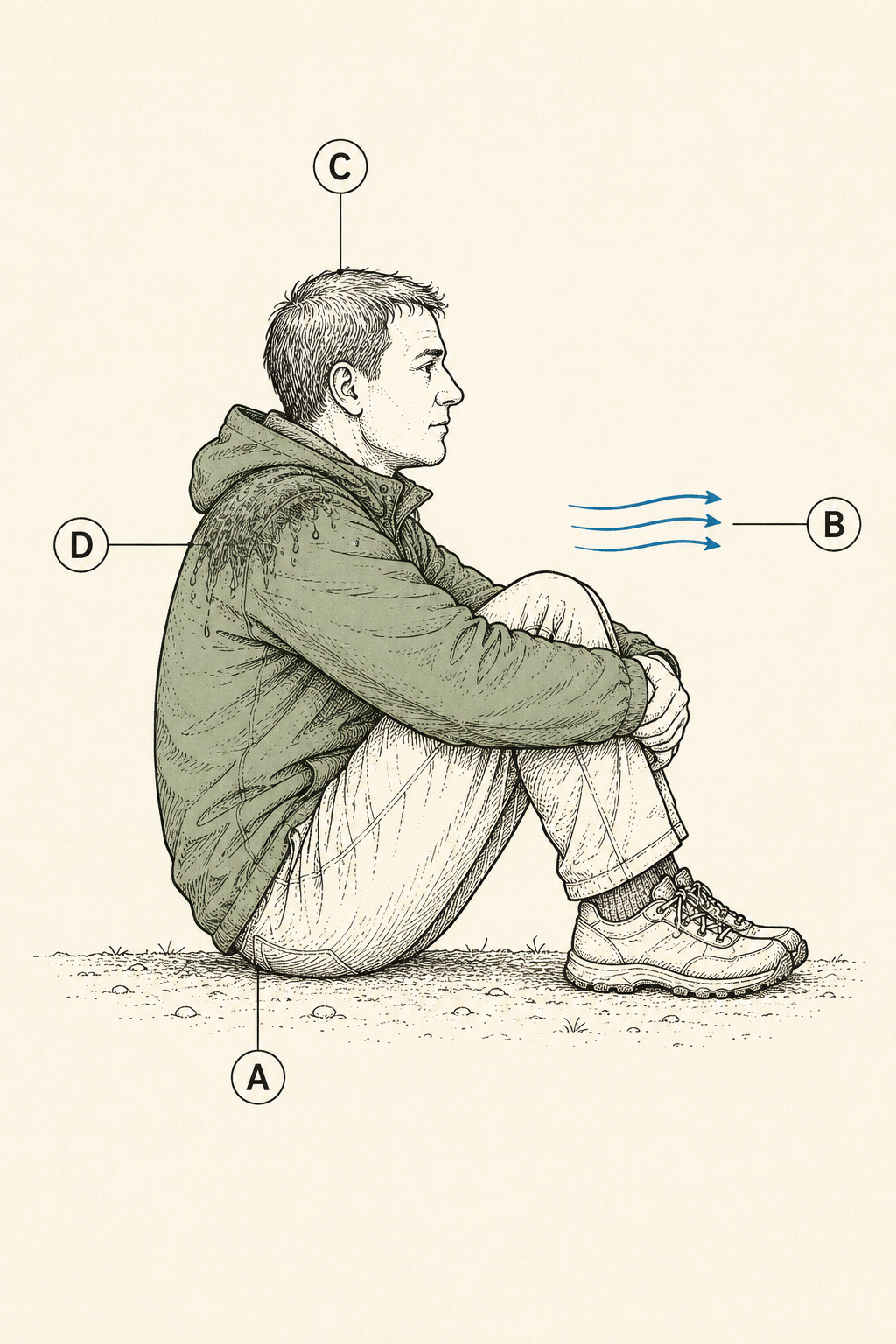
Your body loses heat five ways: conduction into surfaces, convection into moving air, radiation into cold surroundings, evaporation from wet skin and clothing, and a little through breathing. Every shelter trick in this book is aimed at one of those five.
Name the thief and the countermeasure picks itself. Sitting on cold ground is conduction; put insulation under you, and know that the ground drains more heat than the air does. Wind is convection; block it with anything windproof. Clear night sky is radiation; that’s the loss a mylar surface reflects back. Wet clothes are evaporation running continuously; getting dry beats almost any other single move. The breathing loss you mostly just accept.
One myth needs retiring on the way past: you do not lose some magic majority of heat through your head. Heat loss tracks exposed surface area, and your head is simply the part that’s usually bare. Cover it because it’s easy warmth, not because it’s a special drain.
Three days: water
You can live roughly three days without any water, but you’ll be useless long before that. Meaningful dehydration starts degrading your thinking and stamina within the first day, faster in heat or exertion.
The three-day figure describes survival, not function, and a survival situation is a work site. Building shelter, gathering wood, and walking out are labor, and labor runs on water. Thirst is also a late messenger; by the time it nags, you’re already behind. That’s why the rule’s real instruction isn’t “you have three days to find water” but “start managing water immediately, while you’re still smart.”
For the kit, the three-day line buys two commitments. First, the means to make found water drinkable: tablets or a filter, because the clear cold creek is a parasite lottery (Chapter 11 covers what each method actually kills). Second, the means to carry water: a container, even a folding one, because treatment without carriage chains you to the source. A packet of electrolyte powder rides along at almost no cost, covering what plain water doesn’t replace when you’re sweating hard.
Three weeks: food
A healthy adult can survive about three weeks without food. In kit terms, that makes food the last function you fund, and mostly a morale and energy item rather than a survival item.
Here’s the nuance that keeps food in your kit anyway. Calories are fuel for heat production; in the cold, eating is part of shelter. And food is the cheapest morale in the bag: a hot, sweet drink at hour ten of a bad night does more for decision-making than any pep talk you can give yourself. So small kits carry dense, no-prep calories (bars, bouillon, sugar, tea) and bigger kits scale toward real rations (Chapter 13). Procurement gear, the hooks and snares of Chapter 14, is strictly long-duration insurance for the biggest kits.
What food is not, in this book, is the star. If your emergency bag has three days of dinners and one way to make fire, you built the bag for the wrong problem.
The packing order, settled
Fund your kit in this order: bleeding control and air-adjacent hazards, then exposure protection, then water treatment and carriage, then signaling and navigation, then food, then everything else.
Signaling and navigation ride between water and food for a simple reason: the fastest way out of every timeline is to shorten the emergency itself. A whistle or beacon that ends things on day one outperforms any quantity of supplies for day three. The rule of threes never mentions rescue because it describes dying, not being found. Your kit should be better than the rule.
You’re stacking firewood at dusk when your buddy, quiet for the last half hour, drops a log, laughs at nothing, and tells you he’s fine in a voice with rounded corners. The air is 43°F (6°C); the drizzle started at noon; his jeans have been dark with water since. Nothing about the sky looks like an emergency. The rule of threes says this is the three-hour clock, already past its first hour, and the correct response is everything at once: strip the wet cotton, wrap him in the spare layer and the foil blanket, ground pad under him, sugar into him, fire up now.
Pack This Chapter
- The rule of threes is a priority ranking: air (minutes), exposure (hours), water (days), food (weeks). Pack in that order.
- Shelter means heat management, not architecture: dry, windproof, insulated from the ground.
- Hypothermia starts at 95°F (35°C) core temperature, happens mostly between 30 and 50°F (‑1 and 10°C) air temperature, and takes judgment first.
- Water is a first-day problem because function fails before survival does. Carry treatment and a container, always.
- Food is morale and fuel, funded last. Signaling gear outranks it: the best supply plan is a shorter emergency.
Where Kits Fail
- Food-first packing. Three days of snacks, no way to get dry. The bag answers hunger, the one need with weeks of slack.
- Cotton in the cold-wet. It soaks, it stays wet, and it turns evaporation into a constant drain. Wool or synthetic against the skin in any cool season.
- No ground insulation. People pack overhead cover and then sit on the heat thief itself. Conduction into cold ground beats wind for silent damage.
- Reading the numbers as guarantees. Three hours is not a promise. Wet and windblown at 40°F (4°C), you may have one.
Frequently asked
What is the 3-3-3 rule for survival?
It’s the rule of threes: roughly three minutes without air, three hours without shelter in severe conditions, three days without water, three weeks without food. The numbers are deliberately loose. The rule’s value is the ranking, which tells you which need to solve first and how to prioritize kit space.
Can you really only live three minutes without air?
Brain damage from oxygen deprivation typically begins within a few minutes, so three minutes is a fair planning figure even though survival times vary. The category covers more than drowning: choking, carbon monoxide, and severe bleeding all starve the brain of oxygen and all sit on the same clock.
What are the top three survival needs?
In most real incidents: protection from exposure, drinkable water, and the ability to be found. Exposure kills fastest, dehydration starts degrading judgment and stamina within the first day, and rescue ends the emergency entirely, which is why signaling gear outranks its weight class. Food, despite its reputation, is rarely a deciding factor in incidents lasting under a week.
Does hypothermia only happen in winter?
No. Most cases occur in air temperatures between 30 and 50°F (‑1 and 10°C), and wet clothing plus wind can produce hypothermia well above that band. Immersion in cool water works fastest of all. Treat any wet, windy, cool day as carrying real exposure risk.