How often should you check a survival kit?
Twice a year minimum, on calendar anchors you already keep (the season swaps of Chapter 4, or the clock-change weekends), plus the automatic audits that drills and restocking provide. A kit is a living system; unfed, it dies quietly at the rate of its fastest-aging item.
This chapter is the book’s warranty card. Everything built in Parts I–III degrades on known schedules: chemistry fades, elastics slacken, batteries self-discharge, adhesives cook, children outgrow, prescriptions change, phones change connectors. None of it announces itself. The kit that saved the day in this book’s scenarios was never the newest one; it was the maintained one, and maintenance is a calendar problem, which is the easiest kind of problem humans solve.
The system below has three parts: the schedule (when), the manifest-and-log cards (what and how you know), and the expiration table (the facts). Total annual cost: about two hours, most of it satisfying.
The two-audit year
The audit ritual per kit: unseal, lay out against the manifest, touch and test the testables, check every date, replace the failed and the near-expired, update the manifest, reseal, re-date. Ten minutes for a tin, thirty for a go-bag, an hour for the household’s whole fleet.
The touch-and-test list by kit, drawn from the chapters: fire (one strike, one match: consumed as testing tax); light (every switch, every mode; swollen or crusted cells are quarantine events); power (banks and jump packs to full charge: this is the recharge calendar’s anchor); water (pouch seams squeezed, filter flow-checked and never-frozen status honestly assessed, stored water swapped); meds and first aid (dates, packaging integrity, the elastics stretched once); food (dates, swelling, the sacrificial taste test); fabric and rubber (ponchos unfolded once every few years die less often than never-unfolded ones; gaskets flexed); documents (still current? The insurance changed; the kid’s photo is three years old); the seasonal module swap itself (Chapter 4), which is why the audits ride those dates.
The fleet order that keeps it painless: body layers first (five minutes: they’re small and most-used), vehicle at the season swap (its consumables age fastest), home and go-bags on the second anchor, and the specialty kits (boat, travel) before their seasons rather than on the universal dates.
The expiration table
The numbers, consolidated from every chapter, for the items that age:
| Item | Replace/rotate | Notes |
|---|---|---|
| Stored water | 6–12 months | Taste is the tell, not safety, in sealed food-grade containers |
| Vehicle water/food | 12 months | Trunk heat halves everything (Ch. 35) |
| Chlorine dioxide tablets | 4–5 years sealed | Foil blisters; opened bottles far less |
| Ration bars | 5 years | Certified marine type; date on the brick |
| Retort/MRE meals | 3–5 years cool | Hot storage can cut to 1 (Ch. 13) |
| Freeze-dried (sealed) | 10–25+ years | Manufacturer ratings; cool and dry assumed |
| Lithium primary cells | ~20 years | The stored-kit battery for a reason (Ch. 9) |
| Alkaline cells | Not in kits | Leak risk; they don’t ride, period |
| Power banks / jump packs | Recharge every 6 months | Storage at half charge or better (Ch. 10) |
| Chemical lightsticks | Per printed date (~4 years) | Fade even sealed (Ch. 9) |
| OTC medications | Label dates | Blister packs age slower than opened bottles |
| Ointments/adhesives | 1–2 years in vehicles | Heat is the killer; bandage tack dies quietly |
| Bleach (for treatment) | ~1 year | Potency fades; note the purchase date (Ch. 34) |
| Sunscreen/repellent | Label dates, ~2–3 years | Separated or smelly means done |
| Infant formula/diapers | Months / size-up | The fastest module in the book (Ch. 39) |
| Flares (pyrotechnic) | Printed expiry | Legal carriage dates on marine sets (Ch. 37) |
| Elastic (wraps, bands, gaskets) | Inspect; ~3–5 years | Stretch test at audits |
| Documents/photos/cards | 12 months | Life changes faster than gear |
Print-worthy, and Appendix B reprints it. Two reading notes: dates on food are quality promises more than safety cliffs (Chapter 13), so the kit standard stays strict while the retired stock feeds the pantry; and heat multiplies every row (the vehicle column of your fleet ages at trunk rates, not label rates).
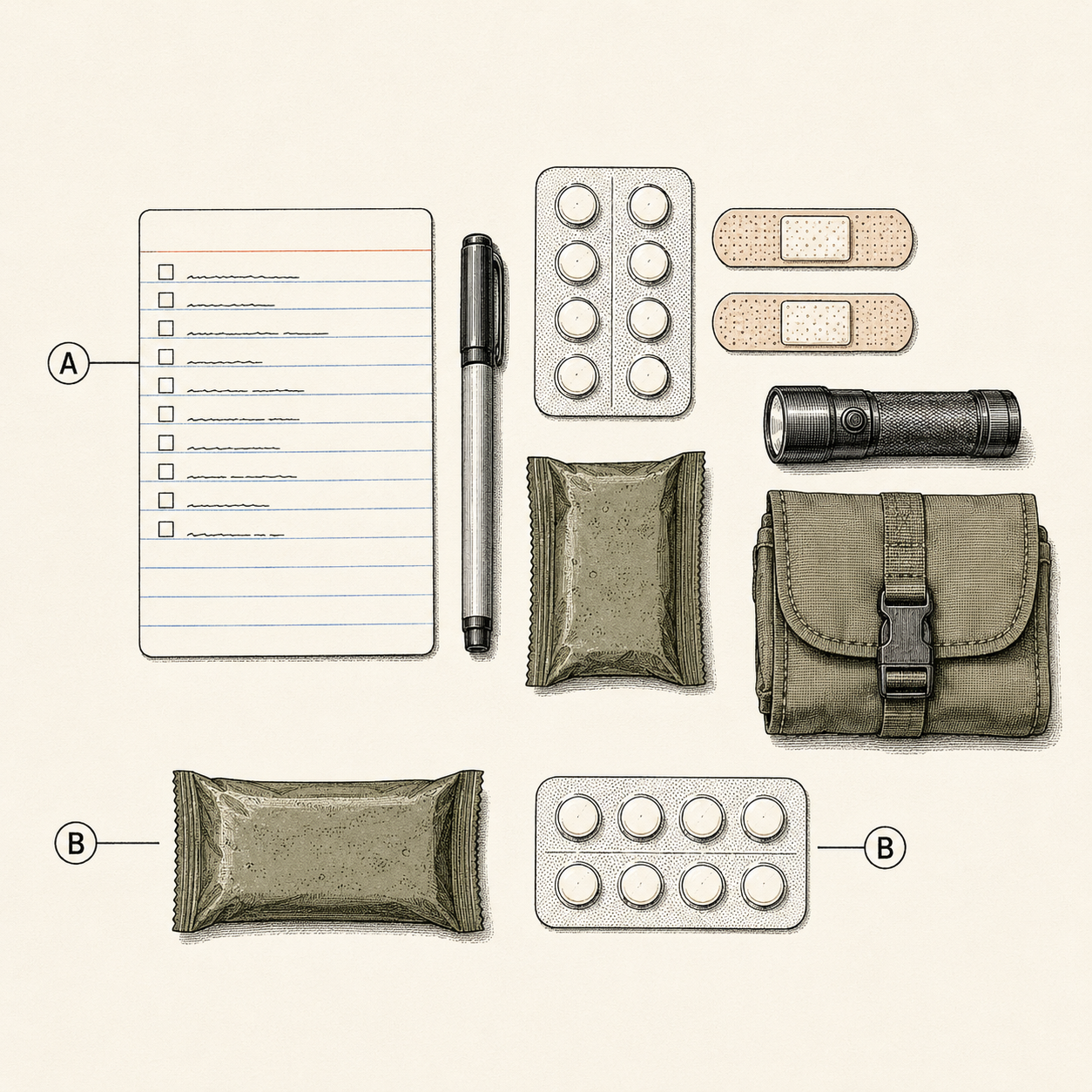
The manifest and the log
Every kit from the pouch up carries two cards: the manifest (contents, dates, the delegation notes) and the log (audits and uses, one line each). Together they make the kit auditable by anyone, including future-you, who remembers nothing.
The manifest doctrine scattered through Part III, consolidated: contents listed by group, expiring items flagged with their dates, the kit’s assumptions written down (Chapter 31‘s delegation ledger: “no trauma module; pairs with pack”), and the emergency-relevant personal data (Chapter 29‘s contact card) on the reverse. The log is humbler and mightier: “3/26: audit, swapped tablets, LED cell dead” is institutional memory that survives household turnover, gear migration, and the simple fog of years.
The system’s quiet payoff is transferability: the spouse, the teen, the house-sitter can audit or use a manifested kit cold. A kit only its builder understands is a single point of failure wearing a checklist’s costume: which is this book’s oldest complaint, aimed at its own reader, with love.
Restock discipline: the other half of use
Every use starts a countdown: the rule is restock within the week, from the standing spares shelf, and log the use. Kits hollow out not through disasters but through Tuesdays: the borrowed batteries, the used bandage, the lighter that wandered.
The mechanics that make it frictionless: the spares shelf (a shoebox of the high-turn consumables: bandages, tabs, cells, tape, bars: bought a few ahead) turns restocking from an errand into a reach; the use log line turns “I think I used some gauze in June” into data; and the depletion walk (after any real use of a kit, the whole thing gets the audit ritual, never the obvious hole alone) catches the secondary consumption every incident causes.
The psychology is worth naming because it’s the actual failure point: using the kit feels like success, and success doesn’t trigger maintenance instincts. Write the rule where you’ll see it (inside the kit lid, on the manifest): opened means owed.
Storage conditions: where kits live
Kits age at the rate of their environment: cool, dark, and dry is the universal prescription; heat is the universal accelerant. Site each kit as well as its role allows, and let the vehicle’s brutal environment be a scheduling fact rather than a surprise.
The environmental notes by home: house kits want closets over garages (temperature swing is the garage’s crime), off concrete (moisture wicks), away from solvents and fuel (Chapter 12‘s water absorbs neighbors’ fumes). Vehicle kits accept their fate (the trunk is an oven-freezer duplex) and compensate by rotation cadence and item choice (lithium cells, freeze-tolerant water packaging, no chocolate anything). Body-layer kits live gently by living used. Stored fabric (bags, ponchos, elastic goods) prefers loose to compressed over the years (compression sets, welds, and creases become the tear lines), which is why the go-bag’s annual repack means genuinely repacking rather than checking.
One siting rule crosses all of it: visible enough to be remembered, staged enough to be grabbed (Chapter 33), and never so buried that the audit itself becomes the barrier. A kit’s storage spot is a design decision with a maintenance budget attached.
The upgrade audit: when maintenance becomes evolution
Once a year, one audit doubles as the evolution pass: what failed, what went unused through every drill, what life change (new baby, new city, new knees) rewrote the Chapter 4 answers, and what one purchase (Chapter 6‘s upgrade order, Chapter 42‘s map) would matter most. Kits are hypotheses; audits are the data.
The evolution questions in checklist form: Did anything fail or annoy in the drills? (Fix or replace.) Did anything ride unused through a year of practice and incidents? (Interrogate it: some insurance rides forever rightly; some is dead weight with tenure.) Did the household change? (Chapter 39‘s members audit rides here.) Did the environment change? (New commute, new climate, new hobby: the scenario audit refreshes.) And the technology check: connectors (Chapter 10), map downloads and subscriptions (Chapter 19), beacon registration currency (Chapter 17): the digital layer rots on its own clock.
This pass is where the book’s system closes its loop: build, practice, maintain, evolve: each feeding the next, at a total cost of hours per year, for a household that stays genuinely ready instead of once-ready.
Pack This Chapter
- Two calendar audits a year (season swaps or clock changes), plus drill-driven and use-driven audits for free. Unfed kits die at the rate of their fastest-aging item.
- The ritual: unseal, lay out on the manifest, test the testables, check dates, replace, re-date, reseal. Ten minutes to an hour by kit size.
- The expiration table is the facts: water 6–12 months, tablets 4–5 years, bars 5, lithium cells decades, banks recharged twice yearly, vehicles at half of everything.
- Manifest plus log make kits transferable and auditable by anyone. Opened means owed: restock within the week from the spares shelf.
- Cool-dark-dry always; the trunk is a scheduling fact; one audit a year runs the evolution questions.
Where Kits Fail
- The once-ready kit. Built beautifully in one motivated week, untouched for four years. The calendar is the kit’s life support.
- Success without restock. The kit worked, the hole stayed. Opened means owed, in writing, inside the lid.
- The builder’s monopoly. Only one person can audit or even find anything. Manifests make kits household property.
- Garage-oven storage. The kit aged three years per year beside the water heater. Closets are cheap; site like it matters.
Frequently asked
How often should you update your emergency kit?
Audit twice a year on fixed calendar anchors (the seasonal module swaps work perfectly), with the full ritual: contents against the manifest, dates checked, testables tested, replacements made, card re-dated. Add automatic audits whenever a drill finds a problem or any use opens the kit.
What expires in a survival kit?
More than people expect: stored water (6–12 months), purification tablets (4–5 years sealed), ration bars (5 years), retort meals (3–5 cool), medications and ointments (label dates, faster in vehicles), lightsticks, bleach (~1 year), sunscreen and repellent, elastics, flares, and every document and photo. Batteries and power banks age by chemistry: lithium primaries last decades; banks want recharging twice yearly.
How do you keep track of kit contents?
Two cards per kit: a manifest (contents by group, dates on the agers, the kit’s assumptions) and a log (one line per audit or use). They make the kit auditable by anyone in the household and turn maintenance from memory work into a checklist. Update both at every audit.
Where should emergency kits be stored?
Cool, dark, dry, and grabbable: closets beat garages, off concrete, away from fuel and solvents, staged in the exit path for go-bags. Vehicle kits live in an oven-freezer by definition, so their consumables rotate yearly and their batteries are lithium. Never store a kit so deep that auditing it becomes the obstacle.