How do you signal for help in daylight?
Three tools cover daylight signaling: a whistle for anyone within a mile, a mirror for aircraft and distant searchers, and contrast (color, smoke, ground symbols) for everything that looks your way. All three are cheap, light, and in every kit this book builds.
Signaling is the function that ends emergencies rather than enduring them, which Chapter 2 already ranked above food for exactly that reason. Daylight signaling is the passive-and-active craft of being findable: making yourself louder, brighter, and stranger than the landscape. (Night and electronic signaling, from strobes to satellites, are Chapter 17‘s beat.)
The mindset shift that makes signal gear work: searchers are looking for anomalies. Nature is green, brown, quiet, and randomly textured. You want to be orange, flashing, rhythmic, and geometric. Every technique in this chapter is one of those four words made practical.
The whistle: your voice, industrialized
A flat pealess whistle produces 100+ decibels for as long as you can breathe, carries a mile or more in decent conditions, and never gets hoarse. Three blasts is the universal distress call. It’s the single cheapest piece of rescue equipment made.
The specs that matter: pealess (no cork ball to freeze, swell, or clog when wet; the pea whistle dies in exactly the conditions that matter), flat or rounded (comfortable on a neck cord or keyring, no snag), loud by design (purpose-made rescue whistles are engineered for output; a referee model is acceptable, a toy is not), and plastic (metal whistles freeze to winter lips, an experience nobody repeats).
Doctrine is as important as hardware. Three of anything means distress: three blasts, pause, three blasts. One blast answers (“I hear you”); two calls for a response check. Blast in threes, then stop and listen for a full minute (searchers may be answering), and repeat. Yelling, by comparison, spends your voice in an hour, carries poorly, and sounds like wind to distant ears. The whistle lives on the body (zipper pull, neck cord, keyring), not in the kit’s depths, because the moment that needs it may not include time to dig.
The signal mirror: reaching out to the horizon
A signal mirror throws a flash of sunlight visible for miles (to aircraft, tens of miles in clear conditions), making it the longest-reaching non-electronic signal a kit can carry. The skill is aiming, and aiming is learnable in five backyard minutes.
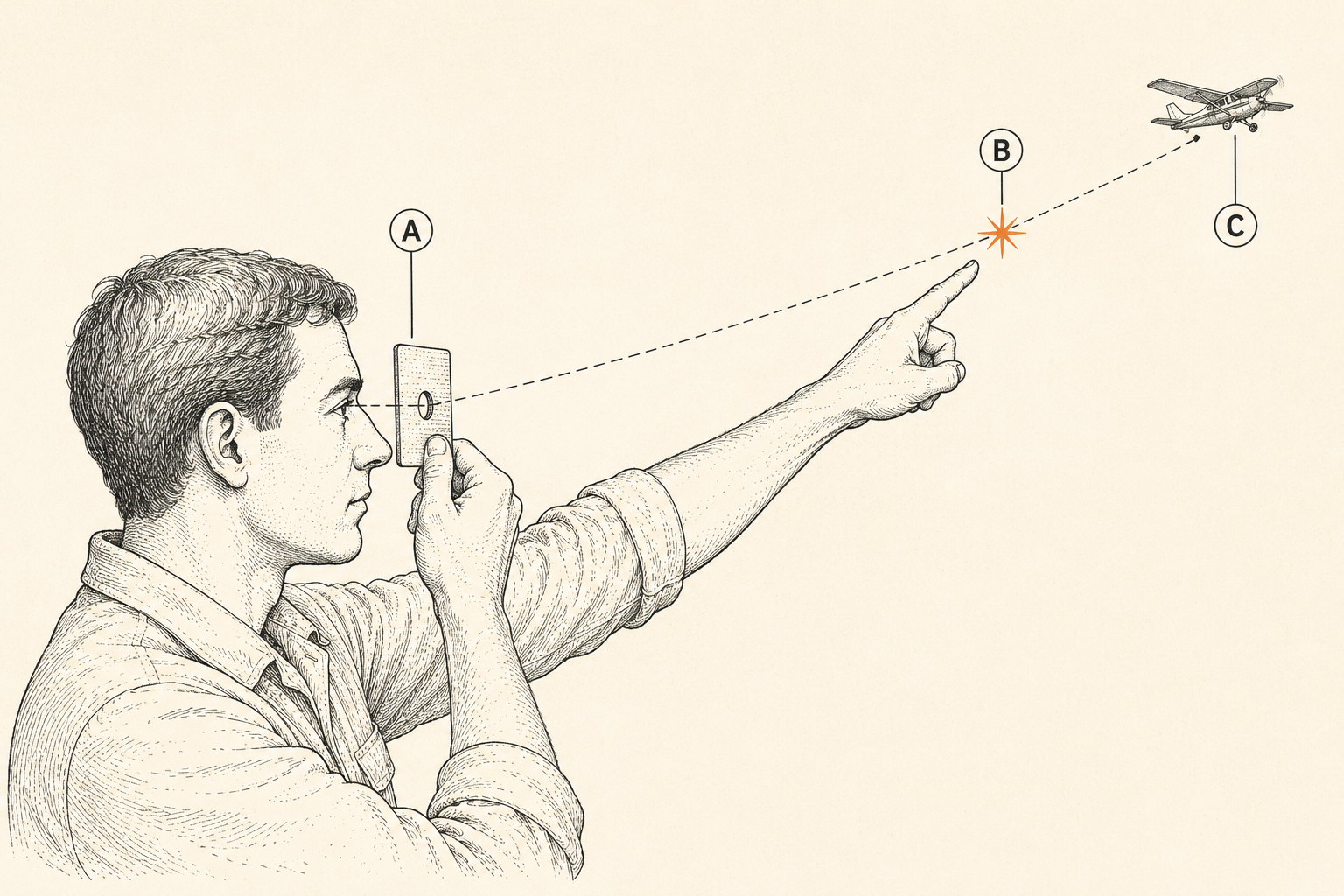
Purpose-made mirrors are polycarbonate or glass with a sighting hole; the aiming method is what the hole is for:
- Catch the sun. Hold the mirror near your eye and find the bright spot of reflected sunlight on your other outstretched hand.
- Sight through the hole. Looking through the aiming hole, you’ll see a bright spot or fireball: that’s where your flash is pointing.
- Walk the fireball onto the target. Tilt slowly until the bright indicator sits on the aircraft, ridgeline searcher, or distant vehicle.
- Flash rhythmically. Rock the mirror slightly so the target sees repeated flashes; rhythm reads as human. Sweep the horizon periodically even with no target in sight; searchers you can’t see may see you.
No purpose mirror? Anything flat and shiny signals: a phone screen, a polished tin lid (Chapter 5 promised), foil smoothed over a card, a vehicle mirror liberated from its housing. The two-hand aim without a sight hole: make a V with your fingers at arm’s length, put the target in the V, and flash across your fingertips.
Aim discipline matters: a mirror flash in a pilot’s eyes is briefly blinding, so flash-flash-flash and pause rather than holding a steady beam on low aircraft.
Contrast: the passive layer
Blaze orange fabric, contrasting movement, and geometry work while you rest. A bandana on a pole, a spread mylar blanket, or gear laid in a straight line signals every minute you’re doing something else.
Passive signaling is underrated because it’s boring, and it’s the layer that works when you’re injured, asleep, or busy staying alive. The kit’s contributions: anything orange (the poncho, the bandana Chapter 27 packs, tape wrapped on gear), anything reflective (the mylar blanket, reflective side up, staked flat in a clearing is a mirror the size of a bed), and anything geometric (straight lines and right angles barely exist in nature; three piles of rock in a row, gear spaced evenly in a meadow, a giant X of dragged logs all read as human from the air).
Placement does the rest: open ground beats forest, high beats low, and edges (shorelines, meadow margins, ridgetops) beat interiors. If you’re staying put (usually the right call once you’re truly lost), building your visibility is the productive use of the waiting.
Smoke and fire as signals
Your Chapter 7 fire signals day and night: smoke by day (green boughs or damp material on a hot fire for white billows), flame by night. Three fires in a triangle or line is the classic distress signal, but one well-tended smoky fire beats three neglected ones.
The physics of visible smoke: a hot, established fire hit with smoke-makers (green evergreen boughs, damp leaves, moss) produces dense white smoke that columns upward on calm days. Contrast rules apply: white smoke against dark timber, darker smoke (from rubber or oil-soaked material, vehicle-kit resources) against snow or pale sky. Site the signal fire in the open (the smoke has to clear the canopy), prep it fully so one match raises it fast when aircraft sounds approach, and keep the smoke-makers stacked beside it.
Ground-to-air signals
One symbol is worth memorizing: a giant V means “require assistance,” and an X means “require medical assistance.” Make any symbol huge (20 ft / 6 m per stroke minimum), high-contrast, and geometric.
The full ground-signal alphabet exists in survival references, but under stress you’ll remember two letters, and those two cover the cases.
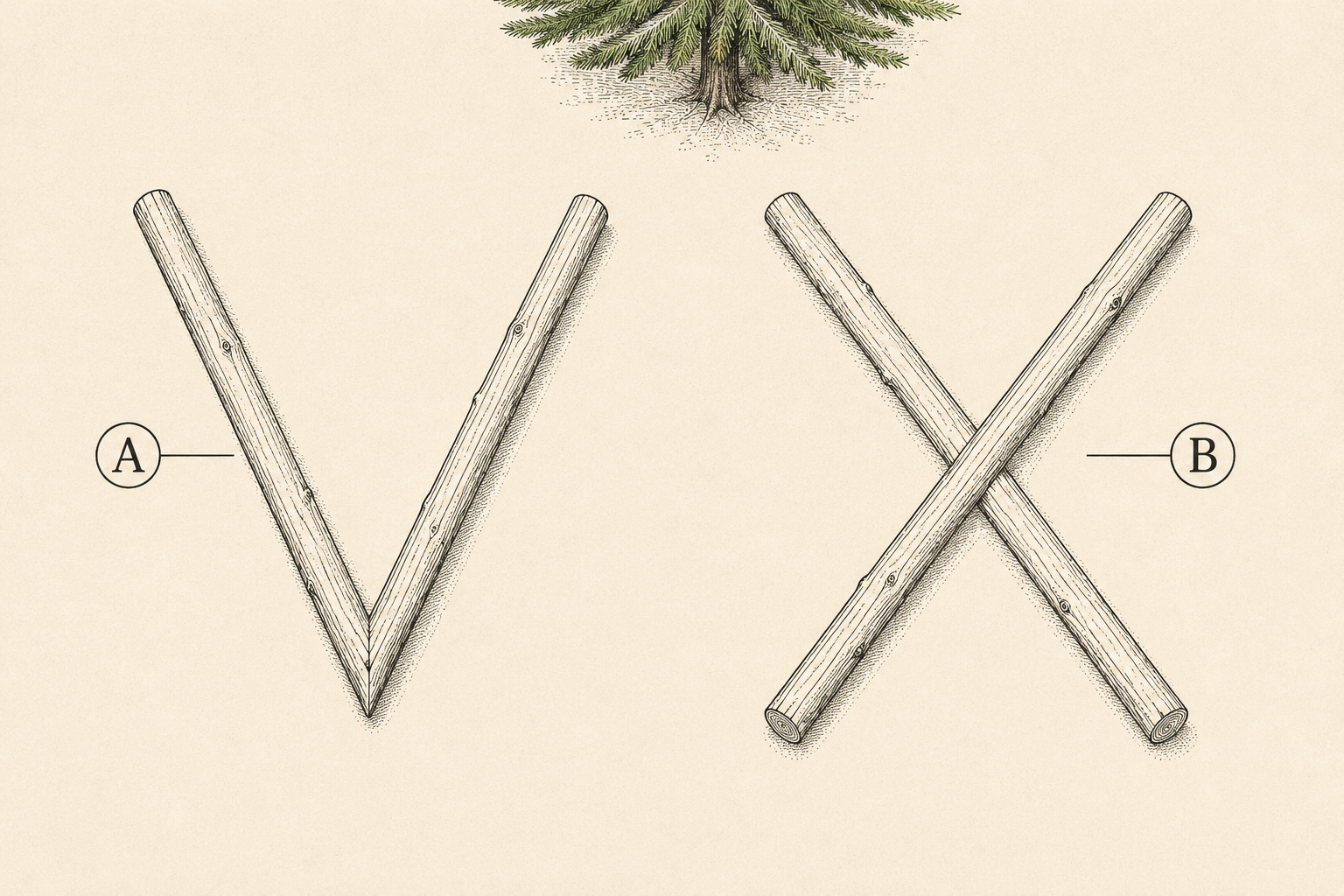
Build them from whatever contrasts: dragged logs on snow, rocks on sand, mylar strips staked on grass, trampled lines in a meadow. Sharp corners and straight edges are the tell; a searcher’s eye slides past blobs and snags on geometry. If you move on, leave the symbol plus an arrow of rocks showing your direction; you’ve turned your abandoned camp into a message.
Modern postscript: many searches now include drones, which fly lower and see better than fixed-wing sweeps. Everything in this chapter works better on a drone: your mirror flash, your orange, your geometry, and your upturned face all read at drone altitude.
Sound beyond the whistle
Rhythmic noise carries meaning: three of anything is distress. Banging metal on metal, striking a hollow log, or three spaced shots (where firearms are lawfully present) all extend the whistle’s principle when the whistle isn’t enough.
Sound craft in the field: bang in the same three-pause-three rhythm, use hard surfaces as sounding boards (a pot against a boulder outperforms a pot against a stump), and exploit terrain (sound carries along water and down valleys; signal from edges rather than hollows). Then practice the hardest sound skill: silence. Regular listening stops (engine noise, dogs, voices, other whistles) are how you catch the search that’s already close, and a whistling person can’t hear an answering whistle.
Cell-dead country note: even with no bars, a phone’s speaker at full volume playing a siren tone is a modest but real noisemaker, and its flashlight strobes. The phone from Chapter 10 signals in more ways than its radios.
Pack This Chapter
- Whistle on the body, mirror in the kit, orange and geometry everywhere. Loud, bright, rhythmic, geometric: be the anomaly.
- Three of anything is distress. Blast in threes, then listen a full minute.
- Mirror aiming: sight hole, fireball, walk it to the target, flash in rhythm. Sweep horizons even without a visible target.
- Passive layer works while you can’t: mylar spread flat, gear in lines, V (assistance) or X (medical) at 20 ft (6 m) per stroke.
- Smoke by day (green boughs on hot fire), flame by night, contrast always, fire discipline non-negotiable.
Where Kits Fail
- The buried whistle. Distress arrives with the whistle zipped in the pack’s bottom. It lives on zipper pulls and neck cords or it barely exists.
- The pea whistle in winter. One wet freeze and it’s a kazoo. Pealess is the whole spec.
- Mirror owned, never aimed. Five practice minutes is the difference between signaling and glinting. The backyard, a fence post, done.
- Camouflage-complete camp. Everything earth-toned, nothing visible from fifty feet up. The searcher’s eye needs one wrong-colored, straight-edged thing.
Frequently asked
What does three whistle blasts mean?
Distress: it’s the universal call for help. Blast three times, pause a full minute to listen for a reply, and repeat. One blast back means “heard you”; keep exchanging so searchers can home in. The three-of-anything rule extends to banging metal, fires, and any repeated signal.
How far can a signal mirror be seen?
Miles at ground level and, to aircraft in clear sun, reports run to tens of miles; flash visibility, not your eyesight, is the limit. That reach is why a mirror rides in every kit despite weighing nothing: it’s the only non-electronic signal that can touch the horizon.
What’s the best whistle for a survival kit?
A flat, pealess, plastic rescue whistle from a reputable maker. Pealess means nothing inside to freeze or waterlog; flat means it carries comfortably where it belongs, on your zipper pull or neck cord. Loudness is engineered, so buy purpose-made rescue models rather than toys or classic pea whistles.
What ground signals do rescuers recognize?
V for “require assistance,” X for “require medical assistance,” built at least 20 ft (6 m) per stroke in high contrast with straight edges. An arrow shows travel direction if you move. Geometry is the real signal: straight lines and sharp corners don’t occur naturally, so searchers’ eyes catch them.