What should a home emergency kit include?
Two weeks of water and food, light and power independent of the grid, sanitation capability, a deepened first aid kit, the NOAA radio, and the family plan on paper. The home kit’s scenario is the most likely one this book covers: the house stands fine while the infrastructure around it fails.
Sheltering in place is the statistically dominant emergency: storms, grid failures, heat domes, ice storms, boil-water notices, and the long tail of regional disasters mostly mean days-to-weeks of camping in your own living room. The home kit is therefore less a bag than a household posture: supplies stored where you live, systems that don’t assume utilities, and a plan the whole household actually knows.
The two-week standard (up from the old three-day guidance) reflects how modern disasters actually run: utility restoration and supply chains take longer than the storm does. Build to three days first, then extend; a finished three-day kit beats a planned two-week one, per the whole philosophy of this book.
Water at house scale
Two weeks of water for a household is real volume: at 1 gallon (3.8 L) per person per day, a family of four stores 56 gallons (212 L): stackable containers in a closet corner, rotated on the calendar, backed by treatment capability and the knowledge of the house’s hidden reserves.
Chapter 12 set the storage rules (food-grade, cool, dark, dated, 6–12 month rotation); the house scale adds sourcing strategy. The stored core: purpose-made stackable containers (the 5–7 gallon / 20–27 L class carries; larger stores), or the flat of retail bottles that rotates through normal life. The treatment backstop: the household’s filter and tablet stock, plus the stove-and-pot boil (Chapter 11) that a home can always run. The hidden reserves worth knowing before the crisis: the water heater’s 40–60 gallons (150–227 L) (drain from the bottom valve after killing power/gas to the unit), toilet tanks (not bowls; treat anyway), and, on warning of a storm, every bathtub filled (a tub liner bag turns the tub into a clean 100-gallon vessel for pocket change).
The pantry, the cold chain, and cooking
Home food runs on Chapter 13‘s pantry method (two weeks of normal shelf-stable eating, rotating through daily meals) plus outage doctrine for the fridge and a no-utility cooking plan with its fuel counted.
The cold-chain rules that save both food and stomachs: an unopened fridge holds safe temperatures for about 4 hours, a full freezer about 48 hours (half-full, 24), so the outage sequence is eat fridge first, freezer second, pantry last, and a $10 appliance thermometer converts guesswork into data (40°F / 4°C is the fridge line; food above it for over two hours is a loss). Two frozen water jugs living permanently in the freezer buy hours more and become drinking water as they thaw.
Cooking without utilities: the camp stove or grill outdoors only (the carbon monoxide law of Chapter 2 kills indoors cooks every storm season), the Chapter 15 fuel math run at household scale (a weekend of canisters is not two weeks; count boils), and the no-cook reserve for the days when even that fails. The manual can opener’s third mention in this book is proportionate to how often it’s missing.
Power, light, and information
The home outage kit: headlamps and lanterns per person (lithium-loaded, per Chapter 9), the power-bank fleet plus the vehicle-as-generator doctrine (Chapter 10), the NOAA radio as the information anchor, and, scaled to your outages, the power-station-or-generator decision made deliberately.
Light doctrine at home: headlamps for tasks, battery lanterns for rooms (area light keeps households calm in a way beam light doesn’t), and candles demoted to ambiance-only in a kit context (open flames plus disrupted households is how outage fires happen). The information layer: the pocket NOAA receiver plus a car radio; official broadcast outlives cell congestion.
The big-power decision, framed honestly: a portable power station (big lithium bank, AC outlets, solar-chargeable) runs phones, CPAPs, and the fridge intermittently, silent and indoor-safe, at real cost. A generator runs more for longer on cheap fuel with maintenance, noise, fuel storage, and the deadly-serious placement rules. Choose by your outage history and medical needs; plenty of households need neither, some need one badly.
Sanitation: the unglamorous system
When water stops, toilets stop, and sanitation becomes the health emergency inside the emergency. The kit: the twin-bucket setup (or heavy liners for the existing toilet), contractor bags, absorbent medium (kitty litter, sawdust), gloves, and bleach, plus the hygiene depth of soap, sanitizer, and wipes.
The mechanics nobody teaches until a disaster does: with water out, the existing toilet still works as a frame: bowl drained, double-lined with contractor bags (Chapter 27‘s grim inclusion explained), a scoop of litter per use, bags tied and stored outside in lidded containers away from living space. The twin-bucket refinement separates liquids from solids and halves the smell problem. Handwashing infrastructure (a jug with a spigot, soap, and the discipline) is the actual disease barrier; stock sanitizer for the gaps.
Bleach earns its shelf slot twice: surface sanitation and emergency water treatment (plain, unscented, 5–9% hypochlorite: 8 drops per gallon / 2 per liter, doubled for cloudy, 30-minute wait), with the caveat that bleach ages out of potency in about a year, which puts it on the rotation calendar too.
The hazard modules
The core kit is all-hazards; regional modules bolt on: hurricane/wildfire (evacuation-forward: go-bags current, tank-half-full rule, document scans, window/defensible-space prep on warning), earthquake (no-warning-forward: bedside shoes and gloves, gas shutoff wrench, furniture anchored), winter storm (heat loss: the warm-room plan, Chapter 36‘s car kit current).
The earthquake module deserves its detail because it’s the pure no-warning case: sturdy shoes and work gloves tied to every bed frame (broken glass owns the floor after a quake; the classic injury is feet), a flashlight in every bedside drawer, the gas-meter wrench mounted at the meter with the rule attached (smell or hiss = shut it; otherwise leave it: relighting requires the utility), the pry bar staged (jammed doors), and the furniture-and-water-heater strapping done some prior Saturday.
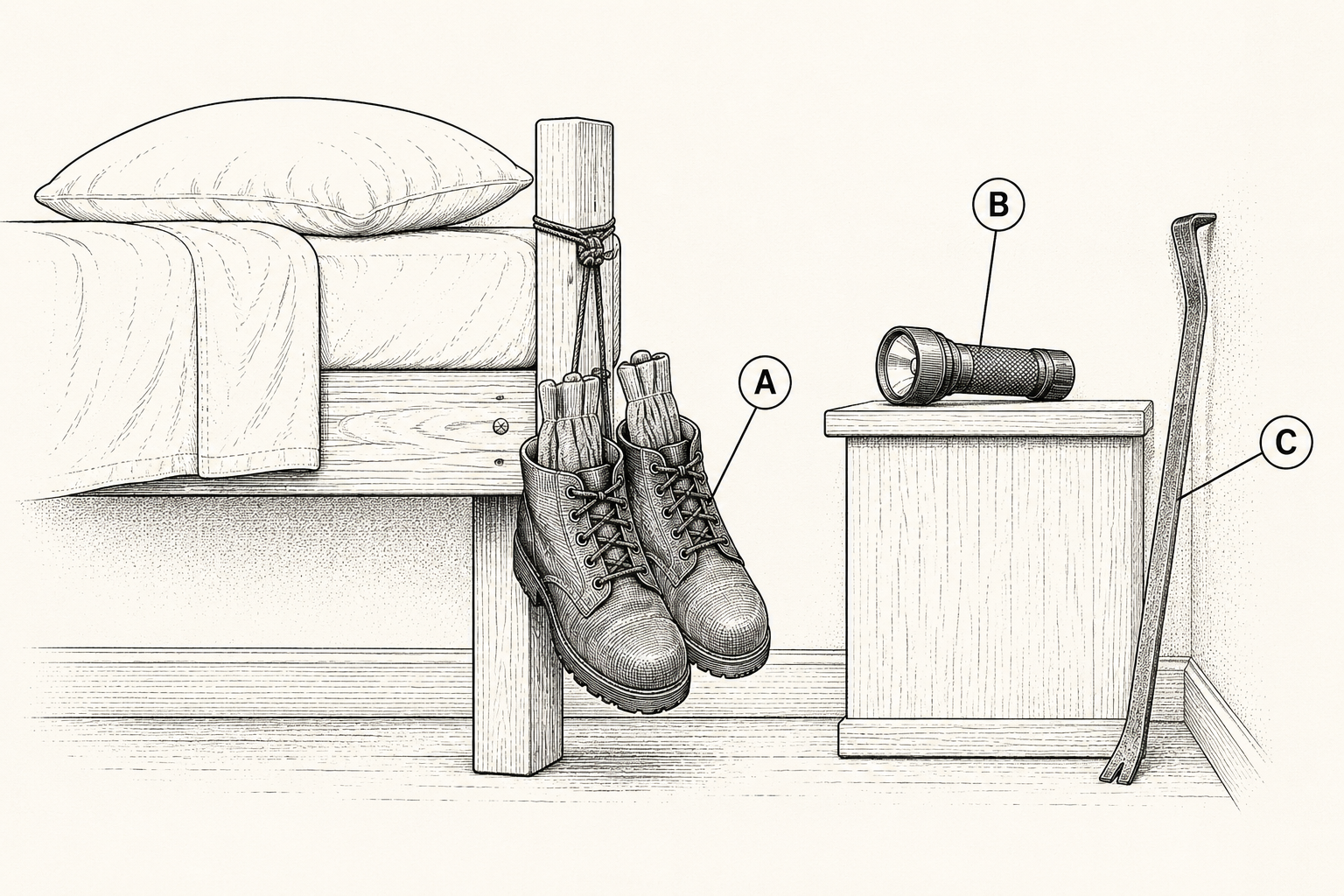
The evacuation-hazard module is mostly the go-bag chapter kept honest: bags current, vehicle never below half in season, the stage-two list taped in the closet, and the region’s alert app plus NOAA radio both live. The winter module: the one-room warm plan (pick the smallest insulatable room, family and blankets consolidate), pipe drips running, and the Chapter 36 vehicle kit treated as part of the home system, because winter strands people between the two.
The family plan: paper, people, practice
Supplies without a plan is a warehouse. The family plan is one page, printed and pocketed: two meeting points (near-home and out-of-neighborhood), one out-of-area contact everyone texts, utility shutoffs mapped, school/work pickup logic, and pet arrangements: practiced twice a year alongside the go-bag drill.
Why the pieces exist: meeting points solve the separated-family problem when networks clog (curbside landmark for house fires; the library parking lot across town for neighborhood-scale events). The out-of-area contact exploits how networks fail (long-distance texts often pass when local circuits jam; everyone reports to Aunt-in-another-state, who becomes the family switchboard). Texts over calls, always, in congestion. The pickup logic pre-answers the school-lockdown-versus-parent-at-work scramble. The wallet-card version (Chapter 29‘s contact card, family edition) rides with every member including the kids who “don’t need” it.
Practice is the plan’s existence proof: the twice-yearly drill (grab, meet, text the contact, name the shutoffs) takes twenty minutes and converts the page from a document into a reflex. Chapter 40 owns the habit; this page just tells you what to rehearse.
Pack This Chapter
- The home kit’s scenario is the likeliest one: intact house, failed infrastructure. Two weeks is the modern standard; build three days first.
- Water at scale: stored gallons (56 gal / 212 L for four), treatment backstop, and the hidden reserves (water heater, filled tubs) known in advance.
- Pantry method plus cold-chain rules (4-hour fridge / 48-hour full freezer), outdoor-only cooking with fuel counted, and the sanitation buckets nobody wants and everybody needs.
- Power by deliberate choice (station vs generator vs neither), lanterns over candles, NOAA radio as the information anchor. Generators: outdoors, 20 ft (6 m), CO alarms, period.
- Hazard modules bolt onto the all-hazards core; the one-page family plan (meeting points, out-of-area contact, shutoffs) is practiced, not laminated-and-lost.
Where Kits Fail
- The three-day assumption. Modern outages and supply gaps run longer than the storm. Two weeks is the planning line.
- The indoor generator. Every storm season, the same preventable tragedy. Outdoors, distant, alarmed: memorize it like a name.
- Sanitation denial. No plan for the toilet is a health crisis on day three. Buckets, bags, litter, bleach: cheap and decisive.
- The unpracticed plan. A beautiful document nobody remembers under stress. Twenty minutes, twice a year, converts paper into reflex.
Frequently asked
How much water should I store at home for emergencies?
One gallon (3.8 L) per person per day for two weeks: 56 gallons (212 L) for a family of four: in food-grade containers, rotated every 6–12 months, plus treatment capability. Know the hidden reserves too: the water heater holds 40–60 gallons (150–227 L), and tubs filled on storm warning add 100 more.
How long does food last in the fridge during a power outage?
About 4 hours in an unopened refrigerator; a full freezer holds roughly 48 hours (24 if half-full). Eat fridge first, freezer second, pantry last, keep doors closed, and judge by thermometer: perishables above 40°F (4°C) for more than two hours are losses. Frozen water jugs stretch every number.
What’s the most important thing in an earthquake kit?
The bedside module: sturdy shoes and gloves tied to the bed frame, plus a flashlight: because post-quake floors are broken glass and the classic injury is lacerated feet in the dark. Then the gas wrench at the meter (shut off only for smell or hiss) and the pry bar for jammed doors.
What should a family emergency plan include?
One page: a near-home meeting point and an out-of-neighborhood one, a single out-of-area contact everyone texts (long-distance texts survive congestion that kills local calls), utility shutoff locations, school and work pickup logic, and pet arrangements: printed, pocketed, and rehearsed twice a year.