What’s the best way to purify water in an emergency?
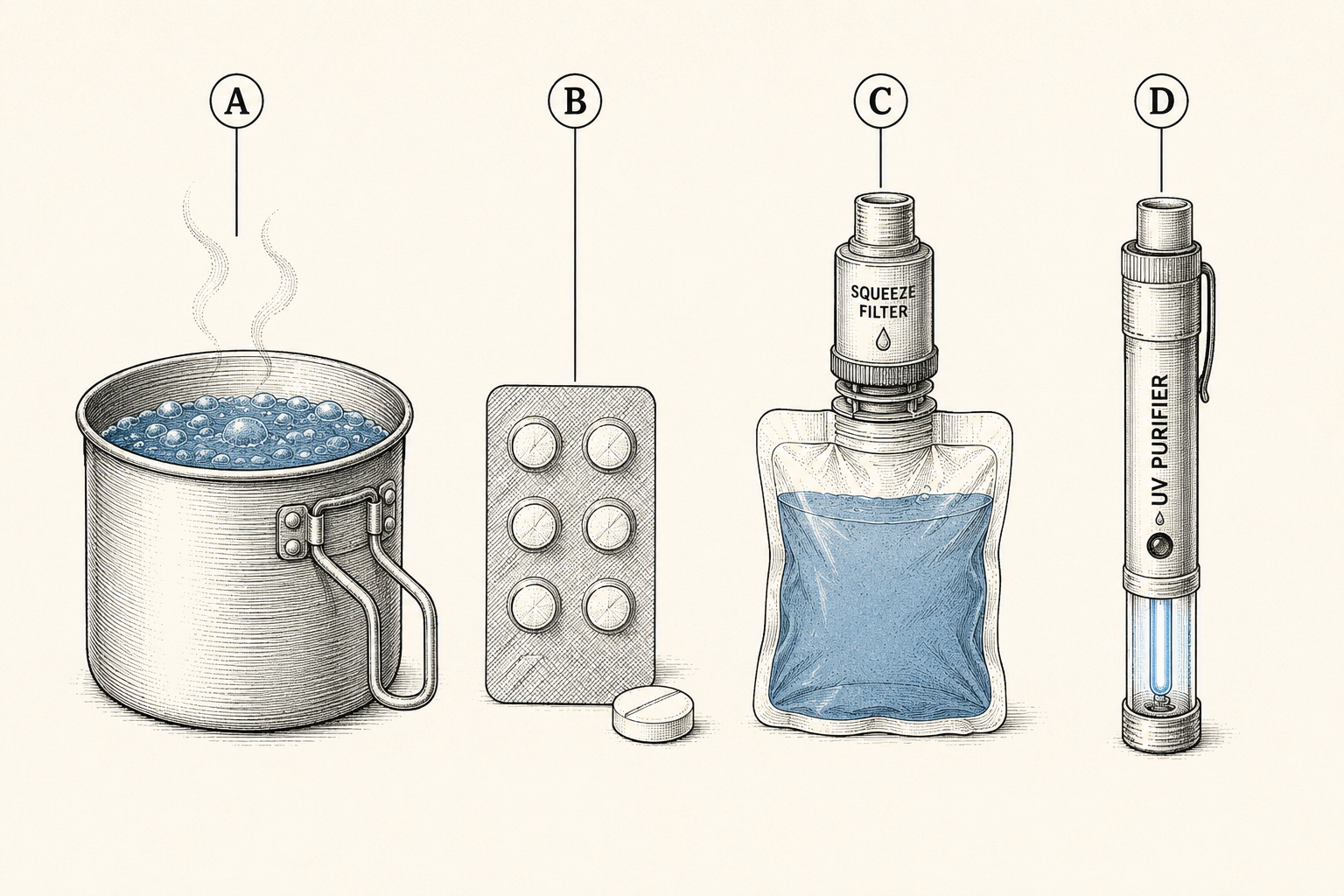
Boiling is the gold standard when you have fire and a vessel; chlorine dioxide tablets are the best treatment to carry in small kits; a hollow-fiber filter is the best daily driver for packs. Most kits should hold two of the three.
Treat all found water as contaminated, including the clear, cold, beautiful creek. Clarity is not cleanliness. The organisms are invisible. Upstream is always longer than you can see. In a survival situation, the diarrhea and vomiting of a waterborne illness aren’t embarrassments; they’re dehydration engines that can turn a manageable situation dangerous.
The good news: this problem is completely solvable. The gear weighs grams. The engineering is mature, the options are cheap, and the only real work is understanding what each method kills, because they are not interchangeable. That understanding is this chapter.
Know the enemy
Waterborne threats come in three sizes: protozoa (Giardia, Cryptosporidium), bacteria, and viruses, plus chemical contamination that no field method fixes. Every treatment method is a claim about which of these it stops.
The size hierarchy is what makes the methods differ. Protozoa are big (by microbe standards) and filter out easily, but Cryptosporidium travels in a chlorine-resistant cyst that shrugs off iodine and gives even chlorine dioxide a long fight. Bacteria are smaller and die readily to heat and chemicals. Viruses are smaller still, small enough to pass most backpacking filters, but chemicals and heat kill them easily. In North American backcountry, protozoa and bacteria dominate; viruses become a serious concern where human sewage reaches water (floods, disasters, dense settlement, much of the developing world).
Chemical contamination (fuel, pesticides, mine runoff, algal toxins) is the category that changes the rule from “treat it” to “don’t drink it.” No boil, tablet, or backpacking filter removes it meaningfully. Skip water with sheen, dead vegetation rings, chemical smell, or industrial neighbors, and let that be the whole policy.
Boiling: the gold standard
Bring water to a rolling boil for one minute and everything biological is dead: protozoa, bacteria, viruses, all of it. Above 6,500 ft (2,000 m), boil three minutes for margin.
Boiling’s virtues are total: no shelf life, no moving parts, no dosage math, works on cloudy water, and the equipment (fire plus any metal vessel, per Chapters 5 and 15) is already in your kit for other reasons. By the time water reaches a rolling boil, the lethal work is essentially done even before the minute starts; the timed boil is your margin of certainty. That margin costs a minute. Take it.
The costs are fuel, time, and hot water when you wanted cold. That’s why boiling is the anchor method rather than the daily driver: it’s what you fall back on when the filter clogs, the tablets run out, or the water is too foul to trust to anything else. Let it cool covered, and improve the flat taste by pouring it between two containers a few times.
Chlorine dioxide tablets: the kit treatment
Chlorine dioxide tablets are the treatment this book puts in every small kit: featherweight, effective against all three organism classes, and tolerable-tasting. The price is patience, especially for Cryptosporidium.
One tablet treats a quart or liter, and the wait depends on the target: 30 minutes covers bacteria, viruses, and Giardia in reasonable water; Cryptosporidium’s armored cyst demands up to 4 hours. Cold or murky water slows the chemistry. Double the wait for either. The practical rhythm is to treat ahead: fill and dose a container at the source, walk on, and drink on schedule instead of standing thirsty over a countdown. Patience is the whole price.
Buy tablets in foil blisters rather than bottles (each dose stays sealed until used), respect the printed shelf life of about 4–5 years sealed, and keep a course of them in every kit layer down to the tin. Their only real failures are impatience and expiration, and both are yours to prevent.
Older iodine tablets deserve their retirement notice: they leave Cryptosporidium alive, taste like a chemistry set, and carry medical cautions (thyroid conditions, pregnancy, extended use). Chlorine dioxide replaced them for good reasons; if iodine is what you have, it’s still far better than raw water against everything except Crypto.
Hollow-fiber filters: the daily driver
A hollow-fiber squeeze filter turns questionable water into drinkable water on demand: no wait, no taste, no chemistry. It stops protozoa and bacteria completely and viruses not at all, which is the one line to memorize.
The technology is a bundle of straw-like fibers with ~0.1 micron pores: water squeezes through, organisms larger than the pores stay behind. Modern squeeze filters weigh a few ounces, thread onto soft pouches and standard bottle necks, and process a liter in about a minute of squeezing. For North American backcountry, where viruses are rare, a squeeze filter plus tablets-as-backup is the pack loadout this book recommends: the filter for volume and immediacy, tablets for the day the filter clogs, freezes, or meets sewage-adjacent water.
Filters are the one water tool that demands maintenance knowledge:
- Backflush on schedule. Flow rate falling means fibers clogging; the included syringe or pouch flush restores it. A filter that’s slowed to a trickle at home will be agony in the field.
- Protect it from freezing. Water inside frozen fibers cracks them invisibly, and a cracked filter passes what it should stop, with no warning. Respect that. Once a filter has likely frozen, demote it to pre-filter duty and replace it. In winter, the filter sleeps in your jacket or sleeping bag.
- Pre-filter murky water. A bandana over the intake keeps silt from doing the clogging.
UV purifiers: fast light, fussy conditions
A UV pen sterilizes a liter of clear water in about 90 seconds by scrambling organisms’ DNA, viruses included. It’s an excellent traveler’s tool and a reasonable pack backup, with two dependencies: batteries and clarity.
UV’s virtues are real: fastest full-spectrum treatment there is, no taste, no chemistry, effective against all three organism classes including Crypto. Its dependencies are equally real. Turbid water shields organisms from the light, so UV wants clear water or a pre-filter first. And it’s electronics: batteries die, lamps break, cold saps output, which lands it under Chapter 10‘s power doctrine (lithium cells, spares, and never as the only method).
Where UV shines brightest is travel: hotel taps and questionable municipal supplies in virus-risk regions, treated a bottle at a time from a device that fits a toiletry bag. In the woods, the squeeze filter usually beats it on toughness; abroad, UV or tablets beat the filter on viruses. Chapter 38 assembles the travel kit accordingly.
Improvised clarifying (not purifying)
Settling, bandana straining, and improvised sand-and-charcoal filters make water clearer, which helps every real method work better. None of them make water safe by themselves.
The distinction deserves italics in your memory: clarifying removes particles; purifying removes or kills organisms. Cloudy water goes through cloth into a container, sits until sediment drops, gets decanted, and then gets boiled, tabbed, filtered, or UV-treated. The old woodcraft sand-charcoal-grass column in a hollowed log or cut bottle is a fine clarifier and a dangerous myth as a purifier; organisms sail through it. In genuinely dire no-gear circumstances, clear-then-boil is the improvised path that actually works, because a vessel and fire are improvisable and chemistry isn’t.
While we’re retiring myths: flowing water is not self-cleaning, springs are safer but not certified, and snow is clean-ish but must be melted (Chapter 4) and ideally treated, since it was filtered through air, not certified by anyone.
Matching method to kit
Two methods per layer, chosen so their failures don’t overlap. Here’s the standard allocation:
| Kit | Primary | Backup | Logic |
|---|---|---|---|
| Tin / pocket | Chlorine dioxide tablets | Boil (tin is the vessel) | Zero weight, zero age-sensitivity in foil |
| Day pack | Squeeze filter | Tablets | Volume on demand; chemistry when fibers fail |
| 72-hour go-bag | Squeeze filter | Tablets + boil | Family volume plus disaster virus caution |
| Home kit | Stored water first | Tablets + boil | Treatment is for when storage runs out (Ch. 12, 34) |
| Travel | UV or tablets | Tablets | Viruses in play; filters alone don’t cover them |
The pattern under the table: filters give volume and speed, chemicals give resilience and virus coverage, boiling gives certainty and needs no shelf. Any two of the three cover almost every real situation, which is exactly the redundancy math from Chapter 7 wearing a different hat.
The habit that makes it work
Treat water before you’re thirsty, in containers you dedicated to “dirty” and “clean,” and never let the two mix. Method discipline fails at the container boundary more often than at the treatment itself.
Cross-contamination is the quiet failure: the treated liter poured back into the bottle that held raw water, the filter’s dirty end stored kissing its clean end, the “just one sip” from the source while the tablets work.
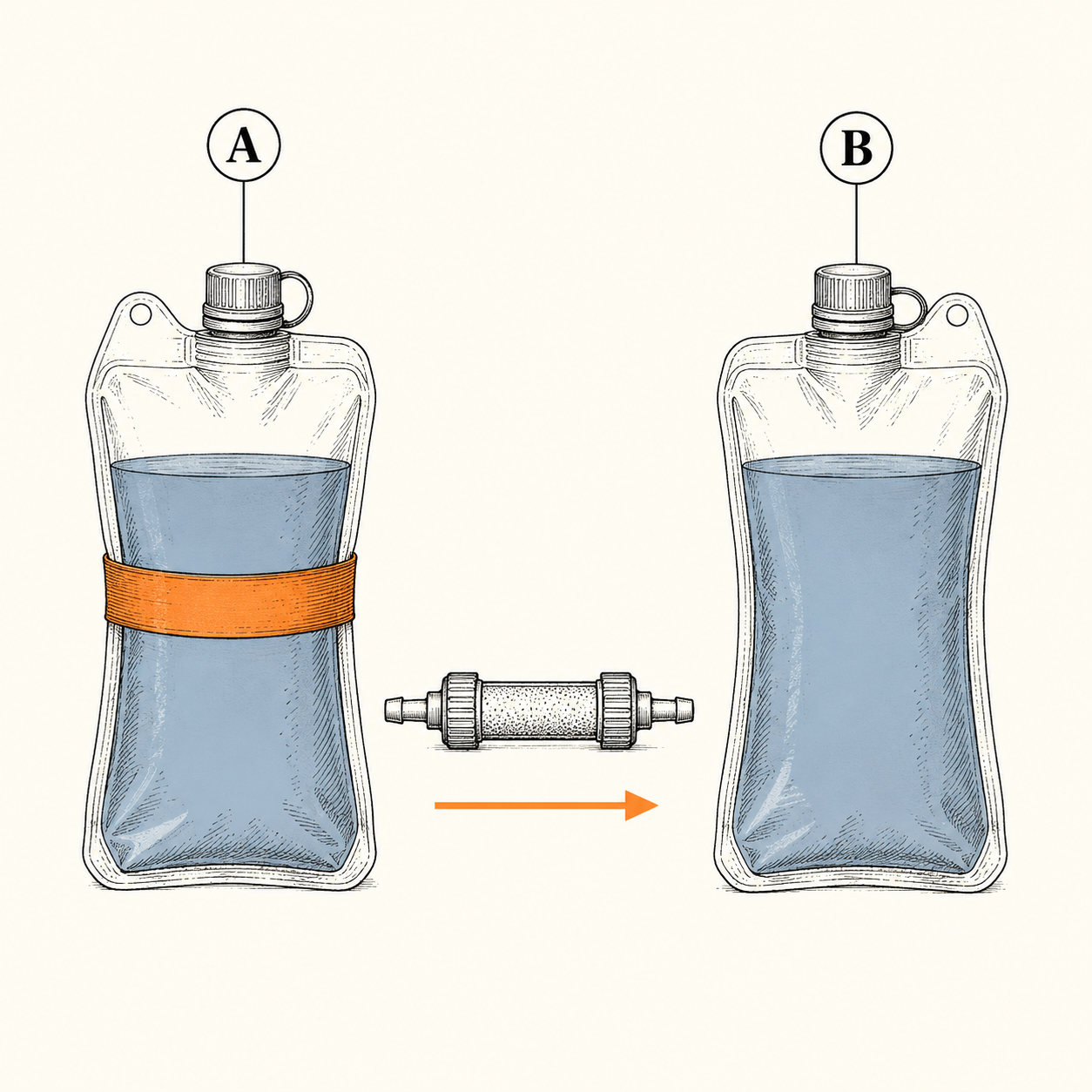
Mark your containers (a strip of orange tape on everything dirty is this book’s convention), thread the filter’s clean side only onto clean vessels, and let the treated water’s first job be rinsing the container’s threads if there’s any doubt.
You learn why the rule exists the week something ignores it. Day two of a heat-wave power failure, and your neighbor is proudly filling everyone’s cups from the creek behind the subdivision, using the pitcher he dipped, because the water “runs clear and it’s moving.” The tablets in your kit cost less than the sports drink he’s mixing in. Offer them. Thirty minutes is the whole price of nobody spending day four sick.
Pack This Chapter
- All found water is contaminated until treated; clarity proves nothing. Chemical contamination means find other water.
- Boil rolling one minute (three above 6,500 ft / 2,000 m): kills everything biological, needs fire and metal.
- Chlorine dioxide tablets in every layer: 30 minutes for most threats, 4 hours for Crypto, foil-sealed, 4–5 year life.
- Squeeze filter as pack primary: instant volume, stops protozoa and bacteria, passes viruses, dies invisibly to freezing.
- Two methods per kit with different failure modes; dirty and clean containers never mix.
Where Kits Fail
- The beautiful creek exception. Clear, cold, moving, and carrying Giardia anyway. The rule has no exceptions because your eyes have no magnification.
- The frozen filter, still flowing. Cracked fibers pass organisms silently. One hard freeze while wet retires a filter, no matter how it looks.
- Tablets from 2019. Chemistry fades quietly past its date. Foil blisters and calendar rotation keep the function real.
- One method, worshipped. The filter clogs, the batteries die, the tablets run out. Two methods, different failures, every layer.
Frequently asked
How long should you boil water to make it safe?
One minute at a rolling boil kills protozoa, bacteria, and viruses; use three minutes above 6,500 ft (2,000 m) where water boils cooler. The rolling boil itself is the visible signal that lethal temperature was reached. Boiling doesn’t remove chemical contamination, and nothing in a kit does.
Do water purification tablets really work?
Chlorine dioxide tablets genuinely kill all three organism classes, with one condition: time. Thirty minutes handles bacteria, viruses, and Giardia; Cryptosporidium’s resistant cyst needs up to 4 hours, longer in cold or murky water. Buy foil-sealed blisters, respect the shelf life, and treat ahead of thirst.
What do backpacking water filters not remove?
Viruses, which slip through hollow-fiber pores, and chemical contamination of every kind. In North American backcountry that’s usually acceptable risk; in floods, disasters, or regions where sewage reaches water, pair the filter with tablets, UV, or boiling. The filter’s other enemy is freezing, which breaks it invisibly.
Is rainwater safe to drink without treatment?
Freshly collected rain, caught in clean containers before it touches roofs or ground, is the lowest-risk found water there is, and treating it anyway costs almost nothing. Once rain has run across any surface it’s ordinary untrusted water. Snow follows the same logic, plus the melting rules from Chapter 4.