What is a 72-hour go-bag?
A go-bag is one pre-packed backpack per person holding three days of essentials for leaving home fast: documents, medications, water and treatment, no-cook food, shelter, clothing, light, first aid, and cash. Its design scenario isn’t wilderness; it’s evacuation: the wildfire notice, the flood order, the gas leak at 2 a.m.
Names for this bag multiply (bug-out bag, GOOD bag, 72-hour kit) and the internet’s versions drift toward apocalypse cosplay, so this chapter plants its flag early: the go-bag is boring, and boring is correct. The realistic uses are evacuations measured in days and destinations that are usually a relative’s guest room, a motel, or a shelter, which is why documents and medications outrank camouflage anything. Seventy-two hours is the standard because it spans the gap before organized relief reliably arrives.
The build target: under 20% of body weight per adult bag (15% is kinder), because a bag you can’t carry a mile at a fast walk fails its one-word job description: go.
Documents and money: the paper core
The go-bag’s most valuable pound is paper: copies of IDs, insurance policies, deeds/leases, medical lists, and key contacts, in a waterproof pouch, plus $100–300 cash in small bills. Add encrypted digital copies on a USB drive and in cloud storage reachable from anyone’s device.
Why paper outranks gear: post-disaster life is administrative. Re-entering a fire zone, filing claims, proving identity at shelters and banks, refilling prescriptions in a strange town: all of it runs on documentation that’s tedious to reconstruct and trivial to copy in advance. The pouch contents: photo ID copies, insurance (home/auto/health) declarations pages, property records, vehicle titles, medication-and-allergy lists per person, pet vaccination records (Chapter 39), recent photos of family members and pets (search-and-reunification currency), and the contact tree with its out-of-area anchor (Chapter 34 explains why out-of-area).
Cash doctrine: small bills, because card networks and ATMs fail with the power, and because the person selling the last two gas cans doesn’t make change philosophically.
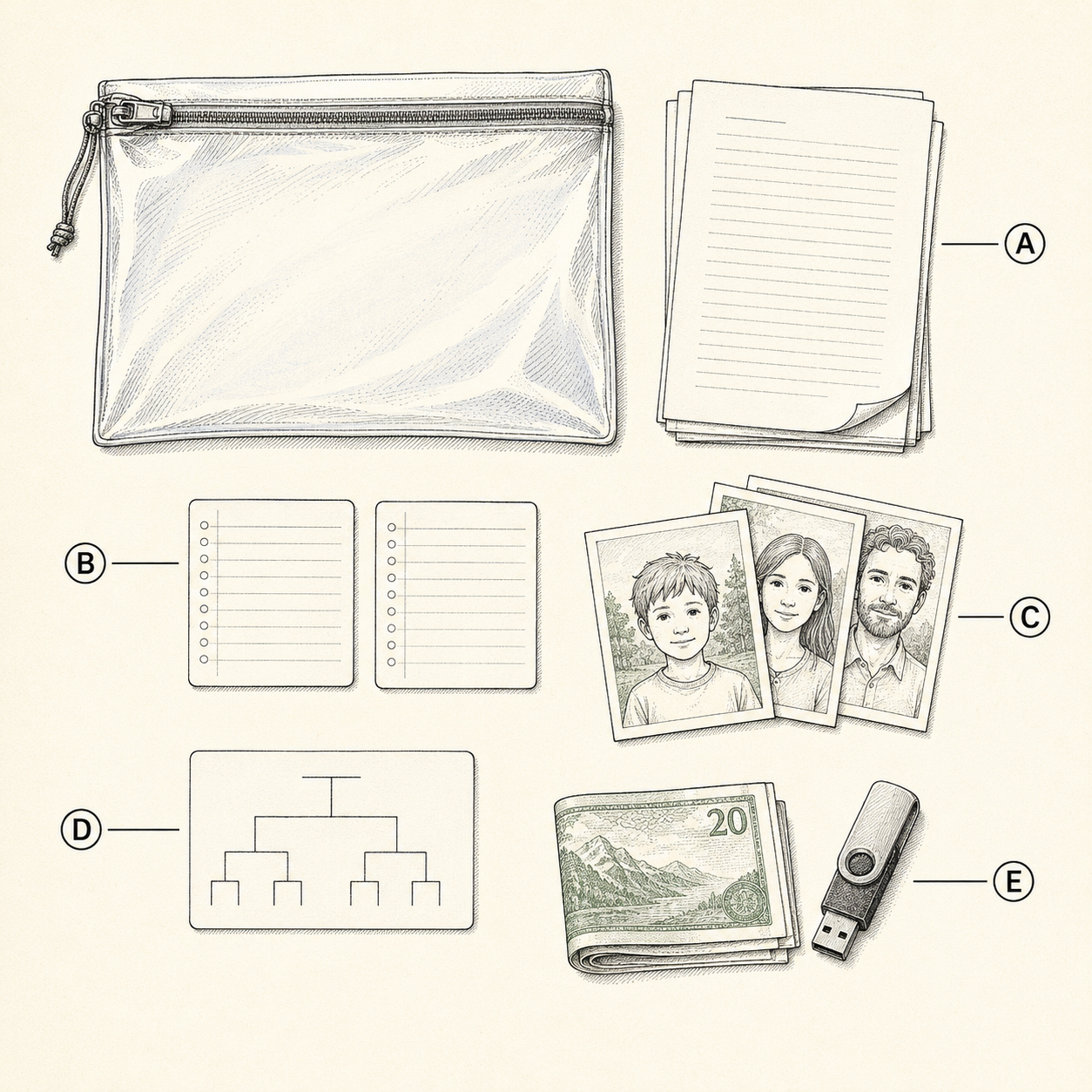
The USB drive is the belt to paper’s suspenders; encrypt it (a passworded archive suffices) since it’s a stealable biography.
Water, food, and the weight problem
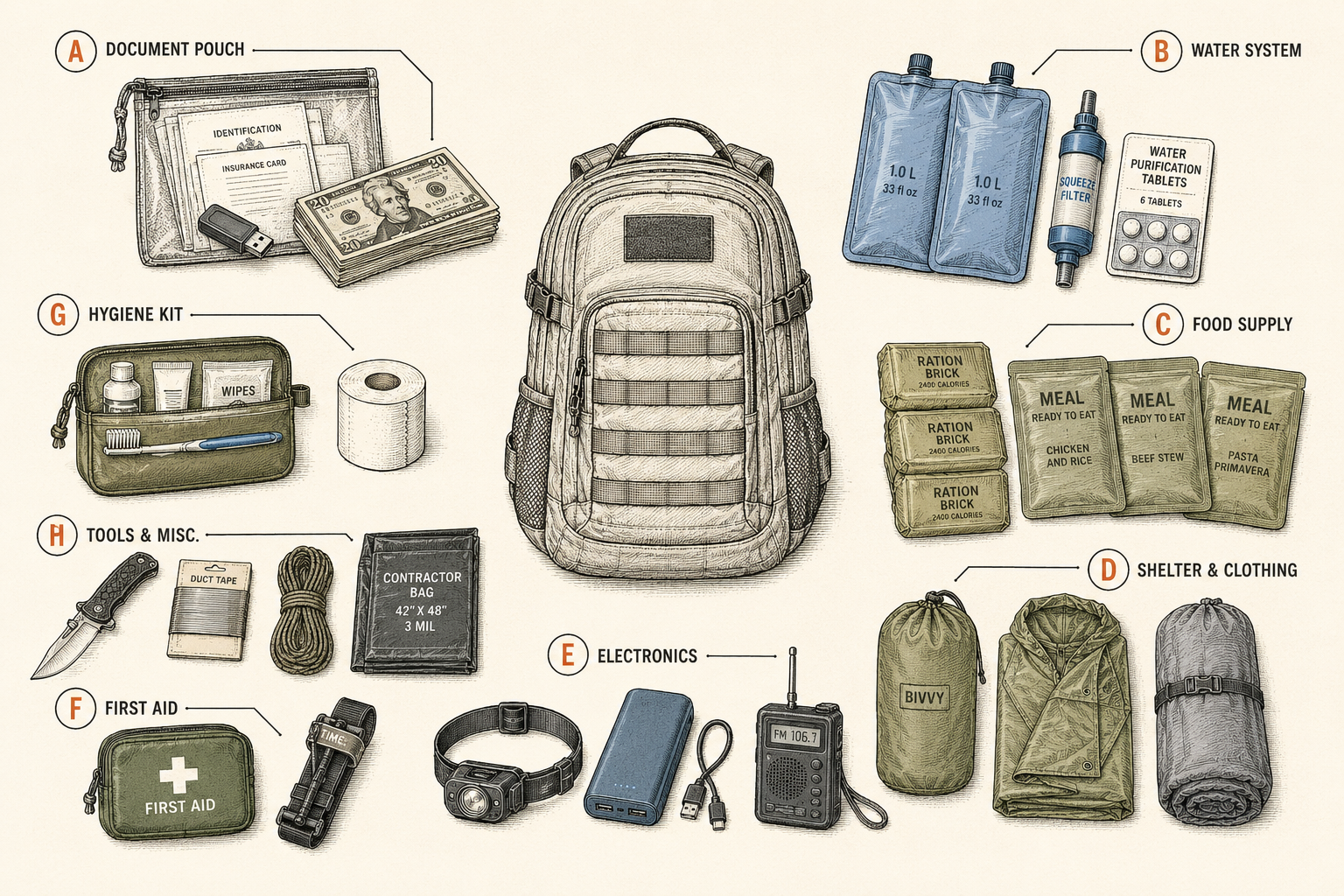
Water is the go-bag’s weight crisis: 3 L per person rides in the bag, and treatment capability (filter plus tablets) stands in for the gallons you can’t carry. Food is 6,000+ no-cook calories per adult: ration bars, pouch meals, nut butters, candy.
The water math, honestly faced: Chapter 12‘s gallon-per-person-day would demand 25 lb (11 kg) of water alone for three days, so nobody packs it. The doctrine instead: carry a day’s worth (3 L / 100 oz), assume refill points (evacuation routes cross civilization), and pack the treatment stack for when assumptions fail. That compromise is fine because the scenario is evacuation, not expedition: the same logic that makes documents king.
Food follows Chapter 13‘s no-cook rules with an evacuation twist: comfort matters double when kids are scared and the motel room is small, so familiar snacks share space with the ration bricks. And the go-bag inherits the tin habit: a manifest card taped in the lid, dates on everything, and Chapter 41‘s calendar governing rotation (this bag’s contents age exactly as fast as they’re forgotten).
The rest of the bag: shelter to hygiene
The remaining systems compress from earlier chapters: shelter (bivvy, poncho, contractor bags), clothing (one full weather-real change plus the sealed spare), light and power (headlamp, bank, and the NOAA pocket radio), first aid (Chapter 25 plus 26), hygiene (the kit nobody lists and everybody misses), and Chapter 27‘s repair sliver.
Two of those earn expansion. Hygiene: toothbrush and paste, soap sheet or mini bottle, quick-dry towel, wipes, hand sanitizer, menstrual supplies, spare glasses or contact solution, prescription list already covered, and a travel roll of toilet paper: the difference between three days of dignity and three days of misery, at half a pound. The radio: a pocket NOAA weather receiver (Chapter 17‘s information layer) earns go-bag space because evacuations are decision-storms (which route, which shelter, is it over) and broadcast keeps informing after cell networks clog.
The clothing note: pack for walking in weather, not for style: broken-in shoes tied to the bag if your daily footwear can’t hike, socks doubled, and everything synthetic-or-wool per Chapter 21. Season-swap the clothing module on the Chapter 4 calendar.
Medications and the people-specific layer
Prescriptions are the go-bag’s hardest item and highest stake: build a rotating 7-day supply where legality and pharmacy cooperation allow, keep the written list-plus-dosages where supply isn’t possible, and audit this layer per person, including the members who are children, elderly, or four-legged (Chapter 39).
The mechanics that work: ask your pharmacy about an emergency-supply fill or vacation override once a year (many insurers allow it) and rotate that bottle through the bag; failing that, the bag’s med pouch holds the list, the prescribing doctors’ numbers, and photos of the labels: enough for an out-of-town pharmacist to work with. Insulin, biologics, and other cold-chain meds get their own plan (a small insulated pouch and the knowledge of which shelters and pharmacies can refrigerate). CPAP users, hearing-aid wearers, and glasses-dependent readers: batteries, cases, spares.
This layer is why the go-bag is per-person rather than per-household: the bags share a shelf, but grandma’s bag and the toddler’s bag are different machines.
The get-home bag: the go-bag’s commuter sibling
A get-home bag inverts the scenario: it lives at work or in the car and assumes you must reach home on foot when transit and roads fail. Its build is the day-hike kit (Chapter 32) tuned for pavement: walking shoes, water, weather layer, light, cash, dust mask, and the route knowledge in your head.
The design case is the regional disruption that strands commuters: earthquake, grid failure, storm-closed roads, transit shutdown. The distance math sets the contents: a 10-mile (16 km) urban walk is 3–4 hours of mostly-annoyance needing shoes, water, and weather protection; a 30-mile (48 km) walk is an overnight problem needing the fuller kit. Build to your actual commute.
The contents beyond Chapter 32‘s core, city-tuned: real walking shoes (the item that decides everything; heels and dress shoes end walks early), a liter of water plus tablets, an N95-class mask (post-earthquake and fire-smoke air), work gloves, the printed neighborhood map with two walking routes marked (Chapter 19‘s offline habit made paper), and the family plan’s rally points in writing. It stages in a desk drawer or the trunk, looking like a gym bag, which is also exactly the profile it should keep.
Staging, grabbing, and the practice run
A go-bag’s performance is measured in seconds-to-door: stage it in the exit path (front closet, garage door hook), keep it married to its shoes and the document pouch, and rehearse the grab twice a year: full family, timed, lights off once for honesty.
Staging doctrine: the bag lives where leaving happens, not where storage is tidy: visible enough to grab, boring enough to ignore. The five-minute-warning drill (everyone to the door with bags, pets crated, car keys and phones in hand) is Chapter 40‘s family homework and the single best audit of the whole system: it finds the buried bag, the outgrown kid shoes, the dead headlamp, and the cat who has opinions about the carrier, all on a calm Saturday instead of a smoky Tuesday.
The half-step that makes evacuations calm: the stage-two list taped inside the door: the five things worth sixty extra seconds if, and only if, time allows (laptop, photo drive, the medication fridge bag, phone chargers, the pets’ food bin). Decided now, the list prevents the burning-decision problem later, which is the entire theory of this book compressed into one index card.
Pack This Chapter
- The go-bag is boring on purpose: evacuation to a guest room, not wilderness cosplay. One bag per person, under 20% of body weight, staged at the exit.
- Paper is the most valuable pound: document copies, med lists, photos, contact tree, plus $100–300 small-bill cash and an encrypted USB.
- Water: 3 L carried plus filter-and-tablets; food: 6,000+ no-cook calories with comfort included; hygiene and the NOAA radio earn their space.
- Medications are the hardest, highest-stakes layer: rotating 7-day supply where possible, lists-and-labels where not, per person.
- Get-home bag = day-hike kit tuned for pavement (shoes, water, mask, map, cash), staged at work or in the trunk. Drill the grab twice a year.
Where Kits Fail
- Apocalypse packing. Camo and hatchets for what is actually a motel stay. Documents, meds, and comfort win real evacuations.
- The 60-pound statement. A bag nobody can carry a mile fails the word “go.” Weigh it against the 20% line.
- Prescription assumptions. “I’ll grab them on the way out” meets a smoke-filled hallway. The med layer is built now or never.
- The buried bag. Behind the winter tires, under the camping bin: found four minutes into a five-minute warning. Exit-path staging, drilled.
Frequently asked
What should be in a 72-hour bug out bag?
Per person: document copies and cash, a 7-day medication plan, 3 L of water plus filter and tablets, 6,000+ no-cook calories, bivvy and poncho shelter, one weather-real clothing change, headlamp and power bank, NOAA pocket radio, first aid with a bleeding module, hygiene kit, and Chapter 27’s repair sliver: all under 20% of body weight.
How heavy should a bug out bag be?
Under 20% of your body weight, and 15% is kinder if you’ll walk far: for a 150 lb (68 kg) adult that’s 22–30 lb (10–13.5 kg). The go-bag’s job is speed, and every pound past the line slows the one thing it’s named for. Weigh it; hopes are not scales.
What’s the difference between a bug out bag and a get-home bag?
Direction and staging: the go-bag leaves home with you (evacuation, staged at the door); the get-home bag returns you home (staged at work or in the car, built around walking shoes, water, a mask, and a mapped route). Same method, mirrored scenarios; many households want both.
How much cash should be in a go-bag?
$100–300 in small bills per household bag, more if your area’s disasters run long. Power failures take card networks and ATMs with them, and small bills buy fuel, food, and rooms without a change problem. Seal it with the documents so it survives the temptation of ordinary Tuesdays.