Does procurement gear belong in a survival kit?
In kits built for extended or remote scenarios, yes: a few grams of hooks, line, and wire buy a real chance at calories. In a 72-hour urban go-bag, no: that weight serves better as a granola bar. Procurement is long-duration insurance, priced honestly.
Chapter 2 put food three weeks down the priority list, and Chapter 13 stocked the kits accordingly. Procurement gear is the layer past stocking: equipment that converts time and knowledge into calories when carried food runs out. The honest math up front: fishing and snaring are low-percentage games that pay off across days, not hours, and they pay best for exactly the kits most likely to strand someone far from resupply (canoe kits, aircraft kits, remote-country vehicle kits, the big pack).
One more honesty before the gear: this chapter teaches what to pack and the principles of use. Competence at catching comes from practice under real conditions and, better, instruction. The gear is cheap and tiny; pack it, then go learn it lawfully in peacetime (Chapter 40), which is where the legal section below matters.
The pocket fishing kit
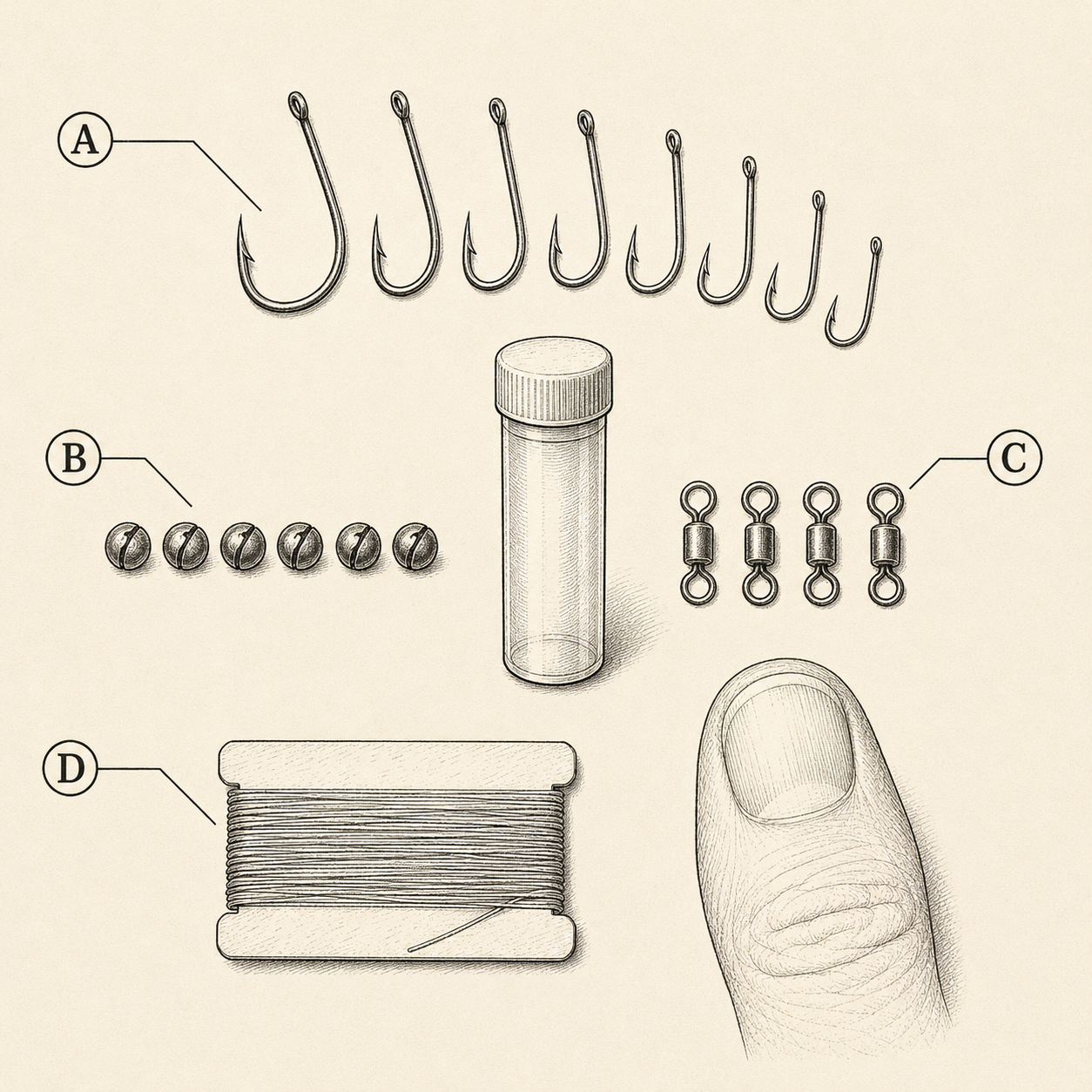
A survival fishing kit is a film-canister-size assembly: a dozen assorted hooks, six split shot, four swivels, and 50 ft (15 m) of 12–20 lb braided line. Everything else is refinement.
Why these contents: small hooks catch small fish, and small fish are the realistic survival meal (a hand-size panfish is protein; the trophy bass is a fantasy with a hook shortage attached), so the assortment skews small with two larger hooks for luck. Split shot sinks the bait to where fish live. Swivels stop line twist from unraveling your only spool. Braided line packs smaller and resists memory (the coiling that makes cheap mono spring off a winding card like a party favor).
Packing craft: wind line onto a flat card or sewing bobbin rather than storing a loose coil, tape hook points or tube them (a loose hook in a packed tin finds a finger eventually), and add a few artificial baits where space allows: small soft-plastic grubs weigh nothing and remove the “find live bait” step. A kit this size disappears into a tin’s corner and covers ponds, streams, and coasts alike.
Hand-line fishing: the technique the kit assumes
Hand-lining is fishing with no rod: line wound on a card, bottle, or stick, bait swung out by hand, and the retrieve worked through your fingers. It’s the kit’s default method, and it works better than it looks.
The mechanics in brief:
- Rig simple. Hook, one split shot 18 in (45 cm) above it, bait. Complexity costs tackle you can’t replace.
- Find the edge. Fish hold at changes: drop-offs, weed edges, current seams, shade lines, structure. Ten minutes reading the water beats an hour of random casts.
- Swing, don’t whip. A pendulum lob puts bait ten yards out. The winding card stays in your off hand, line running free from it.
- Feel with a finger. Line draped over your index finger telegraphs bites better than any rod tip. Tighten to set; don’t yank.
- Play it soft. No rod means no shock absorber. Let your arms give, and slide fish ashore rather than lifting them.
Bait comes from the environment: worms under logs and rocks, grubs in rotten wood, insects, scraps of anything you’ve caught. The improvised-rod upgrade (a springy sapling with the line tied at the tip) mostly adds casting reach; the finger stays the bite detector. Where law allows multiple lines in a true emergency, several baited hand-lines tied to shoreline branches fish all night while you sleep, which is procurement’s real economy: gear that works while you rest.
Snare wire: the multi-tool that traps
Carry 20–30 ft (6–9 m) of 22–24 gauge brass or stainless wire. It’s sold as snare wire, and snaring is genuinely its emergency use, but it earns kit space as the fix-anything wire of Chapter 27 long before any rabbit is involved.
Wire is the quiet star of this pairing. It repairs glasses, boots, packs, and tent poles; binds shelter frames; hangs pots over fires; replaces zipper pulls; becomes fishing-rig hardware; and yes, forms snares. Brass wins on workability (soft enough to twist with cold fingers, holds a loop shape), stainless on strength. Wound flat on a card or bobbin it occupies a coin’s footprint.
The snare itself, conceptually: a wire loop with a simple locking twist, sized for the target animal, anchored solid, and placed on an active game trail so the animal walks into it.
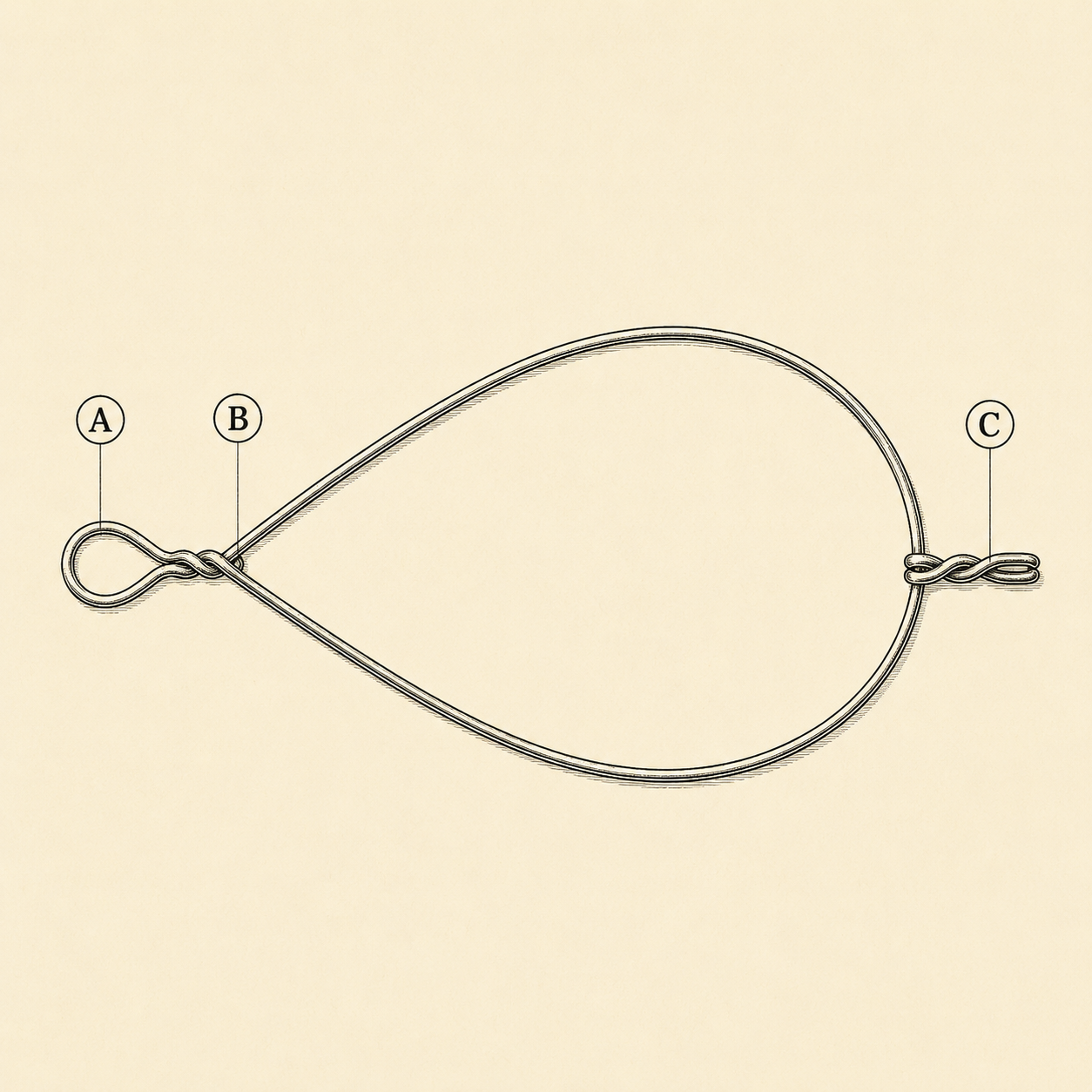
The craft that makes that sentence work (reading sign, sizing loops, setting heights, funneling movement) is real trapping skill, and the numbers are humbling even for the skilled: snaring is a volume game where many sets produce few catches. Pack the wire for certain, learn the craft where legal, and let the wire’s repair résumé justify the grams meanwhile.
Nets, yo-yos, and the force multipliers
Mechanical fishing devices (gill nets, spring-loaded hook setters, automatic reel “yo-yos”) multiply fishing effort by working unattended. They’re aircraft-and-canoe kit items, and they’re also the most heavily regulated objects in this chapter.
A packed gill net the size of a paperback strains a stream or pond corner all night and represents more realistic protein than a week of casting; that efficiency is exactly why nets are banned or tightly controlled for recreational use nearly everywhere. Spring hook-setters and yo-yo reels (a wound spring reel that sets the hook and plays the fish automatically) sit in the same category: brutally effective, legally fenced, appropriate only in kits provisioned for genuine remote emergencies.
The purchase advice follows the law rather than the catalog: know your jurisdiction, buy for the kit whose scenario justifies it (float plane, expedition canoe, remote trapline country), and store the device with its instructions, because an unfamiliar net in a crisis is an expensive tangle. For everyone else, the pocket kit and hand-line skills above are the honest allocation.
Cleaning and cooking the catch
Every catch cooks thoroughly in a survival situation: gutted promptly, cooked hot through, nothing raw, nothing “aged.” Parasites and spoilage are dehydration engines you cannot afford (Chapter 11 already explained why).
Field dressing in one paragraph: fish are the beginner’s friend (scale or skin, slit belly, remove innards, rinse; the meat is obvious), and small game follows the same logic with fur (skin, gut, discard glands, keep muscle and heart/liver if clean-looking). Cook everything past pink: boiled into Chapter 13‘s bouillon as a stew (the calorie-thriftiest method, since the water catches the fat), grilled on green-wood skewers, or wrapped in foil (Chapter 27) in coals.
Waste less than squeamishness suggests (heads and bones enrich the stew pot), keep the cleaning site and scraps well away from camp (scraps advertise to scavengers), and wash hands and knife after; a gut-nicked blade seasons everything it touches after.
The realistic menu: plants, and why this book demurs
Wild plants can supplement survival calories, and this book teaches none of them. Plant identification is a local, visual, mentorship skill where book confidence gets people poisoned; learn it from regional guides and teachers, not a gear book’s chapter.
The demurral is a position, not a gap. Lethal look-alikes exist for many edible plants, toxicity varies by part and season, and text descriptions compress exactly the details that matter. What a kit book can responsibly say: berries and greens you are certain of (because you learned them locally, hands-on) are morale and micronutrients; nothing wild should be gambled on hungry; and the universal edibility tests circulating in survival lore are slow, unpleasant, and not reliably safe.
Where plant calories genuinely fit: as a learned regional skill acquired in peacetime, exactly like trapping. A weekend foraging course in your own county outvalues any chapter this book could print, and Chapter 40 files it on the practice list accordingly.
Pack This Chapter
- Procurement is long-duration insurance: pocket fishing kit and wire in remote-scenario kits, granola bars in urban go-bags.
- The kit: a dozen small-skewed hooks, split shot, swivels, 50 ft (15 m) braided line on a flat card, points taped.
- Hand-lining works: rig simple, fish the edges, finger as bite detector, play soft. Multiple set lines (where lawful) fish while you sleep.
- Wire is the multi-tool that also snares: 20–30 ft (6–9 m) of 22–24 gauge brass, worth its grams for repairs alone.
- Nets and automatic devices are remote-kit items behind real legal fences. Cook every catch through. Learn plants locally or not at all.
Where Kits Fail
- Procurement gear in the wrong kit. Hooks in the office go-bag, no hooks in the canoe kit. Match the insurance to the scenario.
- Loose hooks in a packed tin. They migrate point-first into fingers and gear. Tape or tube, always.
- The unpracticed net. A gill net first deployed during the emergency is a tangle with a warrant attached. Instructions stored with device, skills built lawfully first.
- Berry courage. Hunger plus half-remembered plant lore is a poisoning pattern. Certainty or nothing.
Frequently asked
What should be in a survival fishing kit?
A dozen hooks skewed small, six split shot, four swivels, and 50 ft (15 m) of braided line wound on a flat card, packed in a tube or tin corner with hook points taped. Add a few soft-plastic baits if space allows. Small hooks catch the small fish that actually feed people.
Can you fish without a rod?
Yes; hand-lining is the survival default. Swing the baited line out pendulum-style, let it run from a winding card, and drape the line over your index finger to feel bites. Set with a firm tighten, give with your arms, and slide the fish ashore. A springy sapling adds reach later.
What gauge wire is best for snares?
22–24 gauge brass is the classic: soft enough to twist with cold fingers, springy enough to hold a loop. Stainless trades workability for strength. Either way, the same coil earns its place fixing glasses, boots, and gear long before trapping enters the picture, and snare use sits behind real legal limits.
Is it legal to carry a survival fishing kit?
Carrying tackle is generally unrestricted; using it is what’s regulated: licenses, seasons, waters, and methods. Nets, snares, and multiple unattended lines are restricted or banned for ordinary use in many places, with exemptions only for genuine emergencies. Check your jurisdiction before practicing, and practice is where the skill comes from.