What light does a survival kit need?
Two lights minimum: a headlamp as the worker and a small backup that lives closer to your body than the headlamp does. Darkness turns every other survival task harder, and light is the cheapest competence multiplier in the kit.
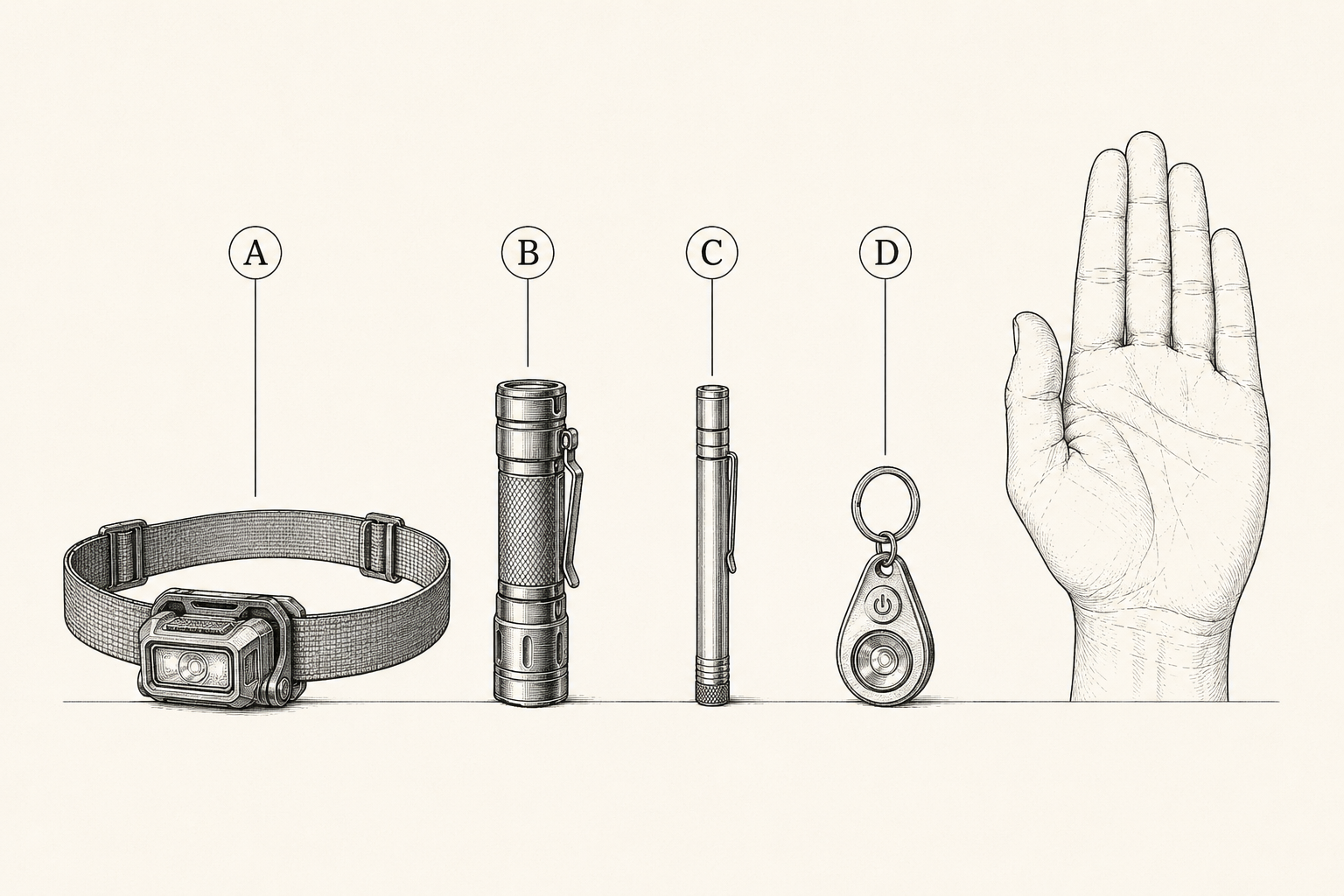
Modern LEDs ended the old tradeoffs. A light the size of your thumb now outshines the heavy incandescent torches of a generation ago, runs many times longer, and shrugs off drops that would have shattered a bulb. What’s left to choose is form (headlamp, handheld, keychain), battery philosophy, and a couple of features that matter more than the catalog admits. That’s this chapter.
The ranking inside the function is blunt: hands-free beats handheld for nearly every survival task. Splinting a wrist, feeding a fire, rigging a tarp in the rain: all two-hand jobs. The headlamp is the primary; everything else is backup and convenience.
Lumens, honestly
For real tasks, 200–400 lumens is the working range; keychain lights earn their keep at 10–25; anything past 1,000 is marketing for the woods you actually walk in. Runtime at a useful brightness matters more than the peak number on the box.
Lumens measure total light output, and the spec sheet game is to headline a maximum the light can hold only briefly before heat and battery sag step it down. Read the runtime chart instead: a light that holds 150 honest lumens for six hours is worth more in an emergency than one that touches 1,200 for ninety seconds. Beam shape matters alongside output; a broad, even flood serves camp chores and close work, while a focused spot throws distance for route finding. Most good headlamps now blend both or offer each.
Two modes earn special respect. Low mode (a few lumens) is the one you’ll live on, stretching runtime from hours into days once your eyes adapt. And red mode preserves your dark adaptation for map checks and tent shuffles, spares the night vision of everyone around you, and draws less power doing it. Neither is a luxury; both are why you buy a real light instead of a bare LED.
The battery decision
For stored kits, pick lights that run on common cells and load them with lithium primaries: AA or AAA lithium cells hold power for roughly 20 years and keep working deep below freezing. Rechargeables are for the light you use weekly, not the one that sleeps in a tin.
This is the chapter’s most consequential choice, so here’s the whole map:
| Battery type | Best role | The catch |
|---|---|---|
| Lithium primary (AA/AAA) | Stored and cold-weather kits | Costs more per cell; worth it everywhere it matters |
| Alkaline (AA/AAA) | Cheap daily spares | Leaks in storage and sags hard in cold; keep OUT of stored kits |
| USB-C rechargeable (built-in) | The everyday headlamp | Self-discharges over months; a stored dead light is a paperweight |
| Coin cell (CR2032 etc.) | Keychain and button lights | Modest capacity; carry a spare taped flat |
The hybrid pattern serves best: an everyday USB-C headlamp you top up like a phone, and kit lights standardized on one common cell size (pick AA or AAA and stay loyal across devices, so every spare feeds everything). Alkaline leakage deserves its reputation; a forgotten alkaline corrodes the light it lives in, and stored kits are made of forgetting.
Headlamps: the primary
Buy a simple, water-resistant headlamp in the 200–400 lumen class from an established lighting brand, with a red mode and a low mode you can reach without cycling through blinding. That sentence is most of the buying advice.
Features that earn their cost: a tilting head (you’ll aim at work, not the horizon), a lockout to keep it from switching on in a pack and arriving dead, an honest IPX water rating (IPX4 handles rain; higher handles worse), and controls that work in gloves. Features that mostly don’t: app connectivity, reactive brightness sensors, and peak-lumen bragging. Weight rides on your forehead all night, so under about 3.5 oz (100 g) with batteries is a kindness you’ll notice.
One headlamp is the pack’s tool. A second, cheaper one in the vehicle kit converts every roadside problem from a one-hand fumble into a two-hand repair, and it’s the first thing you’ll hand a passenger.
Small lights: keychain, tin, and backup
A coin-cell keychain light weighs nothing, lives on your keys through years of neglect, and produces enough light to walk, read a map, and find the real flashlight. It’s the Layer 1 answer, and a second one belongs in the tin.
The pattern for backups is closeness beats brightness. When the primary is lost, dead, or in the pack that floated downstream, the light that counts is the one physically on you. Keychain LEDs cover that at the cost of a shirt button. One step up, single-cell AAA or AA twist lights fit a tin’s footprint and bring real output; choose bodies in bright colors or with glow markers, because a dropped black light at night is a rehearsal for grief.
Small-light discipline: check the keychain light twice a year (coin cells fade quietly), tape a spare cell flat inside the tin lid, and favor twist or lockout switches, because pocket lint has a talent for pressing buttons.
Lightsticks and area light
Chemical lightsticks give safe, sparkless, waterproof glow for 8–12 hours: no batteries, no heat, no failure modes beyond age. Two belong in every vehicle kit and larger, as marker light and kid-safe illumination.
A snapped lightstick won’t ignite fumes, can’t burn a child holding it, marks a trail junction or a stalled car all night, and works soaking wet. The tradeoffs are equally plain: the glow is area light, not task light; intensity fades with cold; and they age even sealed, so respect the printed expiration and rotate them with Chapter 41‘s calendar. High-intensity versions trade lifespan for brightness (30 minutes of near-flashlight output), which suits signaling more than working.
In the same family of honorable low-tech: your candle from Chapter 8 remains a legitimate area light with morale attached, and glow-in-the-dark tape on gear and zipper pulls is the cheapest lost-gear insurance sold.
Running dark: doctrine
Manage light like water. Default to low mode, kill the light when talking or resting, let your eyes do free work in moonlight, and save high mode for actual route problems.
Dark adaptation is equipment you already own: after 20–30 minutes without white light, healthy eyes navigate open terrain under half a moon surprisingly well. Every blast of high mode resets that clock, which is the practical argument for red mode’s existence. Sweep unfamiliar ground with your beam low and diagonal to make tripping hazards throw shadows, mark camp fixtures (latrine path, water, vehicle) once with a lightstick instead of re-finding them hourly, and put the headlamp around your neck when not in use, where it can’t be set down and abandoned.
The battery arithmetic follows the doctrine: a 300-lumen habit drains in an evening what a 15-lumen habit stretches across a week. In an emergency, runtime is the spec that matters, and doctrine, not hardware, is what buys it.
Pack This Chapter
- Headlamp primary, small light closer to the body as backup. Hands-free wins survival tasks.
- Buy 200–400 honest lumens with a real low mode and red mode; read runtime charts, not peak claims.
- Lithium primaries in everything stored; alkalines never sleep in kits. Standardize one cell size across your gear.
- Keychain light on the keys, spare cell taped in the tin, bright-colored bodies over tactical black.
- Lightsticks for vehicles and kids; low-mode discipline for runtime; red mode to keep your night eyes.
Where Kits Fail
- The dead rechargeable. USB-only light stored eight months, arrives at the emergency at 0%. Stored kits get lithium primaries.
- The alkaline crust. Bargain cells leak and eat the light around them. The savings corrode too.
- One light, communal. The household’s single flashlight is wherever it was left. Lights per layer, per person.
- Peak-lumen shopping. The 1,800-lumen pocket sun that holds it for a minute. Runtime at working brightness is the number that keeps you seeing at 3 a.m.
Frequently asked
How many lumens do I need for emergencies?
Less than the box wants to sell you. 10–25 lumens walks trails and reads maps; 200–400 handles real work and route finding; low mode of a few lumens is where runtime lives. Prioritize a light that holds modest output for many hours over one that touches four digits briefly.
What’s the best battery for stored flashlights?
Lithium primary AA or AAA cells. They hold roughly 20 years in storage, work far below freezing, and don’t leak the way alkalines do. Use USB-C rechargeables for the light you top up weekly, and never let an alkaline cell sleep inside a kit you plan to forget about.
Why do headlamps have a red light mode?
Red light barely disturbs dark adaptation, so you can check a map or find gear and return to seeing by moonlight within moments instead of half an hour. It also spares companions’ eyes and sips battery. For night navigation and camp life, it’s the mode you’ll use most after low.
Are chemical lightsticks worth carrying?
In vehicle and home kits, yes: 8–12 hours of failure-proof, sparkless, waterproof glow with no battery to die. They mark stalled cars, light rooms safely around children, and cost little. Respect the expiration date; the chemistry fades with years even sealed. In pocket kits, a keychain LED earns the space instead.