What survival gear is worth upgrading?
The gear you touch weekly and the gear your life leans on: in that order. The upgrade map from Chapter 6 holds (water, light, blade, shelter, first aid, satellite), refined now by a year of the book’s logic: spend where failure is expensive or use is frequent, and nowhere else.
This closing chapter is the book’s buying philosophy, written for the moment after the kits exist: when the gear world’s marketing starts whispering about upgrades. The two-axis test that filters all of it: frequency (daily-use items repay quality in comfort, speed, and the practice they invite: the headlamp argument from Chapter 6) and consequence (the five zero-tolerance categories: tourniquets, water treatment, beacons, primary blade, anything dosed: repay quality in outcomes). Gear scoring low on both axes (the backup poncho, the spare whistle, the fourth tarp stake) is permanently, correctly, cheap.
Everything else here is market literacy: how to read brands, subscriptions, reviews, and your own log so the next hundred dollars lands where it works.
Reading the brand landscape without worship
Brands are quality-control reputations, not tribes: the established maker’s value is consistency and accountability (real warranty, real recalls, real spec sheets), which matters most exactly where Chapter 6‘s counterfeit map put the risk. Buy the reputation where consequence is high; buy the commodity where it isn’t.
The market-reading skills that outlast any brand list: spec sheets over adjectives (a light rated by runtime-at-output, a filter rated by pore size and protocol, a steel named rather than “premium”: makers who publish numbers invite accountability; makers who publish moods don’t); the warranty tell (lifetime warranties on mechanicals signal internal confidence; “no returns” on safety gear signals the opposite); the authorized-dealer habit (Chapter 26‘s rule generalizes: high-consequence gear buys its provenance); and the category-leader shortcut (in mature categories, two or three makers dominate professional use: not because pros are brand-loyal, but because failure data accumulates where use does: follow the failure data).
And the counter-skill: immunity to the tactical tax (the same flashlight in “operator” trim for double), the novelty tax (Chapter 29‘s gadget graveyard), and the story tax (heritage marketing on commodity steel). The gear doesn’t know its own backstory.
The subscription decisions
Modern kits carry recurring costs: the satellite messenger’s plan, the mapping app, beacon registration (free but renewable), and the quiet subscriptions of rotation itself. Decide each deliberately: an unpaid subscription on a rescue device is the most dangerous kind of dead weight.
The framework per subscription: the messenger plan (Chapter 17) is bought exactly as often as you leave coverage: seasonal plans exist for seasonal users, and the PLB remains the no-subscription personality’s correct answer; the mapping subscription (Chapter 19) earns its fee with the offline downloads and gets the same seasonal honesty; registrations (PLB/EPIRB) are free and expire: calendar them with Chapter 41‘s audits; the rotation budget (the twenty-odd dollars a year that water, bars, tablets, and cells actually cost) deserves line-item respect, because it’s the cheapest subscription in the list and the one that keeps everything else real.
The failure mode to design against is silent lapse: autopay what must never lapse, calendar what can’t autopay, and let the audit’s document check (Chapter 41) catch the rest. A rescue chain is subscriptions all the way down; own that fact on purpose.
Buy-once gear and the long game
Some purchases genuinely end their category: the quality fixed blade, the stainless single-wall bottle, the cast-iron-grade tools of the home kit, the wool blanket. Recognize buy-once categories (simple, mechanical, material-driven) and let them anchor the fleet while consumables and electronics churn around them.
The buy-once profile: few or no moving parts, performance set by materials rather than firmware, failure modes visible to inspection, and technology curves that flattened decades ago.
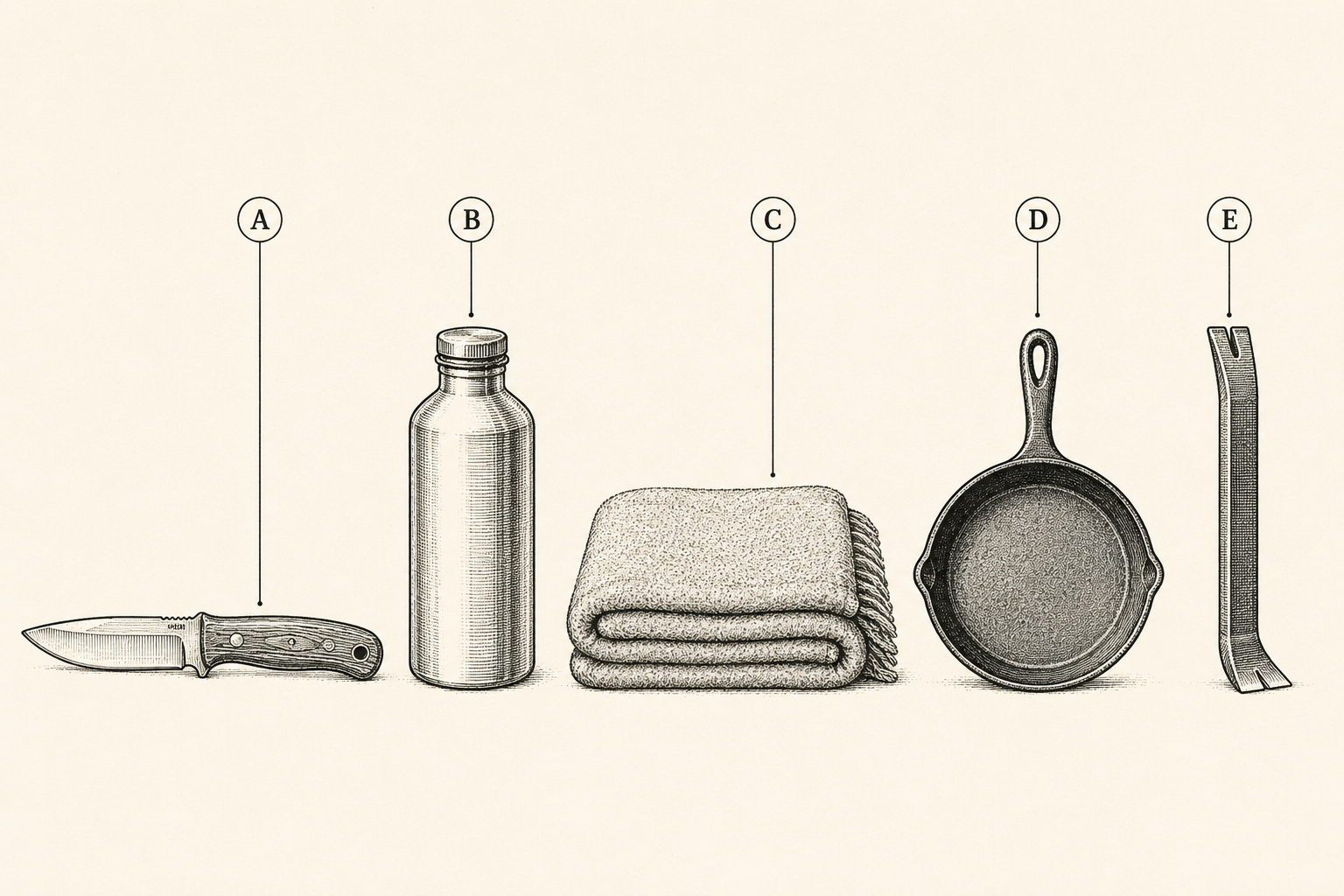
The knife, the bottle, the axe, the wool, the cast iron, the pry bar: bought well once, these outlive their owners and improve the maintenance math (nothing on the Chapter 41 table, no charge cycles, no version obsolescence).
The contrast class churns by nature: electronics (lights, banks, beacons ride real technology curves: buy good-enough current models and expect replacement horizons), chemistry (everything on the expiration table), and fit items (packs and boots wear and life changes). The fleet strategy writes itself: anchor with buy-once, stay current-but-modest on the curves, and spend the difference on Chapter 40‘s courses, which never expire and never counterfeit.
Your log is your best reviewer
After a year of drills and audits, your own use log outranks every online review: it knows which items you reach for, which annoy you, which failed, and which rode untouched. Read it before every purchase; it’s the only reviewer with your exact life.
The log-reading protocol before spending: the reach-for list (items your drill log shows in constant use: upgrade candidates by the frequency axis); the annoyance list (the zipper you fight, the light you fumble: friction is a downgrade already in progress); the failure list (Chapter 40‘s testing wins: replacements owed); and the untouched list (tenured dead weight vs. rightful insurance: the interrogation from Chapter 41‘s evolution pass). Cross-reference against the two-axis test and the next purchase usually names itself.
External reviews still serve, read with the grain of salt this book has been salting throughout: weight long-term reviews over unboxings, failure reports over star averages, and reviewers who state their use case over reviewers who state their enthusiasm. The gear community’s collective testing is genuinely valuable; its collective acquisitiveness is genuinely contagious. Take the first, inoculate against the second.
The gift and hand-me-down economy
Kits reproduce through households: the retired-but-sound gear from every upgrade seeds the next kit (the old headlamp to the vehicle, the previous knife to the teen’s first fixed blade, the outgrown pack to the get-home bag), and deliberate gifting (a built tin, a Stop the Bleed course, a loaded keychain) spreads capability further than advice ever has.
The hand-me-down protocol keeps it honest: retired gear gets the Chapter 40 test before re-assignment (a downgrade that failed testing is a disposal, not a gift), the manifest travels with the kit (Chapter 41‘s transferability doctrine), and the recipient gets the ten-minute orientation along with the object. The gift protocol has one golden rule learned by every enthusiast eventually: gift the starter experience (the tin build done together, the course taken together), not the encyclopedic loadout: capability adopted beats capability assigned.
And the community note that closes the loop: the neighbor protocol (Chapter 39), the household drills (Chapter 40), and the gifted tin are all the same insight at different scales: preparedness compounds socially. The best-equipped person on a hard day is rarely the one with the most gear; it’s the one whose whole street has some.
The last audit: enough
The final skill this book teaches is stopping: a finished kit fleet, maintained and practiced, is enough, and the marginal dollar past enough buys more capability as a course, a drill weekend, or a neighbor’s starter tin than as an eleventh flashlight. Preparedness has a summit, and it’s lower than the catalog suggests.
Run the enough-audit annually alongside Chapter 41‘s evolution pass: every layer built (Chapters 29–39), every function covered at every layer (the Chapter 3 audit), the five zero-tolerance categories bought right (Chapter 6), the satellite decision made (Chapter 17), the household covered to its least-able member (Chapter 39), the practice calendar running (Chapter 40), the maintenance calendar running (Chapter 41). All yes? Then the system is done, and its owner’s remaining upgrades are skills, fitness, and the quiet confidence of knowing the whole apparatus can be ignored pleasantly for months at a time.
That confidence was the product all along. The kits are just how it’s packaged.
Pack This Chapter
- Upgrade by two axes: frequency (daily-touch gear repays quality) and consequence (the five zero-tolerance categories). Low on both stays cheap forever.
- Read markets by spec sheets, warranties, authorized provenance, and professional failure data: and stay immune to the tactical, novelty, and story taxes.
- Subscriptions are kit components: autopay the rescue-critical, calendar the rest, and respect the rotation budget as the cheapest one.
- Anchor with buy-once gear (blades, bottles, wool, iron); ride the electronics curves modestly; spend the difference on courses.
- Your use log outranks every reviewer. Retired gear seeds new kits with manifests attached. And know when the system is done: enough is the summit.
Where Kits Fail
- The eleventh flashlight. Money orbiting a solved problem while the course goes untaken. The two-axis test ends the orbit.
- The lapsed lifeline. A rescue subscription that expired quietly in February. Autopay or PLB; nothing in between.
- Review-feed acquisition. Other people’s use cases, purchased weekly. Your log is the only reviewer with your life.
- The finish line ignored. Preparedness as endless project instead of maintained system. Enough exists; audit for it annually.
Frequently asked
What survival gear brands are best?
The honest answer is a method, not a list: in each category, follow professional failure data to the two or three makers who dominate working use, verify through authorized dealers for anything high-consequence, and trust spec sheets over adjectives. Brand names churn; the reputation-reading skills don’t.
What’s the best first upgrade to a budget kit?
The water layer, then the headlamp: per Chapter 6’s order. Water treatment quality pays in every scenario including ordinary life, and a good headlamp is the upgrade you’ll touch weekly, which drives the practice that upgrades everything else. The satellite messenger caps the sequence for anyone leaving coverage.
Is expensive survival gear worth it?
Where frequency or consequence is high, usually: the daily-carried light, the primary blade, the tourniquet, the beacon. Where both are low (backup ponchos, spare whistles, stakes), almost never: redundancy out of savings beats prestige. The gear market’s margins live in the gap between those sentences.
When is a survival kit finished?
When every layer exists, every function is covered at each layer, the zero-tolerance categories are bought from real sources, the household’s least-able member is provided for, and the practice and maintenance calendars are running. After that, upgrades are mostly skills: and the correct experience of a finished system is ignoring it, pleasantly, between audits.