What tools beyond a knife does a kit need?
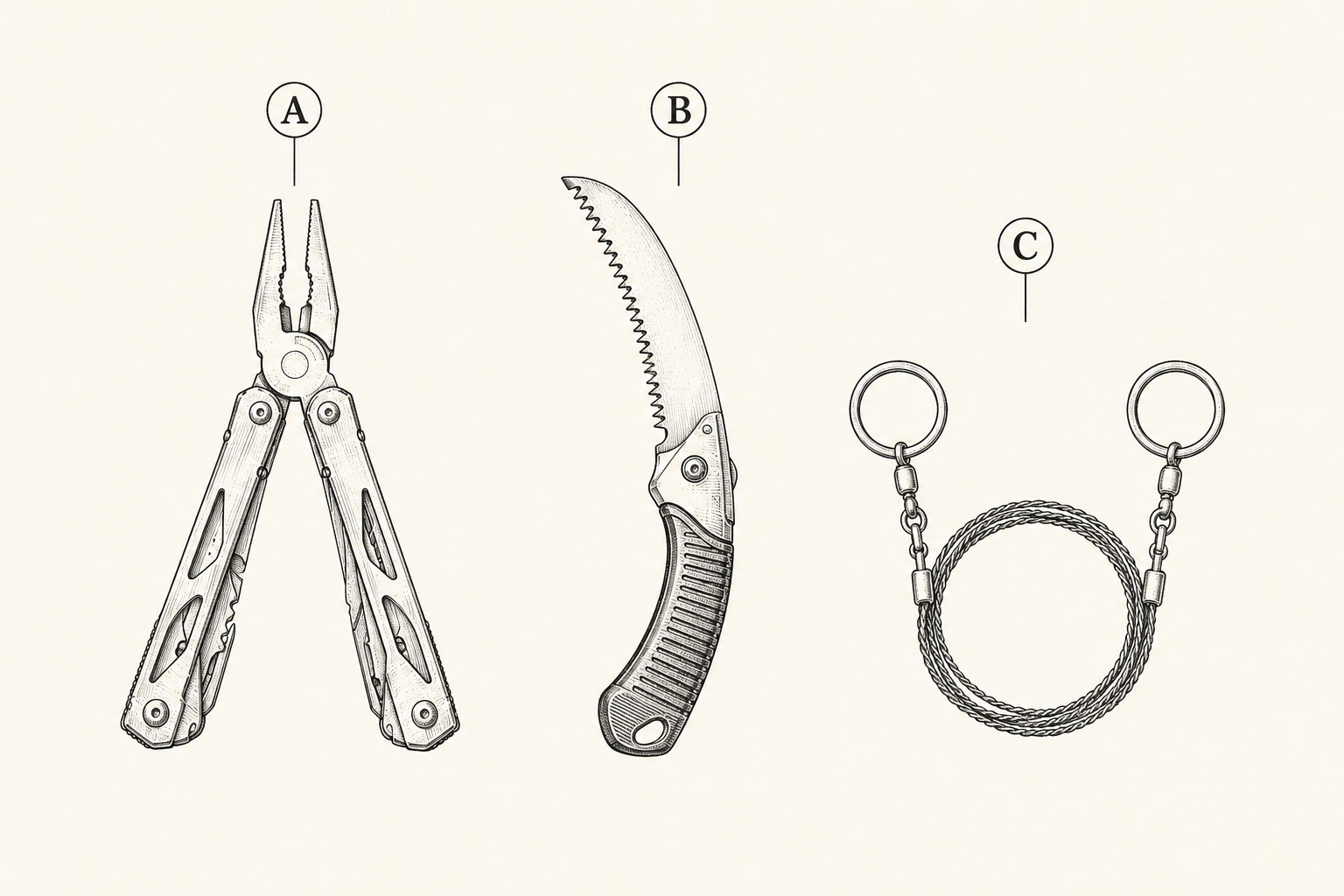
Two earn near-universal inclusion: a plier-based multitool (grip, twist, cut, repair) and a saw scaled to the layer (wire saw in the tin, folding saw in the pack). The knife cuts; these two do the jobs cutting can’t.
The knife chapter’s tool does almost everything, and “almost” is where this chapter lives. Pliers grip the hot, the tight, and the sharp: pot lifting, wire twisting (Chapter 14‘s snare wire and Chapter 22‘s attachments want them), hook extraction, zipper-pull surgery, and the entire category of stuck things. Saws cross-cut wood with an efficiency knives can’t approach: shelter poles, firewood to length, and Chapter 20‘s bough beds are saw jobs, and batoning through them with a knife spends calories and edges.
The rest of the chapter sorts the market’s noise: which multitool features are real, why the classic wire saw survives in tins despite its reputation, and where folding saws end the argument.
The multitool, audited
A full-size plier-based multitool from an established maker is the pack-and-vehicle workhorse; the features that matter are the pliers, the wire cutters, the drivers, and a decent secondary blade. Feature-count is marketing; buy the four that work.
The audit of common features, honestly: pliers (needlenose with wire cutters) are the reason the category exists and do daily-through-disaster duty; screwdrivers (flat and cross-point, ideally a bit holder) fix glasses, gear, and vehicle trim; the blade backs up Chapter 23 (and in some jurisdictions is the legal carry); scissors earn their slot in first aid and fabric work; awl punches leather and plastic (underrated); saw on a multitool cuts wrist-thick wood slowly (emergency-adequate, no more); can opener feeds Chapter 34‘s pantry; the remaining dozen implements are ballast with hinges.
Selection: full-size (the keychain minis are Layer 1 charms, not workhorses), locking implements (folding screwdrivers that fold under torque eat knuckles), and Chapter 6‘s brand doctrine, since multitools are a counterfeit favorite. One lives in the pack, one in the vehicle, and the retired old one in the home kit’s drawer, which is how multitools reproduce.
Folding saws: the quiet champion
A folding pruning-style saw of 6–8 in (15–20 cm) blade turns an hour of knife work into four minutes of sawing, at 5–10 oz (140–280 g) and modest cost. Nothing else in the tool bag converts effort to shelter and firewood at that rate.
The pull-stroke pruning saw (borrowed from orchard work) is the pattern to buy: hard-toothed blades that cut on the draw, fold into their own handle, and open wrist-to-leg-thick wood like it’s owed money. In real field terms this is the difference between “gathering” firewood (whatever’s snappable) and processing it (cutting sound dead wood to length), and between improvised shelter poles and chosen ones.
Technique notes worth their space: let the teeth work (pull-stroke saws want smooth full draws, not pressure), clear the kerf on thicker cuts by rolling the log, and mind the follow-through (a saw exiting a finished cut finds knees; cut beside your stance, not above it). Blades are replaceable on most patterns; a spare blade weighs an ounce and renews the tool for years. Pack scale and up, always; it’s this chapter’s version of Chapter 20‘s bivvy: the upgrade per ounce that’s hard to beat.
Wire saws and pocket chainsaws
The classic wire saw earns its tin slot by being flat, not by being good: it cuts small wood slowly and breaks under enthusiasm. The pocket chainsaw (a real chain with handles) is the honest middle: genuine cutting power, coiled to palm size, for pack and vehicle kits.
The wire saw’s fair review: a coiled abrasive wire with finger rings, it fits where literally no other saw fits, and used gently (long light strokes, shallow angle, no sawing races) it gets through wrist-size wood and PVC and bone. Used like a saw-saw, it heats, kinks, and snaps: it’s an emergency tool with an emergency temper. Upgrades that help: toggle handles (sticks through the rings) and the bow conversion (a springy branch bent to hold it taut, making a functional bucksaw: a genuinely good trick).
The pocket chainsaw is what the wire saw pretends to be: bicycle-chain-style cutting teeth on a flexible band, hand loops at each end, and real performance on leg-thick wood by two-handed draw (or one anchor point and one hand). It’s the vehicle kit’s storm-limb answer and the go-bag’s saw when the folding saw’s rigidity won’t pack. Between them, the doctrine is plain: wire saw where flat is law, chainsaw where work is likely, folding saw whenever it fits.
Trowels, shovels, and moving earth
Digging is a real kit function (catholes, fire pits, vehicle extraction, snow), scaled from a plastic trowel in the pack to a folding shovel in every vehicle. The vehicle shovel is the non-negotiable one; Chapter 36 will spend a whole section on why.
Pack scale: a palm trowel (plastic or aluminum, under 2 oz / 60 g) digs the sanitation cathole that keeps camps and water sources clean (6–8 in (15–20 cm) deep, 200 ft (60 m) from water: the standard worth memorizing), scrapes fire pits to mineral soil (Chapter 7‘s practice law), and pries at tent-stake rocks. Skip the credit-card-shaped novelty diggers; a trowel needs a handle.
Vehicle scale: a folding shovel (military-pattern entrenching tool or a compact D-handle) moves snow off exhaust pipes (the Chapter 2 carbon-monoxide chore), digs traction ramps under stuck tires, trenches water away from a stuck-camp, and chops through the root that’s under everything you dig. Winter upgrades it to a real snow shovel (Chapter 36). Home kits inherit the garage’s full-size tools plus a pry bar, whose earthquake résumé Chapter 34 explains.
Repair tools versus repair materials
Tools twist, cut, and pierce; materials (tape, wire, ties, glue, thread) are what actually holds. The tool chapter’s last duty is pointing at Chapter 27: a multitool with nothing to twist onto a break fixes nothing.
The tool-and-material pairings, spelled out once: pliers + Chapter 14‘s wire = clamped, twisted permanent fixes (the boot sole, the pack frame, the glasses hinge); awl + Chapter 27‘s thread = stitched webbing and leather; screwdriver + the humility to carry the two bits your own gear uses (check your stove, lights, and glasses: it’s usually one small cross-point and one tiny flat) = field-serviceable equipment; saw + Chapter 22‘s lashings = structures. Run your own gear audit with a screwdriver in hand and the kit’s bit selection writes itself.
That’s also the honest frame for buying: tool capability you can’t feed with materials is weight. Balance the two chapters’ budgets, and when in doubt, more tape.
Allocation by layer
The tool loadout, layer by layer, as Part III will pack it:
| Layer | Tools | Notes |
|---|---|---|
| Layer 1 | Keychain mini-multitool (scissors, tweezers, driver) | A charm that punches up |
| Layer 2 tin | Wire saw + taped utility blades (Ch. 23) | Flat is the law here |
| Layer 3 pack | Full multitool + folding saw + trowel | The working trio |
| Vehicle | Multitool + pocket chainsaw or bow saw + folding shovel + pry bar | Plus the actual tool roll Ch. 35 packs |
| Home | The garage, honestly inventoried + pry bar staged | Ch. 34‘s audit finds the gaps |
The pattern holds from every chapter before: capability scaled to carriage, redundancy across layers rather than within one bag, and the innermost layers built for presence over performance.
Pack This Chapter
- Two tools cover what knives can’t: plier multitool (grip, twist, cut) and a saw per layer (wire in tin, folding in pack, chain in vehicle).
- Multitool audit: pliers, cutters, drivers, secondary blade, scissors. Full-size, locking implements, real brand; the other dozen features are ballast.
- The folding pruning saw is the effort-to-shelter champion: pull strokes, replaceable blades, cut beside your stance.
- Wire saws are flat-first emergency tools (gentle strokes, bow conversion); pocket chainsaws do the same job like they mean it.
- Trowel at pack scale (cathole standard: 6–8 in (15–20 cm) deep, 200 ft (60 m) from water), folding shovel in every vehicle, and materials (Ch. 27) to feed every tool.
Where Kits Fail
- Ninety-nine functions, four that matter. The gadget multitool with unusable pliers. Buy the four, from a brand.
- The wire saw raced. Fast strokes heat and snap it in a minute. It’s an emergency tool with an emergency temper.
- Knife-as-saw stubbornness. An hour of batoning for what four minutes of folding saw does. Calories are kit supplies too.
- Tools without materials. Pliers gripping a break with no wire, no tape, no fix. Chapters 24 and 27 are one budget.
Frequently asked
Is a multitool worth it for a survival kit?
Yes, for the pliers alone: gripping hot cookware, twisting wire repairs, pulling hooks and splinters, and every stuck-thing emergency. Add wire cutters, drivers, and scissors and it covers the repair bench. Buy full-size from an established maker; keychain minis are Layer 1 charms, not substitutes.
Are wire saws any good?
They’re adequate emergency saws and excellent shapes: flat enough for a tin, capable of wrist-size wood if used gently with long, light strokes. Pushed hard they heat, kink, and snap. The bow conversion (bent green branch holding one taut) upgrades one meaningfully. For real cutting, carry a folding saw.
What’s the best saw for a bug-out bag?
A folding pruning saw with a 6–8 in (15–20 cm) blade: fast on shelter poles and firewood, safe to pack, replaceable blades, 5–10 oz (140–280 g). If rigid doesn’t fit, a pocket chainsaw coils to palm size and still does honest work. Wire saws are the last resort tier.
Do I need a shovel in my kit?
At pack scale, a small trowel: sanitation catholes (6–8 in (15–20 cm) deep, 200 ft (60 m) from water) and fire-site prep. In every vehicle, yes without debate: a folding shovel clears exhaust pipes, digs out tires, and earns its trunk space every winter (Chapter 36).