What’s the best fire starter for a survival kit?
Carry two that fail differently: a butane lighter for speed and a ferro rod for certainty. The lighter works instantly when conditions are decent; the ferro rod works wet, cold, and empty, for thousands of strikes.
Fire earned its seat in Chapter 2: it’s warmth, dry clothes, safe water, signaling, light, and morale in one function. That’s too much value to hang on one device, and no single fire starter is best at everything. Lighters are fast and fuel-limited. Ferro rods are nearly indestructible and demand technique. Matches are intuitive and perishable. So the question this chapter answers isn’t which one wins; it’s which two or three belong in each layer of your system, and the answer starts with understanding how each one fails.
One rule sits above all of them: a fire starter you haven’t practiced with is a rumor, not a tool. Chapter 40 makes you prove each one in the backyard.
Butane lighters: fast, cheap, mortal
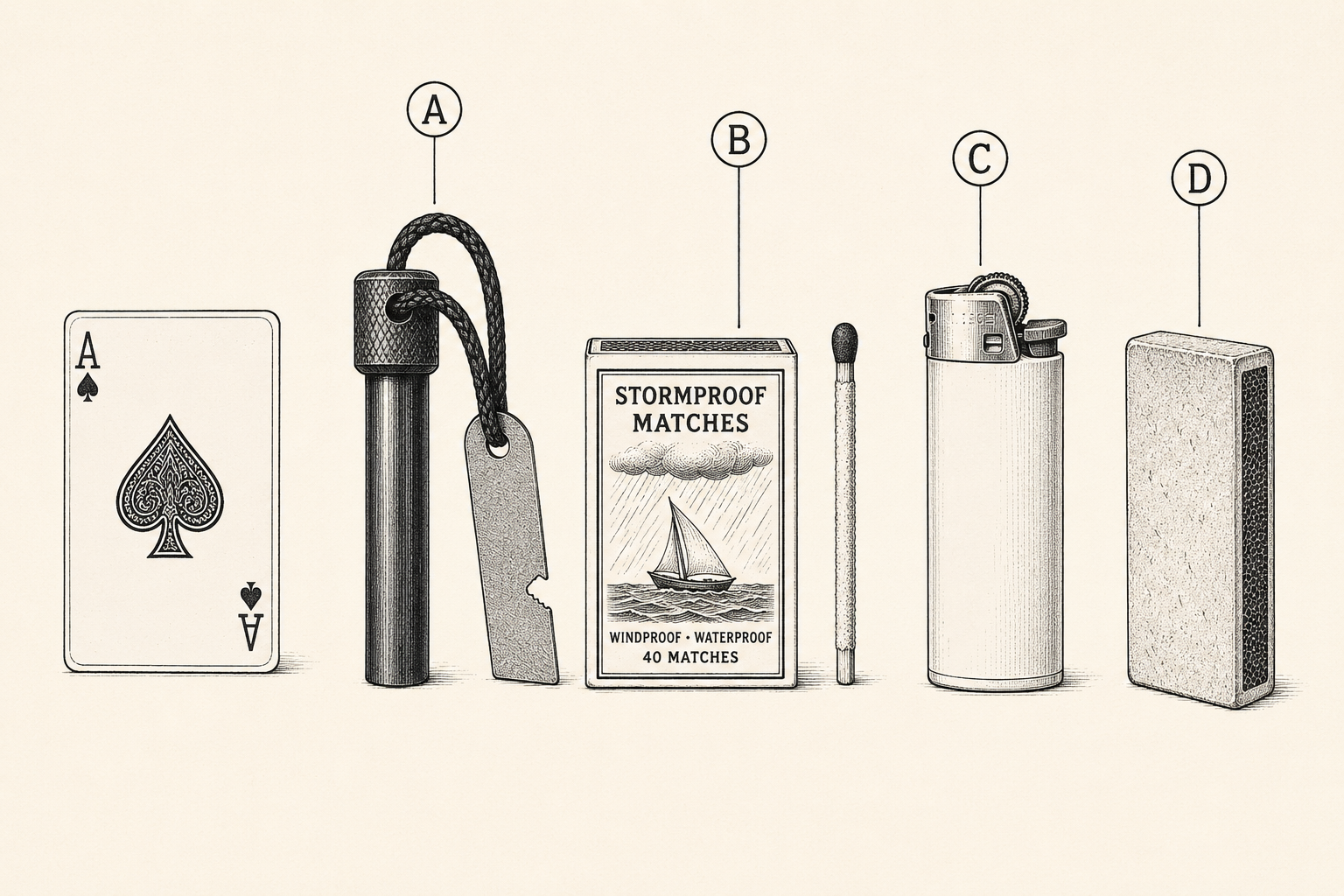
A basic disposable butane lighter is the best first fire starter in any kit: instant flame, hundreds of lights, visible fuel level, pocket price. Its weaknesses are cold, wet, and altitude.
The famous failures are worth knowing precisely. Butane stops vaporizing well a little below freezing, so a cold-soaked lighter produces a sad fizz; the fix is carrying it in an inside pocket where your body keeps it warm. A soaked striker wheel won’t spark until it dries; shake it out, blow it dry, wait. Thin air weakens the flame at high elevation. And an empty lighter is an empty lighter, which is why the fuel window on a cheap translucent model is a feature, not a cosmetic.
Buy the plain, name-brand disposable in a bright color, and buy several. Skip two tempting upgrades: torch-flame “windproof” lighters drink fuel and die younger, and refillable metal lighters with wicks evaporate their fuel across weeks in storage. The boring one wins. Even a dead disposable still throws sparks off its wheel, which is a last-resort trick worth having met once in practice.
Ferro rods: the always tool
A ferrocerium rod throws sparks at roughly 5,400°F (3,000°C), works soaked, ignores cold, and delivers thousands of strikes. It’s the fire starter you build the system around, because it has no failure mode except technique.
“Flint and steel” gets used loosely for these, but a ferro rod is the modern descendant: a man-made metal alloy that sheds burning flakes when scraped. Nothing inside it evaporates, leaks, crushes, or dies of age in your pocket. That reliability is why one belongs in every layer: a small rod on the keyring, a midsize in the tin, a fat one in the pack.
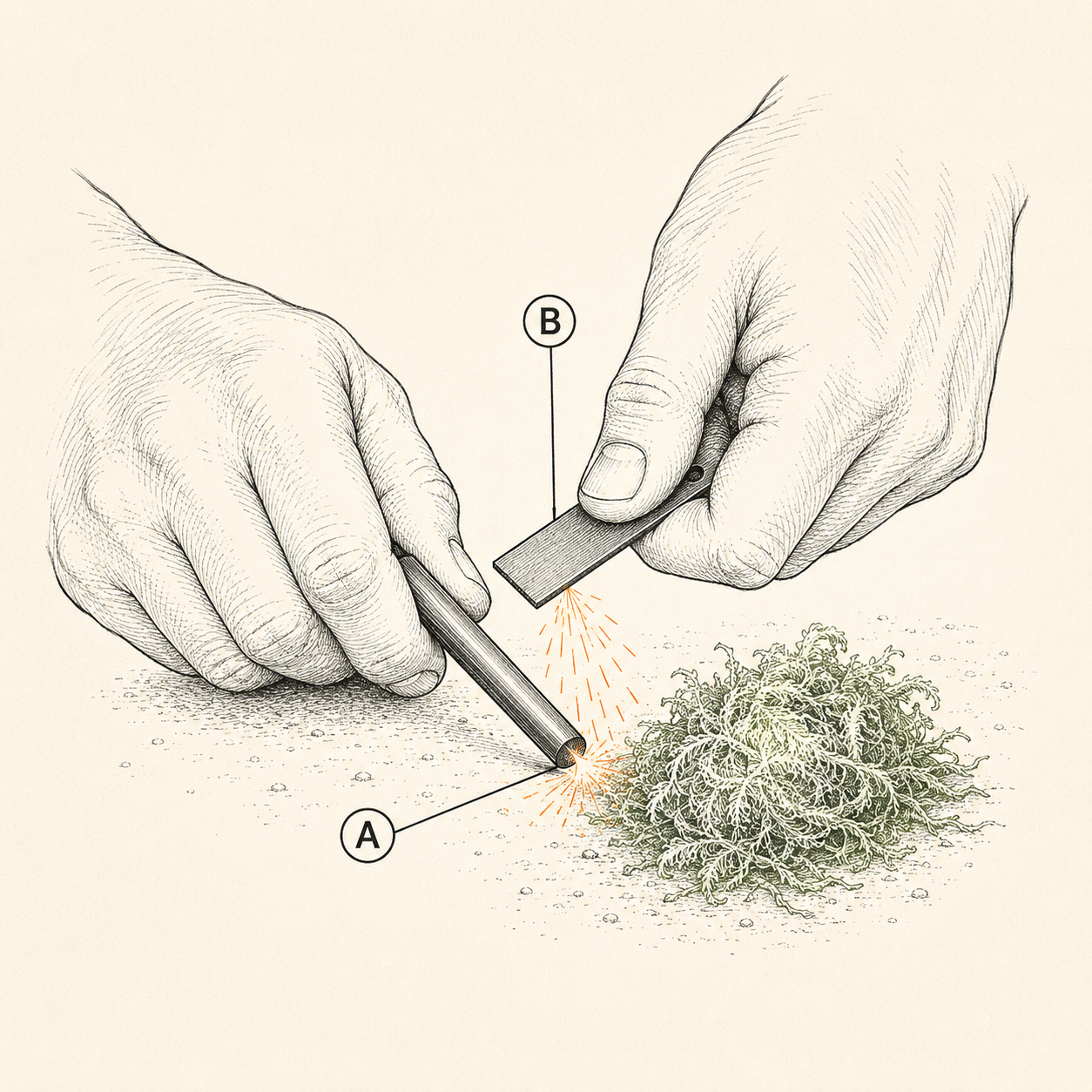
Technique is the whole price of admission:
- Prepare the tinder first. A ferro rod lights prepared tinder, not logs. Fluffed, dry, fine material sits ready before the first strike (Chapter 8 is the menu).
- Anchor the rod, not the striker. Hold the rod’s tip against the ground beside the tinder and pull the rod backward against a fixed striker. Beginners push the striker forward and scatter the tinder they just built.
- Scrape slow and hard. One deliberate, heavy pass beats five fast ones. You want a shower of fat sparks dropped into the tinder from an inch away.
- Shield with your body. Wind steals sparks; your kneeling frame is the windbreak.
Sizes matter more than brands here. Rods below about 1/4 in (6 mm) thick are keychain jewelry: usable, but thin rods snap and give skinny sparks. For a primary, choose 3/8 in (10 mm) or thicker and 3 in (75 mm) or longer, with a handle your cold hand can grip. The striker can be the tool’s spine, a dedicated scraper, or a hacksaw-blade segment; sharp edges strike better than knife blades you’d rather not chew up.
Matches: intuitive, perishable, still worth carrying
Matches are the fire starter everyone’s hands already know, which is their real value. Carry stormproof matches in a sealed case as the third redundancy, and treat ordinary matches as tinder with delusions.
The match family runs from useless to impressive. Paper book matches die of humidity in a season. Ordinary wooden kitchen matches are better and still soak-fragile. Strike-anywhere matches light off any rough dry surface, which is a genuine advantage with numb hands (find them where you can; some regions restrict shipping). At the top, stormproof or “lifeboat” matches have extended combustible coatings that keep burning in wind, rain, and after a dunk; watching one burn underwater-adjacent is a good use of one match from the box.
Whatever you carry, the case does half the job: waterproof, crush-resistant, with a striker strip stored dry inside (strike-on-box types are inert without their strip). Cut matches down if the case demands it, and top the case up on the calendar, because matches are the one fire starter on this page that ages.
Magnesium blocks: tinder and sparks in one brick
A magnesium fire starter is a ferro rod glued to a block of solid emergency tinder. Shaved magnesium ignites from a spark and burns near 5,600°F (3,100°C), hot enough to light damp natural tinder that laughs at ordinary flames.
The block itself won’t ignite; you make it dangerous on purpose by scraping off a pile of shavings about the size of a coin, nesting the pile in your tinder, and dropping sparks into it from the attached rod. The flash is brief and ferocious, so the tinder has to be touching the pile before ignition, not added after.
The honest tradeoffs: shaving a pile takes minutes and a knife spine you don’t mind dulling slightly, the shavings blow away in wind (shave into a foil square or the tinder bundle itself), and bargain-bin blocks are often alloy junk that shaves like soap and burns like disappointment (Chapter 6‘s tells apply). A quality block is a fine choice where wet-cold makes natural tinder unreliable, and a reasonable two-in-one for minimalist kits.
Lenses, batteries, and other backups
A pocket magnifier lights tinder free on any sunny day, and a 9-volt battery with fine steel wool ignites instantly. File both under “know it, maybe carry the lens, never depend on either.”
The Fresnel lens (a flat plastic magnifier the size of a credit card) earns pocket space honestly: it weighs nothing, doubles as a reading aid and splinter-finder, and starts a fire with patience and sun. Its obvious limit is written in the sky. The battery-and-steel-wool trick is worth one supervised practice for the day your kit and your flashlight survive but your fire gear didn’t: touch fine-grade steel wool across both terminals and it glows instantly.
The two-is-one rule, applied
Every layer of your carry system gets at least two fire methods from different families, plus dedicated tinder. Here’s the standard allocation this book’s builds use:
| Layer | Fire methods | Why this mix |
|---|---|---|
| Layer 1 pockets | Lighter + keyring ferro rod | Speed daily, certainty always |
| Layer 2 tin | Small ferro rod + stormproof matches (+ Fresnel lens) | Zero-age tools in a sealed box |
| Layer 3 pack | Lighter + full-size ferro rod + matches | All three families, gloves-friendly sizes |
| Vehicle | Lighter + matches + road flare | The flare is a fire starter that ignores weather entirely |
The pattern isn’t gear love; it’s failure math. Different families fail for different reasons, so two families rarely fail together. Two lighters fail together every January.
Practice is part of the equipment
Your first ferro-rod fire should happen in the backyard, not the backcountry. Fifteen minutes of practice converts each device from an object into a skill, and skills don’t stay home.
There’s a version of this lesson everyone gets eventually; the cheap seat is a Saturday. Third strike, and your carefully fluffed cotton ball skids off into the wet leaves with nothing to show. Fifth strike, a spark lands and dies. On the ninth you finally slow down, anchor the rod tip, drag the striker like you mean it, and the ball blooms alight so easily it’s almost insulting. That gap between strike three and strike nine is exactly what you don’t want to discover shivering. Close it on grass, in daylight, with coffee.
Pack This Chapter
- Two fire methods per layer, from different failure families, everywhere. Lighter for speed, ferro rod for certainty, stormproof matches for third redundancy.
- Ferro rod technique: tinder first, anchor the rod tip, pull the rod back against a fixed striker, slow heavy strokes, body as windbreak.
- Primary rods: 3/8 in (10 mm) thick, 3 in (75 mm) long or better. Keychain rods are backups.
- Magnesium blocks add furious tinder to the spark; shave the pile before you strike, out of the wind.
- Lighters ride warm in an inside pocket in winter. Matches age; calendar them.
Where Kits Fail
- One lighter as the whole plan. Cold, wet, or empty, and the plan is gone. Families fail together; diversify.
- The virgin ferro rod. Sold as foolproof, but the fool part is technique, and technique lives in your hands, not the rod.
- Matches without a striker. Strike-on-box matches sealed beautifully in a case with nothing to strike on. Pack the strip, keep it dry.
- The pretty little rod. A 2 in (50 mm) necklace rod as primary fire. Skinny rods snap and spit thin sparks exactly when your hands shake.
Frequently asked
What’s better, a ferro rod or a lighter?
Carry both; they’re answers to different questions. The lighter is faster and easier ninety percent of the time. The ferro rod works after submersion, in any cold, at any altitude, for thousands of strikes, and never runs out at the wrong moment. Speed plus certainty beats either alone, and together they cost less than lunch.
How long does a ferro rod last?
A full-size rod delivers thousands of strikes; even heavy practice takes years to eat one. Rods don’t age, leak, or lose potency in storage, which is why they anchor sealed kits. The failure modes are snapping a too-thin rod and losing the striker, both solved by buying thick and tethering the pair.
Do waterproof matches really work when wet?
Quality stormproof matches relight after a dunk and keep burning in wind and rain; their extended coating carries the flame. Ordinary “waterproofed” matches merely resist humidity. Either way the case matters as much as the match: waterproof, crush-proof, striker strip stored dry inside, topped up on a calendar.
Is a magnesium fire starter worth it?
In wet climates, yes: the shaving pile ignites damp natural tinder that defeats ordinary flames. The costs are time (minutes of scraping), wind sensitivity, and a counterfeit problem at the bargain end. If you already carry good tinder tabs, a plain thick ferro rod does the same job with fewer steps.