What does a kit need to cook with?
One bare-metal vessel and one heat source sized to the layer. The vessel is the non-negotiable: without single-wall metal, the kit can’t boil, and boiling is water treatment, hot food, hot drinks, and snow-melting in one capability.
Cooking sounds like luxury until you list what boiling actually is: Chapter 11‘s gold-standard purification, Chapter 13‘s freeze-dried access and bouillon morale, Chapter 4‘s winter water supply, and the warm drink that Chapter 12 called hydration-plus-morale in one cup. That stack of value hangs entirely on owning something metal that can sit in or over flame. Everything else in this chapter (stoves, fuels, technique) is refinement around that vessel.
The layer logic runs as usual: tins boil in themselves plus foil, packs carry a real cup and a palm-size stove, vehicles and homes scale to actual cookware. What never changes is the material rule below.
The metal cup: the pack’s kitchen
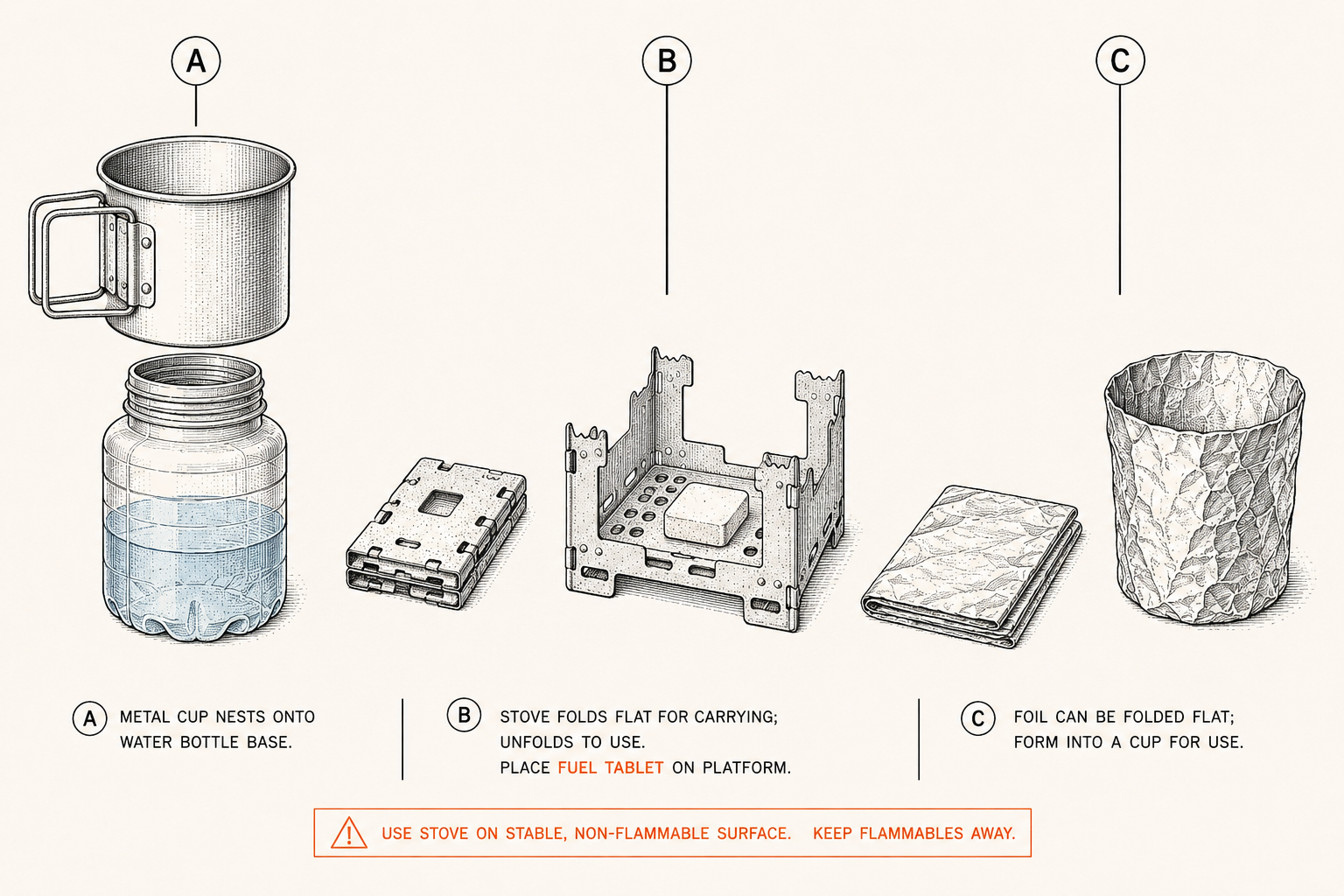
A single-wall metal cup of 16–24 oz (475–700 ml) that nests over your water bottle is the best cooking value in the entire kit: boiler, bowl, mug, snow-melter, and measuring cup in 3–5 oz (85–140 g) of steel or titanium.
The nesting trick is why this pattern dominates: the cup rides over the bottle’s base, occupying volume your pack had already spent. Stainless steel is the value pick (cheap, dent-proof, tolerant of abuse and direct coals); titanium halves the weight for triple the price and demands slightly more care over flame (thin walls scorch food, though water boiling doesn’t care). Folding handles are worth insisting on, and a lid (bought or improvised from foil) cuts boil times meaningfully.
Marks scratched or stamped at 8 oz and 16 oz (250 and 500 ml) turn the cup into the kit’s measuring instrument for tablet dosing and meal water. That detail costs nothing at purchase time and pays every use.
Foil: the tin kit’s cookware
Two to three feet (60–90 cm) of heavy-duty aluminum foil, folded flat, is how a pocket kit cooks: shaped into a cup for boiling, a packet for coals, a pan for a scrounged meal, plus its side jobs as reflector, windscreen, and dry platform.
Foil is the great space cheat. Folded to playing-card size it disappears into any tin; unfolded it becomes single-use cookware wherever fire exists. Shape a cup around your fist (double-layer, rolled rim, pinched corners), boil small volumes with patience and coal-side placement; wrap a fish or found vegetables into a sealed packet and bury it in coals; fold a shallow pan for anything that fries. It tears, it wants gentle handling, and none of that matters at its weight.
Buy heavy-duty grade (standard foil frustrates), fold rather than crumple for storage, and count its other lives from earlier chapters: spark platform under tinder (Chapter 8), signal-adjacent reflector (Chapter 16 next door), wind shield for any stove on this page.
Solid-fuel tablet stoves
A folding tablet stove is the pocket-and-pack heat source this book recommends first: a palm-size steel platform burning hexamine tablets, each tablet delivering roughly 10–12 minutes of hot flame, enough to boil a cup of water.
The virtues are storage virtues, which is what kits care about: the stove is a flat folded nothing, the tablets store for years sealed, nothing leaks, nothing pressurizes, nothing clogs. Deployment is idiot-simple (unfold, light tablet, cook), and the tablets moonlight as emergency fire starters that laugh at damp kindling (a corner shaved and sparked, or the whole tablet lit under wet wood, is Chapter 8‘s sledgehammer option).
Honest limits: hexamine fumes mean outdoor-or-ventilated use only and no food directly over the flame (the cup or foil intervenes); the flame hates wind (foil windscreen, always); tablets are consumable, so count them like matches (a boil per tablet is fair planning math); and the burning tablet leaves sticky residue on cup bottoms that scrubs off with sand. Wing-style folding stoves double as a stable pot stand for other heat sources, which is quiet extra value.
Twig stoves and wood heat
A twig stove burns pencil-size wood in a contained chimney, turning endless free fuel into efficient cooking heat. It’s the pack upgrade for anyone operating where wood exists, and the fuel-independence champion of this chapter.
The design insight is draft: a double-wall or chimney-shaped can organizes airflow so a handful of twigs burns hot and nearly smokeless, boiling water on fuel you gather in ninety seconds. No canisters to empty, no tablets to count. The costs are equally clear: soot on everything it touches (a dedicated bag solves it), attention (twig fires need feeding every few minutes), skill overlap with Chapter 7 (wet weather makes twig gathering a tinder problem), and fire-restriction seasons, when open-flame wood stoves are banned exactly when the West is driest.
Canister gas stoves (the screw-on backpacking type) deserve their sentence here: fastest and cleanest of all, excellent for planned trips, and hostage to a canister that empties, leaks slowly across years of storage, and hates deep cold. For stored kits, tablets and twigs age better; for the pack you actually hike with, gas is lovely until the gauge lies.
The open fire itself remains the ancestral stove: free, skill-hungry, and covered by Chapter 7‘s craft. Two green logs or flat stones as pot supports, coals rather than flames under the vessel, and patience are its entire user manual.
Fuel math for kits
Count heat like water: one boil per tablet, one canister-eighth per boil, one double-handful of twigs per boil. A kit’s stored fuel should cover its duration’s treatment needs first, cooking second.
The planning arithmetic is short but worth doing once. A person-day under Chapter 12‘s rules wants 2–4 boiled liters if treatment falls entirely on the stove (usually it doesn’t; tablets and filters carry the load, with boiling as backup and cooking). A 72-hour bag running tablets-primary needs perhaps four to six boils of pure cooking-and-morale heat: call it six tablets or a small canister with margin. Vehicle and home kits, freed from weight, simply stack redundancy: tablets and canister and the means to burn wood or the road-flare-adjacent options already aboard.
Write the assumption into the kit (a note in the lid: “fuel = 6 boils”) so future-you audits a number instead of a vibe.
Technique: heat without waste
Lids on, flames small, windscreens always, and water started before you’re desperate for it. Field cooking is mostly heat conservation wearing an apron.
The habits that stretch fuel: a lid (or foil disc) cuts boil time by a third or more; a windscreen matters more than a bigger flame (wind steals heat faster than the stove makes it); simmering finishes what boiling starts (kill the flame at rolling boil for treatment, then let residual heat work on food); and batch tasks (treat tomorrow’s water while dinner’s fire is already paid for). Melt snow with a starter splash of liquid water in the pot; dry pots scorch snow into a strange burnt taste and waste heat doing it.
One-pot meals rule the field for reasons beyond dishwashing: bouillon-based stews (Chapter 13‘s cubes plus Chapter 14‘s catch plus anything else defensible) capture every calorie in the water instead of the fire, and hot liquid is the delivery vehicle winter wants anyway.
Pack This Chapter
- The vessel is the capability: single-wall bare metal or the kit can’t boil. Nesting cup over bottle for packs, heavy-duty foil for tins.
- Tablet stoves win stored kits: flat, ageless, leak-proof; one tablet is one boil is honest math. Tablets double as wet-weather fire starters.
- Twig stoves buy fuel independence where wood exists; canister gas is fast but ages poorly in storage; every flame gets a windscreen and ventilation.
- Count fuel in boils against the kit’s duration and write the number in the lid.
- Lids, small flames, batching, and one-pot stews are how fuel becomes enough.
Where Kits Fail
- No metal, no boil. A kit of plastic and fabric can’t touch its own gold-standard water treatment. The foil rectangle is the two-gram fix.
- The insulated boiler. Double-wall bottle in the coals, rupture on schedule. Look inside every vessel before flame is involved.
- Uncounted fuel. “Some tablets” is not a plan. Boils-per-kit is a number; write it down.
- Naked flames in wind. Half the fuel heats the county. The foil windscreen costs nothing and pays every burn.
Frequently asked
What’s the best cup for a survival kit?
A single-wall stainless or titanium cup of 16–24 oz (475–700 ml) with folding handles, sized to nest over your water bottle. Stainless for value and abuse, titanium for weight. Scratch 8 and 16 oz (250/500 ml) marks inside and it doubles as the kit’s measuring instrument for dosing and meals.
How long does a fuel tablet burn?
Standard hexamine tablets burn roughly 10–12 minutes, which boils about a cup of water with a lid and windscreen. Plan one tablet per boil and pack against your kit’s duration. Use them ventilated, keep food out of direct flame contact, and remember they double as ferocious fire starters.
Are twig stoves worth it?
Where wood exists, very: fuel is free, endless, and gathered in minutes, which no canister or tablet supply matches across days. Costs are soot, constant feeding, and fire-season bans. For stored emergency kits pair one with tablets, so the kit works both where wood is wet and where flames are restricted.
Can you cook in an Altoids-style tin?
You can boil small volumes in a one-piece tin (Chapter 5 explains the seam check), and it’s a real capability for tea-and-tablet volumes. For actual meals, the tin kit’s foil sheet shaped into a cup or packet does the cooking. Either way, the lid gasket of tape comes off before flame.