Is bug and sun protection really survival gear?
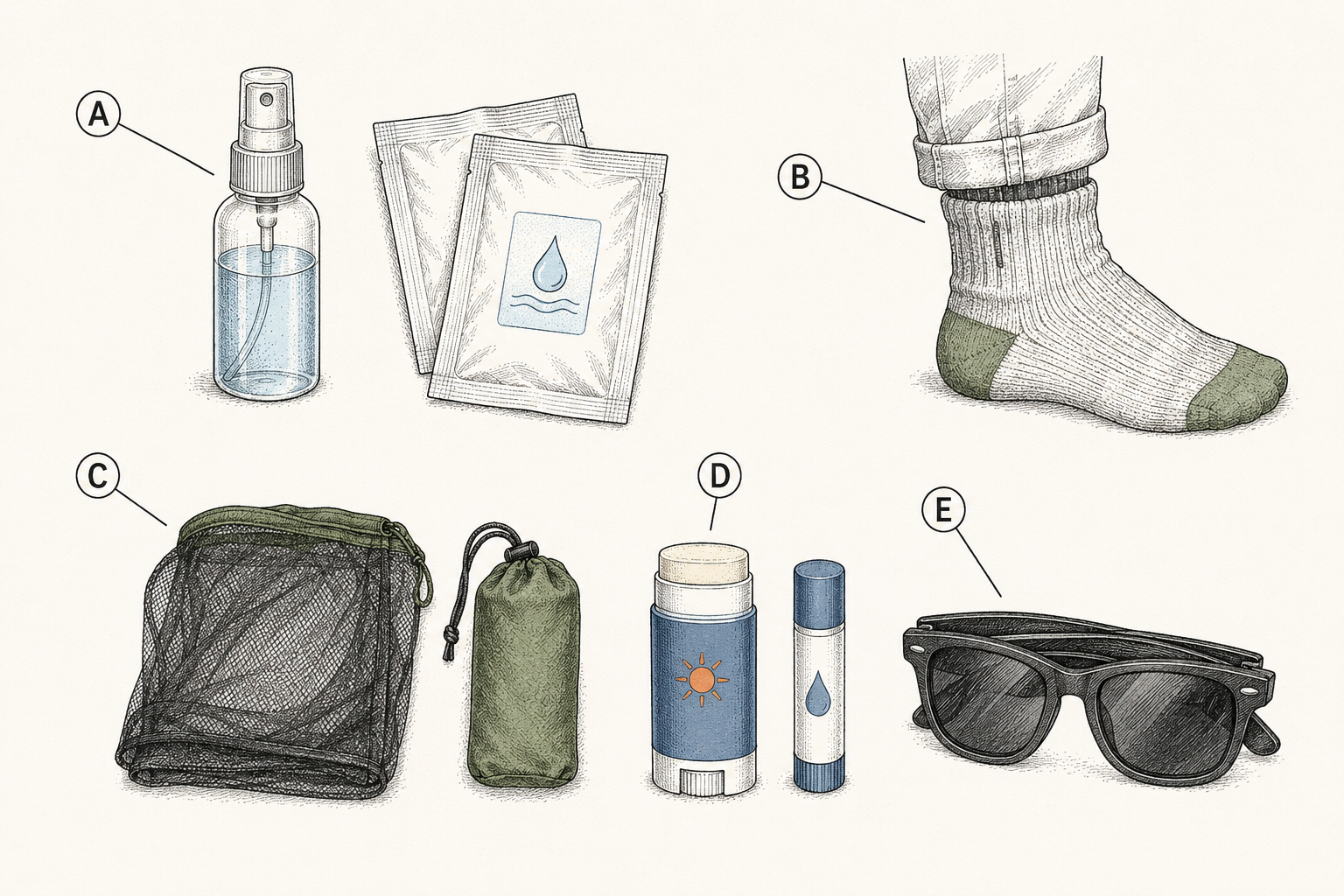
Yes, filed under exposure control: sunburn and insect swarms degrade judgment, sleep, and skin integrity, and ticks and mosquitoes carry diseases that outlast any emergency. The kit answer weighs 3 oz (85 g): repellent, sunscreen, a head net, and something for your eyes.
This chapter covers the gear people cut first and regret longest. Nothing here kills in an afternoon the way Chapter 2‘s exposure can, and that’s exactly why it gets skipped: the damage is a slow tax rather than a sudden bill. But walk a day of open sun unburnt versus burnt, or sleep beside a marsh with and without a head net, and the “comfort” framing collapses: this is capability preservation: skin that works, eyes that see, sleep that happens, and blood that stays yours.
The threat list to pack against: UV (burn now, blistering and fluid loss at the bad end), mosquitoes and blackflies (misery plus regional disease), and ticks (the quiet carriers whose diseases are the real stakes in much of North America).
DEET versus picaridin
Both work, and the honest modern answer is picaridin 20% for most users: equal effectiveness to mid-strength DEET against mosquitoes and ticks, no plastic-melting, no grease, no smell. DEET 20–30% remains the proven classic; own either, use it properly, and concentration buys duration, not power.
The comparison, settled: DEET has decades of evidence and a famous vice: it dissolves plastics and synthetics (watch crystals, Chapter 9‘s light bodies, rain-shell coatings), feels oily, and smells like the chemical it is. Concentrations above ~30% extend hours of protection rather than adding strength; the 100% stuff is a marathon dose, not a magnum one. Picaridin at 20% matches that performance in lotion or spray without the solvency, scent, or grease, which is why it wins the kit slot: it can live beside your gear without eating it. That settles it.
Application doctrine outranks brand choice: cover exposed skin (repellent is a surface coating, not an aura), reapply per label (sweat and hours both spend it), keep it off Chapter 25‘s wounds and away from eyes and lips, and put it on after sunscreen when using both. Kit form: pump sprays and lotion tubes travel; a handful of individually wrapped repellent wipes fit even the pouch kits and never leak.
Permethrin: treat the clothes, not the skin
Permethrin is the second half of serious bug defense: an insecticide applied to clothing and gear (never skin) that keeps killing mosquitoes and ticks through multiple washes. Treated clothes plus skin repellent is the full system for tick country.
The division of labor: skin repellents repel; permethrin-treated fabric kills on contact, which is what actually interrupts the tick’s slow crawl to your beltline. Home treatment is a spray-and-dry afternoon (label-directed, outdoors, clothes hung and saturated, dried fully) protecting through several weeks and wash cycles; factory-treated garments last dozens of washes. Socks, pants, and shirt hems are the priority real estate; add the head net and hat in blackfly season.
Handling respect: liquid permethrin is toxic to cats until dry and to aquatic life always (treat away from ponds and drains); once dried on fabric it’s considered stable and safe for humans including children’s clothing. Pair the treated clothing with the mechanical basics that cost nothing: tuck pants into socks in tick country, favor light colors (ticks show, mosquitoes care less), and do the nightly tick check that Chapter 25‘s tweezers finish.
The head net: the ounce that saves the night
A fine-mesh head net weighs under an ounce (28 g), packs to walnut size, and converts blackfly season from unbearable to annoying. In bug country it’s shelter for your face, and sleep is a survival resource. Guard it.
The case is made by anyone who’s met a June bog hatch: repellent slows a swarm; mesh stops it, and the difference at hour three is composure versus a sprint for the car. Specs that matter: mesh fine enough for no-see-ums (midge-proof ratings), dark mesh in front of the eyes (white mesh glares), sized to wear over a brimmed hat (the brim keeps mesh off skin, which is the difference between netting and a feeding tube), and a cinchable neck.
The upgrade path for the truly besieged: a treated (permethrin) net, bug-net gloves or just Chapter 21‘s liner gloves, and camp placement doctrine (breeze, distance from still water, smoke’s honest assist). The net rides in every pack kit in bug latitudes and in the vehicle year-round, because the ounce is invisible until the evening it’s everything.
Sun: screen, stick, and lip balm
Sunscreen doctrine: SPF 30+, broad-spectrum, water-resistant, applied generously and re-applied by the clock; the kit carries a stick or mini-tube plus SPF lip balm. Burned skin is damaged equipment, and at altitude, on snow, or on water, the exposure multiplies.
The physiology in one line: sunburn is a radiation injury that swells, blisters, leaks fluid, and wrecks sleep: in kit terms it converts a functioning person into Chapter 25‘s patient. The multipliers are worth respecting: altitude adds UV with every thousand feet, snow and water reflect a second sky’s worth from below (Chapter 4‘s environments), and cloud cover is a liar (UV shrugs at overcast).
Kit craft: sticks and small tubes survive kits better than bottles (no leak, no freeze-burst), the SPF lip balm is non-negotiable (burned lips are absurdly disabling and absurdly preventable), and clothing does half the job for free: the brimmed hat, the long light sleeve (Chapter 4‘s desert module), the bandana’s neck coverage. Reapplication is the honest failure point: by the clock, not by the feel, because the feel arrives six hours late. Trust the clock.
Eyes: sunglasses and the improvised slit
Eye protection is survival gear in snow, on water, and in deserts: snow blindness is real, painful, and temporarily blinding. Carry sunglasses with genuine UV protection; know the slit-goggle improvisation for the day you don’t.
Snow blindness (photokeratitis) is sunburn of the cornea: hours of bright reflection, then a night of gritty, weeping, light-intolerant misery that can take a day or more to resolve: an incapacitation, in Chapter 2‘s accounting. Water and pale sand run the same scam at lower intensity. Any real sunglasses (UV400-class, wraparound or side-shielded preferred, retained on a cord per Chapter 27‘s zip-tie-and-cord arts) retire the risk; a cheap spare pair lives in the vehicle and go-bag because sunglasses are the most-forgotten gear in the book.
The improvisation, worth knowing cold: cut narrow horizontal slits in cardboard, bark, foam, or duct-tape-doubled-on-itself, tie it as a mask, and blacken beneath the eyes with charcoal: crude, ancient, and effective at cutting glare to tolerable.
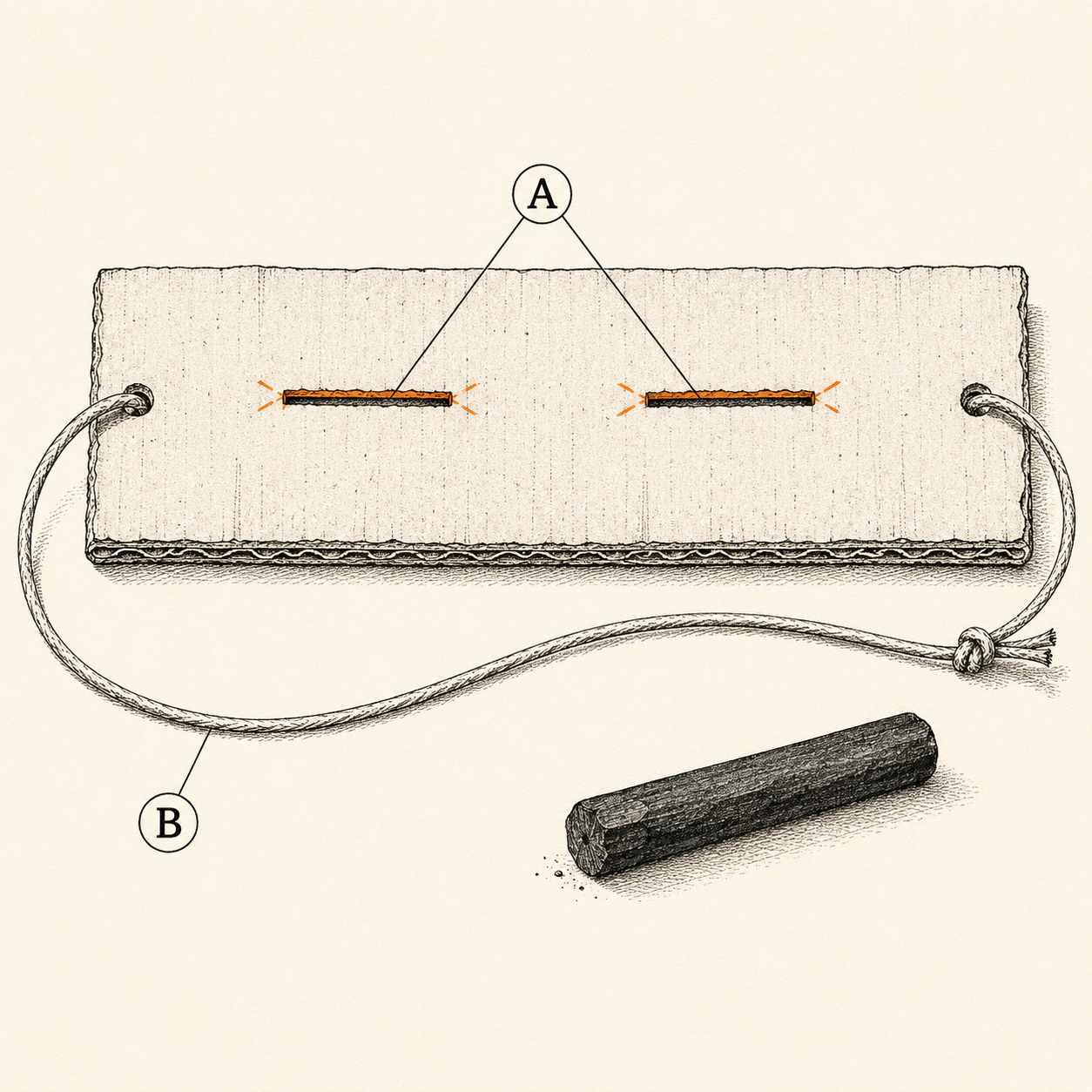
It’s a Chapter 40 party trick until the day the goggles blow off the sled.
Skin, hands, and the small miseries
The last shelf is the small-maintenance set: lip balm (already drafted), a mini tube of general balm or petroleum jelly (chafe, cracked fingertips, windburn: and it’s Chapter 8‘s fire starter moonlighting), and hand care doctrine, because split, sunburnt, or bitten hands fumble everything the kit needs done.
Chafe and cracking are mileage taxes: balm on hot spots (the same stop-now discipline as Chapter 25‘s blisters), and petroleum jelly’s twelve jobs per ounce make it the chapter’s honorary multiplier item (skin, fire, zipper lube, rust wipe for Chapter 23‘s carbon steel). Windburn and cold-crack respond to the same grease-and-cover logic as sunburn’s screen-and-shade. Insect-bite aftermath loops back to Chapter 25: antihistamine from the core five, clean short nails beating the scratch-infect cycle.
None of this is glamorous, which is the chapter’s closing point about its whole subject: exposure control is maintenance of the only tool in the kit you can’t replace, restock, or improvise. The hands, eyes, and skin are equipment; keep them serviced like it.
Pack This Chapter
- Exposure control is capability preservation: 3 oz (85 g) of repellent, sunscreen, mesh, and lenses keeps the operator functional.
- Picaridin 20% wins the kit slot (DEET-equal, gear-safe); DEET remains proven; concentration buys hours, not power. Wipes fit the small kits.
- Permethrin on clothing (never skin) kills ticks on contact: treat socks, pants, hems; tuck, lighten colors, check nightly.
- Head net over a brimmed hat: under an ounce, saves the night. SPF 30+ broad-spectrum plus lip balm, reapplied by the clock; multipliers at altitude, snow, water.
- UV400 sunglasses (spares in vehicle and go-bag); slit-goggles are the improvisation; snow blindness is real and temporary.
Where Kits Fail
- Comfort-gear contempt. The cut ounce returns as a burnt, bitten, sleepless operator. Exposure taxes compound.
- DEET on the gear pile. One leak and the watch crystal, shell coating, and light body are frosted. Picaridin, or DEET quarantined in its own bag.
- The aura theory of repellent. A dab behind the ears repels nothing. Coverage and reapplication are the entire mechanism.
- Dark lenses, no UV. Fashion lenses dilate pupils into the glare. UV rating or nothing.
Frequently asked
Which is better, DEET or picaridin?
Effectiveness ties at 20% picaridin versus 20–30% DEET for mosquitoes and ticks. Picaridin wins the kit on handling: no melted plastics, no grease, no odor. DEET’s decades of evidence keep it a fine choice if quarantined from synthetics. Either way, coverage and timely reapplication do the real work.
Do mosquito head nets really work?
Completely, for what repellent only mitigates: mesh is a wall, not a discouragement. Fine no-see-um mesh, dark in front of the eyes, worn over a brimmed hat so it stands off the skin, cinched at the neck. Under an ounce and walnut-packable: the best sleep insurance in bug country.
What SPF should a survival kit carry?
SPF 30+ broad-spectrum water-resistant, in stick or mini-tube form (leak-proof, freeze-tolerant), plus SPF lip balm. Application generosity and clock-based reapplication matter more than the number. Respect the multipliers: altitude, snow, and water can double your dose while the air feels cool.
How do you prevent snow blindness without goggles?
Improvise slit goggles: narrow horizontal slits cut in cardboard, bark, foam, or doubled duct tape, tied across the eyes, with charcoal smudged beneath them to cut glare. It’s the ancient design and it works. Then treat sunglasses as year-round kit gear, with a spare in the vehicle.