What can a pocket-scale kit actually do?
More than its size suggests: a well-built micro kit covers fire, cutting, signaling, light, and basic navigation in under 3 oz (85 g). It can’t shelter you or treat much water, and it never leaves you, which is the entire point.
Part III begins here, at the smallest end, on Chapter 3‘s logic: presence beats capability, and these are the kits that are always present. Each build below follows the same recipe this whole part uses: the container, the contents item by item with the reasoning shown, the finished weight and cost, and what the build deliberately leaves out. Nothing in these chapters is sacred; they’re worked examples of the method, meant to be adapted to your pockets, your climate, and your Chapter 4 answers.
A scope reminder for the micro scale: these kits are supplements to Layer 1’s loose carry (the real knife, the real lighter, the phone), not replacements. They shine when Layer 1 is stripped by circumstance: the gym, the borrowed jacket, the airline day (checked-bag versions, per Chapter 38).
Build one: the keychain kit
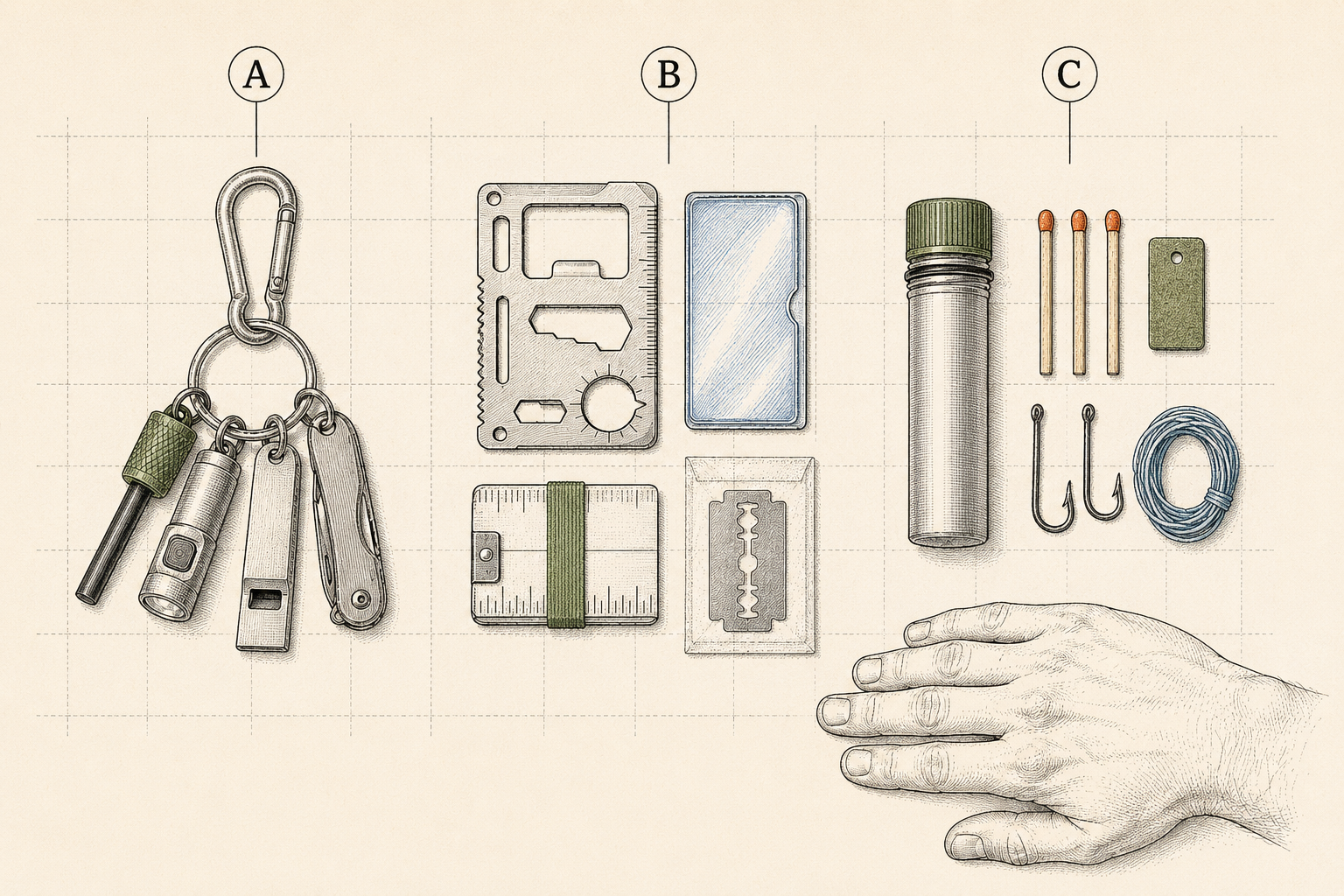
The keychain build hangs four functions on the ring you already carry: a micro ferro rod, a button light, a flat whistle, and a tiny blade or multitool charm, plus the ring itself as hardware. Total: about 2 oz (60 g) and $25–35.
The item-by-item, with reasoning:
| Item | Pick | Why |
|---|---|---|
| Fire | Micro ferro rod with striker bead | Works soaked and ignores years; the lighter in your pocket is primary, this is the always |
| Light | Coin-cell button light, twist or lockout switch | Finds keyholes, trailsides, and the real flashlight; spare cell taped at home (Ch. 9) |
| Signal | Flat micro whistle | Chapter 16‘s three blasts, always on your person |
| Cutting | Mini one-piece knife or keychain multitool charm | Envelope-and-cordage class cutting; legal in more places than a folder |
| Hardware | Small split rings + one mini carabiner | The carabiner clips the ring to belt loops and pack loops: lost-keys insurance that’s also kit retention |
The build notes: quality over cuteness on every item (Chapter 6‘s junk tells apply hardest at novelty sizes), the button compass joins the ring for anyone whose Chapter 4 audit includes trail time, and the whole assembly gets the shake test: if it rattles annoyingly or bulges the pocket, it will migrate to a drawer by March, and drawer kits protect drawers.
Build two: the wallet kit
The wallet build turns two card slots into capability: a flat multitool card, a Fresnel lens, folded duct tape, a razor blade in a card sleeve, and folded cash plus a contact card. About 1.5 oz (45 g) and $15–25, invisible until needed.
Contents and reasoning: the multitool card (a flat steel card of wrenches, edges, and openers) does light mechanical work and passes as a bookmark; the Fresnel lens (Chapter 7‘s sunny-day fire and a magnifier for splinters and fine print); duct tape (3 ft / 1 m re-folded flat, per Chapter 27, for repairs and blister saves); a single-edge razor blade sleeved in folded card stock (real cutting where the multitool card scrapes: check local rules and strip it for air travel); cash in small bills (the disaster economy runs on it when terminals die, a Chapter 34 preview); and the contact card: home, out-of-area contact, medications and allergies, written plainly, because the wallet kit’s likeliest emergency is you being found unable to speak for yourself.
The two-item version for minimalists: the lens and the cash. The wallet kit’s deeper value is philosophical anyway: it proves the method scales to any container, which is the mindset this part exists to install.
Build three: the pocket tube
The tube build packs a waterproof cylinder (a repurposed medicine bottle or purpose tube) with the wet-fragile micro items: stormproof matches and striker, tinder tabs, water tablets, hooks and line, needles, and a rolled bill. About 2 oz (60 g), $15–20, and it seals.
The tube earns its place as the micro scale’s waterproof annex: everything in it is something the keychain and wallet can’t keep dry. Packing order matters in a cylinder (last in, first out): tinder at the bottom (needed with fire, which means matches are out anyway), then hooks-and-line in a mini bag, tablets in their foil, matches and striker on top with the striker taped to the cap’s underside. A strip of duct tape wraps the tube’s outside (storage that’s also waterproofing’s second gasket), and bright tape or cord marks it findable.
Variants by Chapter 4 audit: the angler’s tube leans tackle; the traveler’s tube swaps hooks for meds and a spare card of cash; the winter tube doubles tinder and adds a birthday-candle stub. The container rule from Chapter 5 applies in miniature: genuinely waterproof (test it submerged), pocket-honest (round tubes ride better in coin pockets and pouches than square), and sized to finish: a half-empty tube rattles and invites junk.
What micro kits leave out, on purpose
No shelter, no real water carriage, no first aid beyond a bandage, no food: the micro scale can’t do those jobs, and pretending otherwise builds worse kits. The honest micro kit does five functions well and delegates the rest upward.
This is the part of micro-kit culture that goes wrong most often: the pill bottle stuffed with forty items doing nothing well, the credit-card knife that cuts like a credit card, the “survival grenade” of wound paracord hiding a rusting assortment. Capability theater, per Chapter 3. The audit discipline is the same as every layer (each item justifies itself against the six functions), plus the micro-specific test: does this item work at this size? A two-inch wire saw doesn’t. A button compass does.
What the micro layer delegates upward it should also advertise: pairing notes. The keychain assumes your pocket lighter. The wallet kit assumes the tin (Chapter 30) on any real outing. Written on the contact card or simply known, the pairings keep the system honest.
Carrying, sealing, and the pocket audit
Micro kits live by the same maintenance rules as their big siblings, compressed: seal what needs sealing, shake-test what rattles, and audit twice a year on Chapter 41‘s calendar, plus the pocket audit: once a month, notice whether it’s actually still with you.
The pocket audit is the micro layer’s special discipline, because these kits fail by evaporation: the whistle migrates to the junk drawer, the tape gets used and not re-folded, the button cell dies at two years silently. The monthly noticing (it’s on the keys; the wallet card’s still there; the tube’s in the coat that’s now in storage: move it) takes ten seconds and is the entire difference between owning micro kits and having once assembled them.
Seasonal note: coats. Half the micro layer’s real estate is outerwear pockets, and outerwear rotates seasonally, which orphans kits every spring. The season-swap calendar from Chapter 4 gets one added line: sweep the retired coats.
Cost, weight, and the whole micro layer
All three builds together: roughly 5.5 oz (155 g) and $55–80, covering fire, cutting, light, signaling, navigation, water treatment, tinder, repair, and fishing at always-carried scale. As a system, they’re the cheapest insurance in this book.
The point of totaling them is the argument it makes: the entire micro layer costs less than one mid-tier gadget and weighs less than a candy bar, and it’s the layer statistics favor, because it’s the layer that’s present for the unplanned emergencies that dominate real incidents. Build all three in one weekend evening; the tube and wallet kit assemble from a drugstore run plus Chapter 27‘s shelf.
Then stop. The micro layer resists the upgrade spiral by design: there’s no premium keychain whistle worth chasing. Spend future gear money upward (Chapter 30‘s tin is next), and spend the saved attention on Chapter 40‘s skills, which are the only micro-scale upgrade that compounds.
Pack This Chapter
- Micro kits cover fire, cutting, light, signal, and navigation in under 3 oz (85 g); they delegate shelter, water carriage, and first aid upward, on purpose.
- Keychain build: micro ferro rod, button light, flat whistle, mini blade, carabiner ($25–35). Quality over novelty; shake-test it.
- Wallet build: tool card, Fresnel lens, flat tape, sleeved razor, cash, contact card. The contact card may be the most important item in this chapter.
- Tube build: the waterproof annex: matches, tinder, tablets, hooks, needles, sealed and taped. Test it submerged.
- Monthly pocket audit and the coat sweep keep the layer real. Total layer: ~5.5 oz (155 g), $55–80.
Where Kits Fail
- Capability theater. Forty items in a pill bottle, none functional at size. Five functions done well beat fifteen pretended.
- Evaporation. Micro kits die by migration: the drawer, the retired coat, the borrowed keys. The monthly notice is the defense.
- The novelty tool. Credit-card knives that cut like credit cards. Every item passes the works-at-this-size test or stays home.
- No pairing plan. The keychain assumes the lighter; the wallet assumes the tin. Unwritten assumptions are how functions fall through the cracks.
Frequently asked
What goes in a keychain survival kit?
A micro ferro rod with striker, a coin-cell button light, a flat pealess whistle, and a small one-piece blade or multitool charm, joined by a mini carabiner that clips the ring to belt loops. About 2 oz (60 g) covers fire, light, signaling, and cutting everywhere your keys go.
Are wallet survival kits useful or gimmicks?
Useful if built honestly: a Fresnel lens (fire and magnification), 3 ft (1 m) of flat-folded duct tape, a flat tool card, small-bill cash, and a contact card with medical information. The gimmick versions fail the works-at-this-size test; a credit-card “knife” mostly proves the point.
How do you waterproof a small survival kit?
Give the wet-fragile items their own sealed cylinder: a gasketed tube or medicine bottle holding matches, striker, tinder, and tablets, wrapped outside with duct tape as bonus storage and second seal. Test it submerged for ten minutes with a paper scrap inside. The keychain items don’t care about water; the tube’s contents do.
What’s the minimum survival kit possible?
A lighter, a button compass, a whistle, and a blade on your person, plus knowledge. That’s four functions at almost zero weight. Everything else in this chapter is that skeleton dressed for weather, water, and repair. The honest minimum is whatever you will actually, verifiably, always have with you.