What are the Ten Essentials?
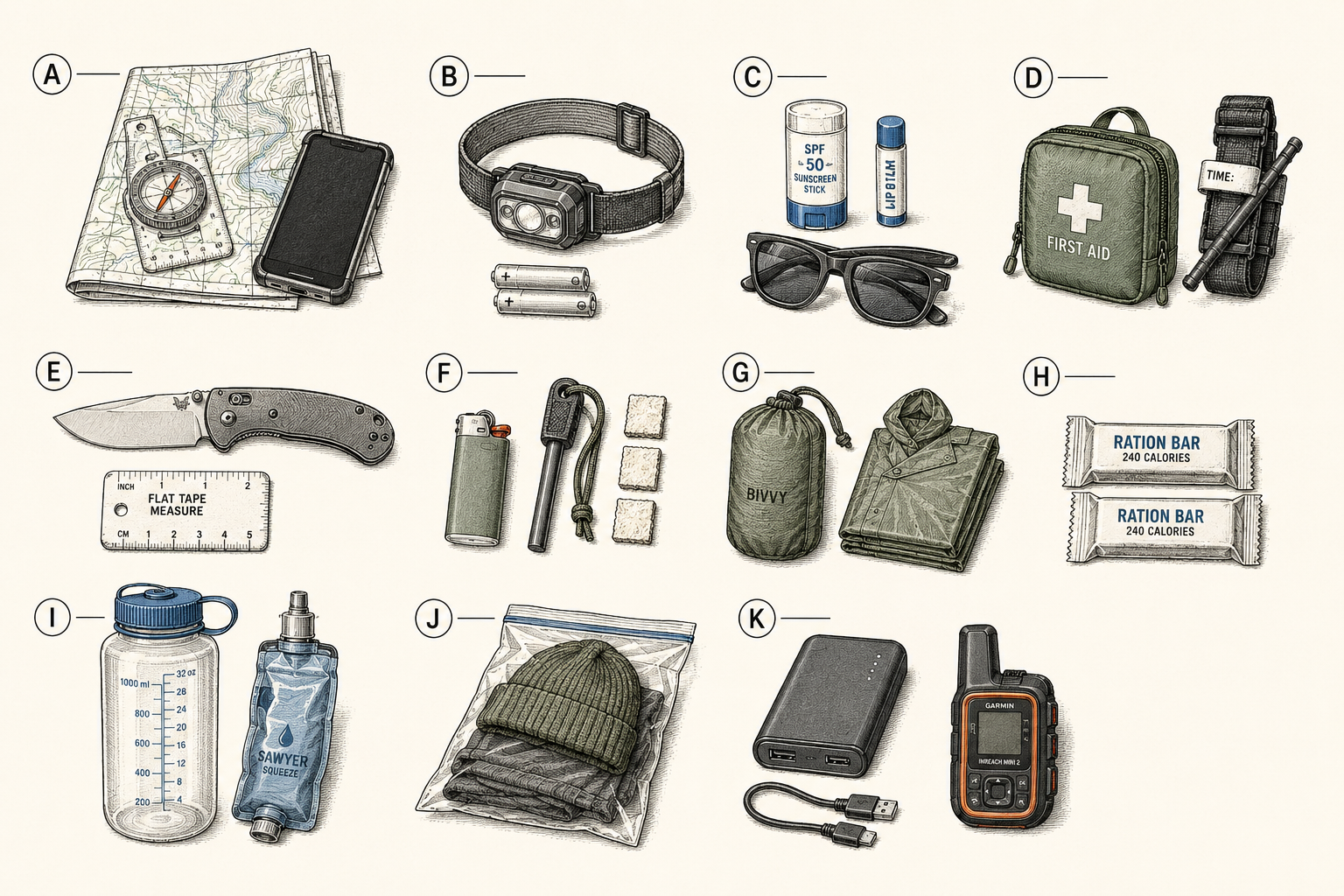
The Ten Essentials are the classic day-pack checklist, best known in the systems version published by The Mountaineers: navigation, headlamp, sun protection, first aid, knife, fire, shelter, extra food, extra water, extra clothes. This chapter builds them into a modern kit and adds the eleventh that changed everything: communication.
The list earns its fame honestly: it was distilled from decades of incident reports asking two questions: can you respond to an emergency, and can you spend an unplanned night out? Every item answers one or both. The “systems” framing (navigation rather than “a map,” shelter rather than “a tarp”) is the same functions-not-objects doctrine this book opened with, which is why the Essentials and the six survival functions map onto each other so cleanly.
The build target: a day-hike kit of 3–5 lb (1.4–2.3 kg) beyond water, living permanently in the day pack so that “packing” for a hike means adding lunch and leaving. Permanence is the trick; kits assembled per-trip are kits forgotten per-trip.
The modern systems, one through five
1. Navigation: phone with offline maps (Chapter 19) plus paper map and baseplate compass (Chapter 18), plus the trip plan filed with a person (Chapter 17). 2. Headlamp: with lithium spares; benightment is the classic day-hike emergency, and Chapter 9‘s low-mode doctrine applies. 3. Sun protection: Chapter 28 complete: screen, lip balm, sunglasses, hat. 4. First aid: Chapter 25‘s kit plus, at this book’s insistence, Chapter 26‘s bleeding module: the modern list’s biggest upgrade. 5. Knife: plus the repair sliver of Chapter 27 (tape card, ties, pins).
The commentary these five deserve: navigation is the system most transformed by the phone and most dependent on the download habit; do the two-minute airplane-mode check before every unfamiliar trailhead. The headlamp is the item day-hikers skip most and need most: the majority of lost-hiker incidents begin with darkness arriving on schedule while the hike didn’t. And the bleeding module’s promotion into day-pack doctrine reflects Chapter 26‘s whole argument: the trailhead parking lot and the switchback are exactly where tourniquets get used.
The modern systems, six through ten
6. Fire: lighter, ferro rod, and tinder per Chapter 7‘s two-families rule. 7. Shelter: the emergency bivvy (Chapter 20), plus a poncho that moonlights. 8. Extra food: 500–800 calories beyond lunch, no-cook (Chapter 13‘s bar logic). 9. Extra water: a liter beyond the day’s plan, plus the squeeze filter or tablets (Chapters 11–12). 10. Extra clothes: the sealed spare (Chapter 21) sized to season: cap, gloves, base layer, and the insulation piece the forecast argues about.
The classic mistake in six-through-ten is scaling them to the plan instead of the failure: extra food for a longer lunch rather than a night out; extra clothes for a chilly summit rather than fourteen motionless hours at 3 a.m. The Essentials are an emergency’s shopping list, not the day’s. Size them against Chapter 2‘s question (what kills first out here tonight?) and the ounces argue themselves.
11. Communication, the modern addition this book makes standard: the charged phone, the power bank (Chapter 10), and for anyone past cell coverage regularly, the satellite layer (Chapter 17). The Mountaineers’ list predates the satellite era; your kit shouldn’t.
The pack itself and the permanence rule
Any 15–25 L daypack holds the Essentials with lunch room to spare; the pack’s real spec is that the kit never leaves it. Dedicated kit, dedicated pack, permanently married: that’s the system that’s present at the trailhead.
The permanence rule deserves its own section because it’s the difference between owning the Essentials and hiking with them. The failure pattern: gear pooled with household equipment gets borrowed (the headlamp to the garage, the filter to the camping bin), and the day the hike happens, reassembly doesn’t. The fix costs one set of duplicates: kit gear is kit gear, the pack hangs loaded, and the pre-trip ritual shrinks to water, lunch, weather-word on the clothing bag, and the airplane-mode map check.
Pack-craft notes: the Essentials live in 2–3 stuff sacks or zip bags by function (the access-probability logic of Chapter 31 scaled up: shelter-and-fire sack, first-aid-and-repair sack, the clothing bag), heavy items ride high and against your back, and the bleeding module obeys Chapter 26‘s reach test even here: lid pocket or hipbelt, never the bottom.
Trailhead doctrine
The kit works when paired with four trailhead habits: file the plan (two sentences, one person, per Chapter 17), pin the car (Chapter 19), check the download, and glance at the sky-and-layers question once before walking. Ninety seconds, total.
These four habits convert gear into a system, and they’re worth ritualizing because the day hike’s danger is precisely its casualness: nobody files a plan for a familiar four-miler, and the incident statistics are full of familiar four-milers. The plan text costs a thumb-swipe (“Blue Lake loop, back by 6, call county if silent by 9”). The car pin ends the parking-lot-shuffle that closes so many long days badly. The download check is Chapter 19‘s two minutes. The sky glance is Chapter 4‘s audit compressed to a breath: what’s the worst plausible weather before dark, and does the clothing bag answer it?
Then walk. The entire apparatus of this chapter exists to be ignored pleasantly for years, which is the correct experience of insurance.
Scaling: companions, kids, dogs, and seasons
The kit scales by copies, not by growth: each adult carries their own Essentials core (separation happens; Chapter 3‘s logic), kids carry age-scaled versions plus whistle-and-stay-put training, and dogs carry nothing this book will pretend is reliable. Seasons swap the clothing bag and the traction question.
Companion doctrine, expanded: the group may share big items (one filter, one full first aid kit, one messenger), but shelter, whistle, light, water, and fire ride per-person, because groups separate exactly when things go wrong. Kids’ versions (Chapter 39 details them) center on the whistle, a light, a mylar blanket, water, a snack, and the drilled instruction that beats all gear: when lost, stop, hug a tree, blow threes. The family that practices that drill owns something no pack contains.
Seasonal swaps run through the clothing bag and one added question per season: traction devices and the earlier-dark math in winter (headlamp checked, not assumed), water doubled and the Chapter 4 heat doctrine in summer, and in fire season, the region’s closure map checked with the weather.
Pack This Chapter
- The Ten Essentials are systems: navigation, light, sun, first aid, knife, fire, shelter, extra food, water, clothes: plus this book’s eleventh, communication.
- Size the extras against the unplanned night, not the planned lunch. The bleeding module is a day-pack item now.
- 3–5 lb (1.4–2.3 kg) beyond water, permanently married to a dedicated pack: duplicates are the price of presence.
- Trailhead ritual, ninety seconds: file the plan, pin the car, check the download, ask the sky-and-layers question.
- Scale by copies: per-person cores, kid versions built around whistle-and-stay-put, seasonal swaps through the clothing bag.
Where Kits Fail
- The borrowed headlamp. Pooled gear disassembles kits silently. Kit gear is kit gear; buy the duplicate.
- Extras scaled to the plan. Lunch-plus-a-bar meets a fourteen-hour night. The Essentials shop for the emergency, not the itinerary.
- The familiar-trail exemption. No plan filed for the four-miler you know: the exact profile of the incident reports. Two sentences, every time.
- Group gear, group separation. One shared light and shelter, two directions of travel at dusk. Cores are per-person.
Frequently asked
What are the Ten Essentials for day hiking?
Navigation, headlamp, sun protection, first aid, knife, fire, emergency shelter, extra food, extra water, and extra clothes: the systems version popularized by The Mountaineers. This book adds communication (charged phone, power bank, satellite layer when you leave coverage) as the modern eleventh.
How heavy should a day-hike emergency kit be?
Three to five pounds (1.4–2.3 kg) beyond water buys the full Essentials with modern gear: bivvy-class shelter, real first aid with a bleeding module, fire redundancy, filter, headlamp, and spare layers. Ultralight trimming below that is a skills-for-ounces trade; make it knowingly.
Do I really need all ten on a short hike?
The incident data’s answer is blunt: short, familiar hikes produce the emergencies, because they’re where plans, extra layers, and lights get skipped. The kit weighs a few pounds and lives in the pack permanently, so carrying it costs one decision made once. That’s the entire point of the list.
What should kids carry on a hike?
An age-scaled core: whistle on a breakaway lanyard, a small light, a mylar blanket, water, a snack, and a card with their name and your contacts, plus the drilled rule that outperforms gear: when lost, stop where you are, stay put, and blow three whistle blasts. Practice it as a game.