What should a car emergency kit include?
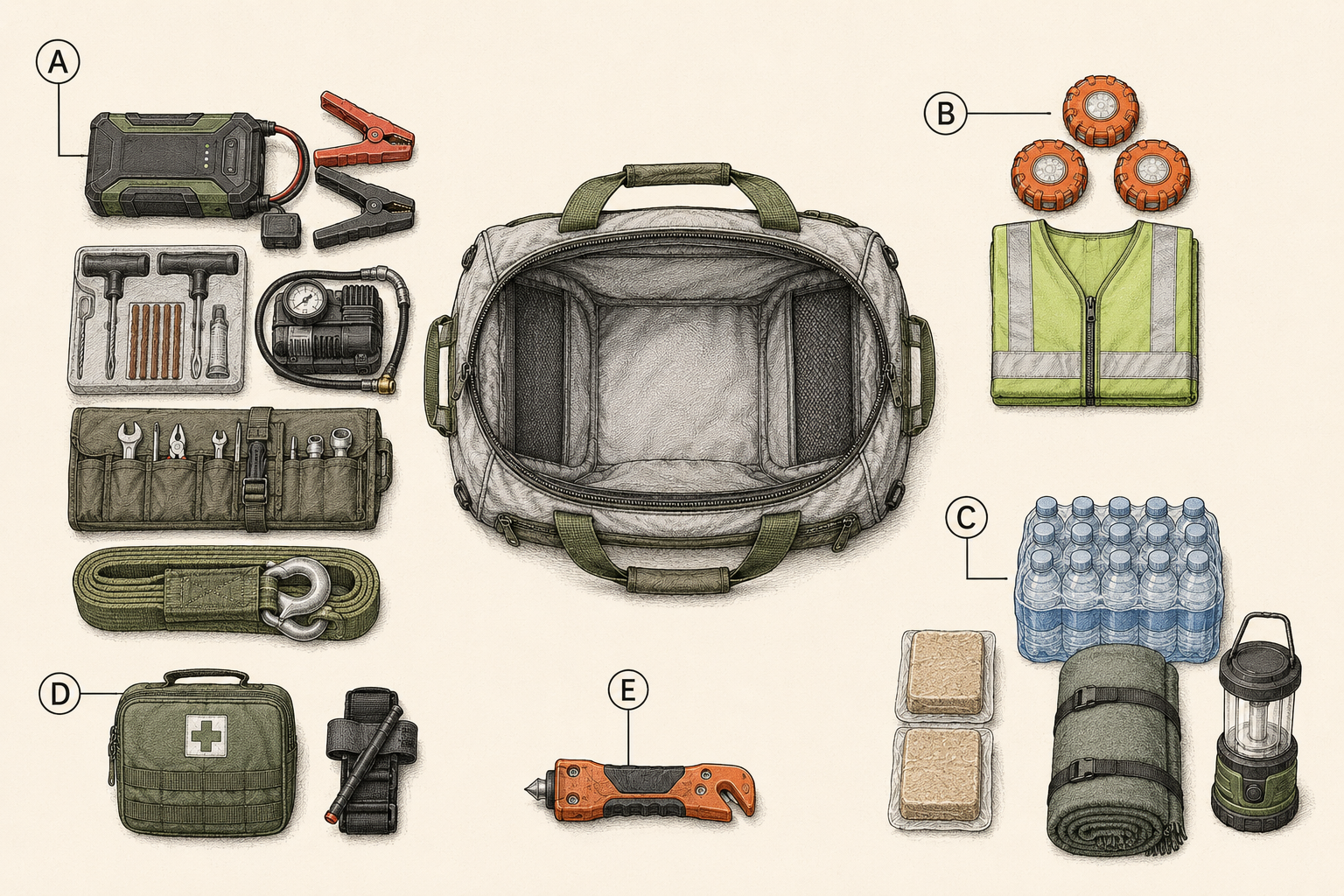
Four modules: breakdown gear (jump pack, tools, tire kit, tow strap), visibility gear (LED flares, vest, triangle), the human module (water, blanket, food, first aid, light), and the mounted rescue tool at the driver’s reach. The car kit answers the most statistically likely emergencies in this book.
The vehicle is where preparedness math gets friendly: weight barely matters, the kit rides everywhere you drive, and the scenarios (breakdowns, crashes, strandings, weather closures) are common enough that the kit pays for itself in ordinary years. It’s also where Chapter 5‘s container rule matters most: loose supplies rolling in a trunk are not a kit. One duffel you can lift one-handed, one hard case for the crushables, staged so the grab is a motion, not an excavation. One motion is the spec.
The build below assumes a general climate; Chapter 36 stacks the winter module on top, and Chapter 37 handles the vehicles that float, fly, and off-road.
The breakdown module
The self-rescue tools: a lithium jump pack (Chapter 10‘s star), a tire kit (plug kit + 12 V compressor, plus the spare’s tools actually checked), basic hand tools, work gloves, a tow strap, duct tape and zip ties, and a headlamp because every breakdown is a two-hand job in the dark.
The jump pack replaced the good-Samaritan cable dance: it starts the car alone, charges phones, and joins the recharge calendar (Chapter 41) like every stored battery. The tire reality check most drivers skip: does the spare exist (many modern cars ship without), does it hold air (check on the calendar), and do the jack and the wrench actually fit this car’s lugs (locking lugs need their key; discover this in the driveway, because driveways forgive mistakes and shoulders don’t). The plug-kit-and-compressor pair fixes the common nail-puncture without a wheel change at all, which on a highway shoulder is a safety upgrade as much as a convenience.
Tools stay honest: pliers, drivers, an adjustable wrench, a utility knife: the roll that fixes trim, hoses, and battery terminals, not a mechanic’s fantasy chest. Fluids per your car’s age (a quart of oil, coolant, washer fluid), and the tow strap rated for vehicles with the shackle points located before the mud day.
The visibility module
A stopped car near traffic is the scenario that kills, so visibility gear stages first: LED flare pucks or triangles deployed far behind the car, a high-visibility vest worn before stepping out, and the discipline of exiting away from traffic.
The distances that matter: warning devices start 100–200 ft (30–60 m) behind the vehicle on ordinary roads and 300+ ft (90+ m) at highway speeds, because drivers need seconds, not car-lengths, to react. Distance buys those seconds. LED pucks (magnetic, rechargeable or lithium-loaded) have largely retired pyrotechnic flares for this job (no fire risk, no expiry drama), though one or two classic flares remain aboard in this build for their weather-proof brightness and their Chapter 7 fire résumé.
The vest costs five dollars and changes how traffic reads you; it lives in the door pocket, not the trunk, because the trunk is on the traffic side half the time. Always the door pocket. The behavioral half of the module outweighs the gear: hazards on early, car off the travel lane if it moves at all, wheels turned away, exits on the shoulder side, and nobody stands between two vehicles. That rule has no exceptions.
The human module
The people-keeping supplies: a case of water bottles (freeze-tolerant, per Chapter 12), ration bars, a real wool or fleece blanket per seat plus mylar backups, the pack-grade first aid kit with Chapter 26‘s bleeding module, a headlamp and lantern, phone cables, cash, and the boredom kit if kids ride.
This is the module that turns strandings from crises into stories: the road closure that holds you four hours, the ferry line, the weather wait. Its design run: water in single-serving bottles (they tolerate freezing and hand out), calories in Chapter 13‘s indestructible tier (heat-rotated yearly), warmth in real textiles (mylar supplements; it doesn’t comfort a scared kid), and light in the room-filling lantern class alongside the task headlamp.
First aid at vehicle scale earns its upgrade because the road is where trauma statistics live: the full Chapter 25 kit, the complete bleeding module in reach (below), and the elastic-and-splint extras the trunk can afford. Cash in small bills; a phone cable that isn’t the frayed one; and the kid module (snacks, entertainment, spare clothes by age) sized to your actual passengers. Pack for the people you haul.
The rescue tool and cabin staging
One item mounts in the cabin, not the kit: the seatbelt-cutter-and-window-breaker, fixed within the belted driver’s reach, because its scenario (submersion, entrapment, fire) allows no trunk trip. The cabin also stages the vest, a flashlight, and the first aid module’s location knowledge.
The tool: a spring-loaded center punch or hammer-point plus a shielded hook blade, mounted on the console, door, or column: mounted, because a glovebox tool becomes a projectile in the crash that makes it necessary, and a loose tool is wherever the crash threw it. Window doctrine, learned now: tempered side windows shatter at a corner strike; windshields are laminated and don’t (aim side glass, always).
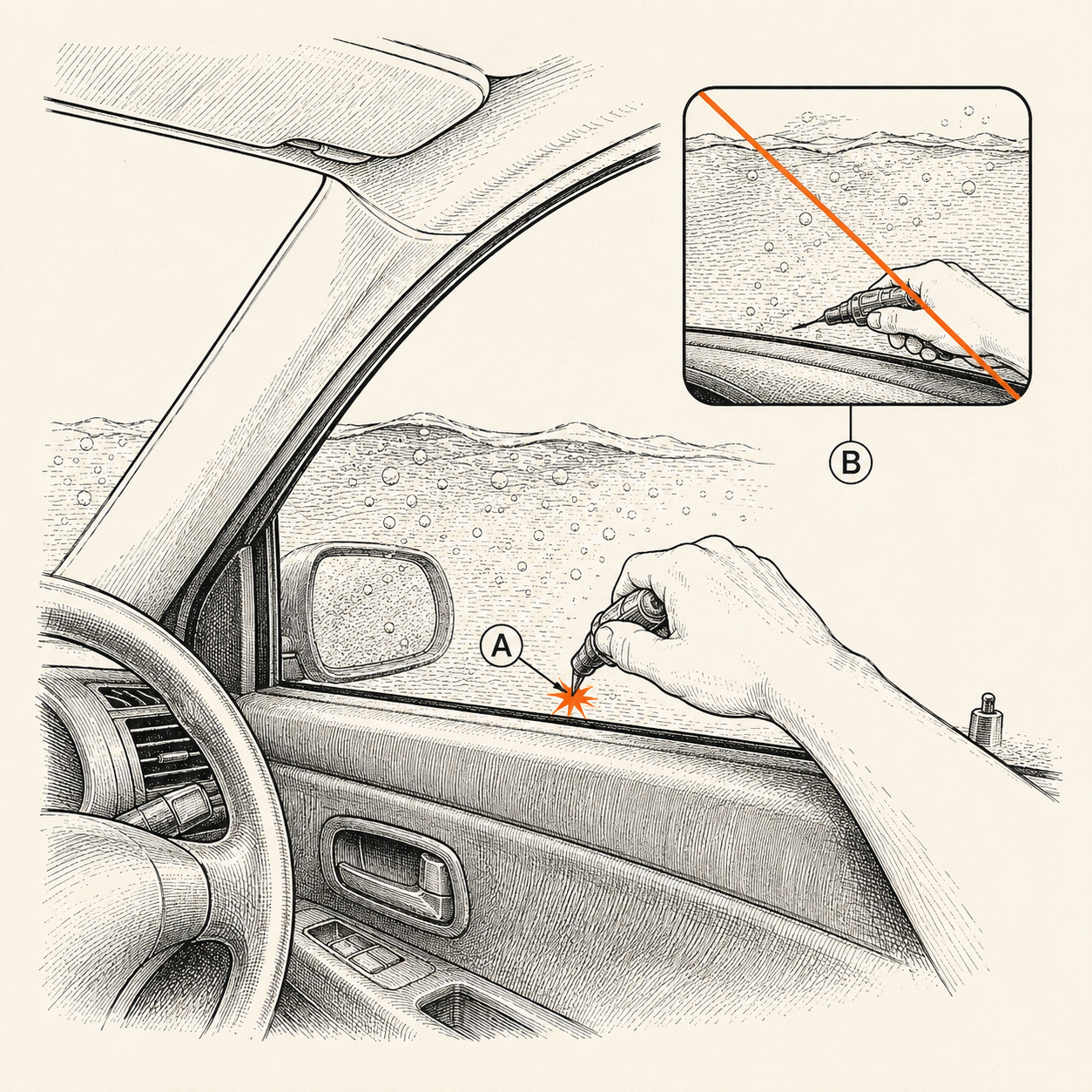
In water, the sequence taught by every rescue body: belts off, windows open or broken early (electric windows often work briefly; glass breaks easily only before pressure equalizes), children first, out and up.
Cabin staging completes the reach-test audit: vest in the door pocket, a flashlight in the console, and every licensed driver in the household knowing where the first aid module rides. The trunk carries the kit; the cabin carries the seconds.
Living with the car kit
The car kit’s enemies are heat, borrowing, and drift: batteries and adhesives cook in trunks (rotate on the calendar), contents wander into household service (the duffel discipline and a manifest card fight back), and the kit built for one car quietly fails to move when the car does.
The maintenance rhythm, folded into Chapter 41‘s calendar: twice-yearly full audit (water swapped, food dates, jump pack charged, tire kit present, lights tested), plus the seasonal module swap from Chapter 4 (the winter add-on of Chapter 36 in and out). Heat is the silent variable: the trunk that hits oven temperatures each summer ages food, meds, tape, and batteries at multiples of shelf rate, which is why vehicle consumables rotate yearly where house consumables rotate on their labels.
The transfer rule: the kit belongs to the household, not the vehicle: it moves with rentals, borrowed trucks, and new cars, which is exactly what the one-duffel architecture makes a thirty-second job. Move it every time. And the family note: everyone who drives the car knows the duffel exists, where the rescue tool mounts, and what the vest is for: a kit only the buyer knows about protects one person badly. Brief the household this weekend.
Pack This Chapter
- Four modules: breakdown (jump pack, tire kit, tools, strap), visibility (pucks, vest-in-door, distances that matter), human (water, real blanket, rations, first aid), and the mounted rescue tool.
- One duffel, one motion: loose trunk supplies are not a kit. Hard case for crushables; manifest card inside.
- Traffic is the killer scenario: warning gear at 100–300+ ft (30–90+ m), vest before exiting, and stay belted inside if the car sits in a live lane.
- The rescue tool mounts at the driver’s reach: side glass at a corner, belts first in water, early.
- Heat ages everything: vehicle consumables rotate yearly; jump pack and lights join the recharge calendar; the kit transfers with the household.
Where Kits Fail
- The scattered trunk. Supplies everywhere, kit nowhere, at night in the rain. The duffel is the kit.
- The glovebox rescue tool. In the crash it’s needed for, it’s under a seat three feet and one universe away. Mounted, or it’s decorative.
- The July-cooked module. Chocolate-coated everything, swollen batteries, limp tape. Vehicle rotation is yearly, not aspirational.
- The one-person secret. A kit the spouse and teen drivers have never opened. The household briefing is part of the build.
Frequently asked
What are the most important things to keep in your car?
A lithium jump pack, a tire plug kit with compressor, LED warning pucks and a vest (vest in the door pocket), water and ration bars, a real blanket, a first aid kit with a bleeding module staged in cabin reach, a headlamp, and a seatbelt-cutter window-breaker mounted at the driver’s seat.
Do I need road flares or are LED ones enough?
LED pucks cover the visibility job better for most drivers: no fire risk, no expiration urgency, magnetic mounting. This build keeps one or two pyrotechnic flares anyway for all-weather brightness and their emergency fire-starting value: with the fire discipline any burning device demands roadside.
Where should a car first aid kit be kept?
In cabin reach, not the trunk: door pocket, seat-back organizer, or console: because crash-scenario seconds don’t include a walk to the tailgate. The deeper first aid depth can ride in the duffel; the bleeding module obeys Chapter 26’s reach test wherever the vehicle goes.
How do you break a car window in an emergency?
With a mounted tool: strike a corner of a side window (tempered glass shatters at a point strike; laminated windshields don’t break usefully), clear the edge, exit. In water: seatbelts off first, windows open or broken early before pressure builds, children out first, then up. Mount the tool now; practice the reach blind.