What goes in a winter car kit?
The Chapter 35 kit plus the winter module: real insulation per seat (sleeping bag or wool blankets), a snow shovel, traction aid, a metal cup and candle heat source, extra calories, winter clothing you could walk in, and the half-tank fuel rule as standing policy.
Winter converts the ordinary breakdown into the exposure scenario of Chapter 2: the car that would be an annoying wait in July becomes a cold box on a closed road in January, and the kit’s job flips from “fix it” to “outlast it warmly.” The module below assumes the base kit exists; it adds the heat, the digging, and the doctrine. It goes in with the Chapter 4 season swap and comes out the same way, which is also when its contents get audited.
The standing policies that cost nothing: fuel never below half in winter (fuel is heat), the phone charged before mountain and rural legs, and the household rule that winter road trips file the same two-sentence plan as hikes (Chapter 17): route, ETA, call-if-silent hour.
The warmth math
Plan insulation for motionless hours at your region’s worst plausible night: a sleeping bag or two wool blankets per seat, insulation from the seat itself (foam pad), dry socks and gloves staged, and chemical warmers by the box, because a parked car is a metal tent with windows.
The car’s thermal reality: it blocks wind completely (a huge Chapter 2 win) and insulates almost nothing, so interior temperature walks toward ambient within the hour when the engine stops. The countermeasures mirror Chapter 20‘s shelter system: under matters (the foam pad on the seat fights conduction into cold upholstery), around matters (bags beat blankets; blankets beat mylar; mylar over either adds its reflection), and together matters (occupants sharing a back seat share heat; the one-room-warm plan of Chapter 34, automotive edition).
The staged-clothing rule fixes winter’s commuter trap: the driver dressed for a heated cabin (dress shoes, light jacket) is dressed for neither shoveling nor walking. A trunk bag with real boots, gloves, a knit cap, and an insulated layer per regular occupant turns the office outfit back into survivable clothing in ninety seconds.
Heat: the engine, the candle, and the rules
Heat sources rank by risk: the engine (10–15 minutes per hour, exhaust cleared, window cracked), the candle-and-can (real warmth, open-flame respect), and chemical warmers (safe, targeted, finite). All three live under the carbon monoxide law.
The idling protocol, spelled out because it’s the classic winter killer: before each engine run, clear the exhaust pipe (drifting snow buries it and feeds CO into the cabin), crack a window on the downwind side, run 10–15 minutes for heat and phone charging, then off: which stretches a half tank across a long night while keeping CO risk managed. A battery CO alarm in the winter module is cheap paranoia of the correct kind.
The candle heater (Chapter 8‘s multi-wick can, or tea lights in the metal cup) genuinely raises a car’s cabin by useful degrees and doubles as morale light; it demands the open-flame rules (stable surface, cleared dash, out before sleep, window cracked).
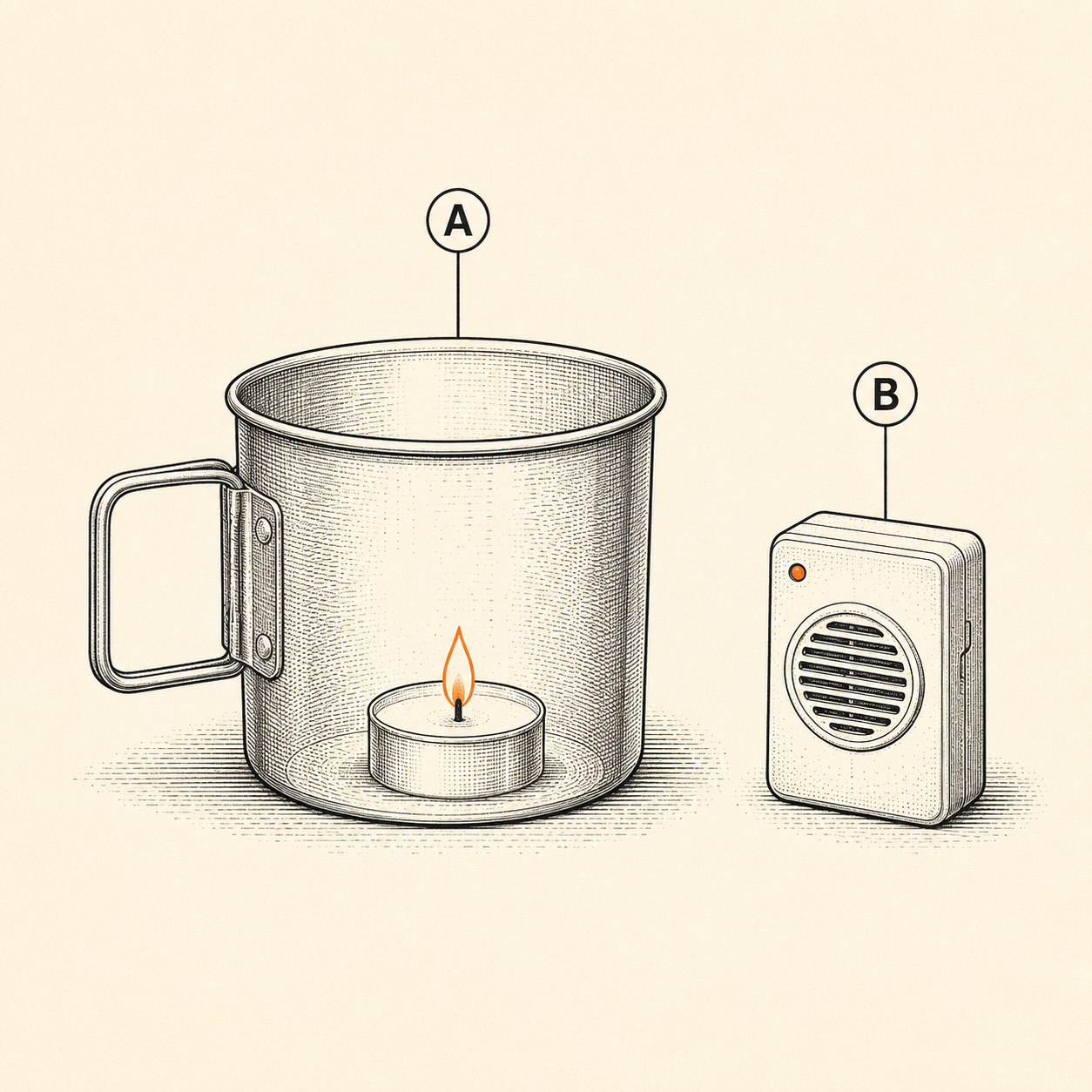
Warmers go to extremities per Chapter 21 (hands that work zippers, boots at the toes), and the ranking closes with the reminder that food is heat: the module’s extra calories (Chapter 13‘s densest tier) are fuel for the furnace you already own.
Stuck in snow: the self-rescue sequence
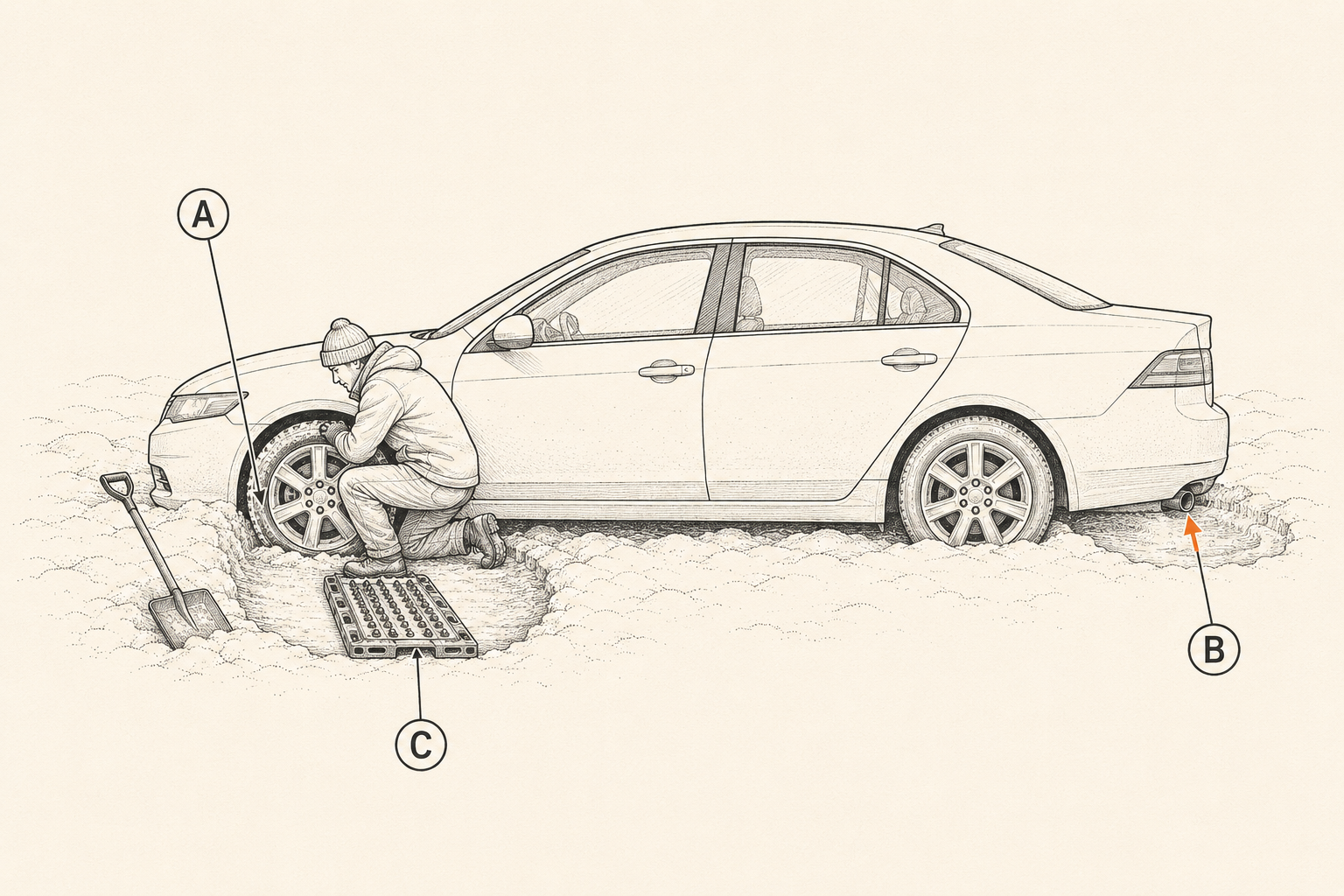
The sequence: stop spinning immediately, dig the wheels and the exhaust, lay traction, clear a straight path, rock gently in the lowest gear, and know when to stop burning fuel and start staying warm. Ten minutes of shovel beats forty of throttle.
- Stop the spin. Spinning polishes ice under the tires and digs the car deeper. The moment traction fails, stop.
- Dig. Shovel snow from ahead of (or behind) all driving wheels, from under the frame if it’s high-centered, and always from the exhaust.
- Lay traction. Purpose traction boards, kitty litter or sand, or the floor mats (carpet-side to tire, and expect to sacrifice them) in the travel direction.
- Straighten and rock. Wheels straight, lowest gear (or highest the transmission offers for gentle starts), a rhythm of gentle forward-and-back, never a launch. Passengers push on the rocking beat if footing is safe.
- Call it. Two or three failed cycles means the situation wants a tow, not a transmission. Save the fuel for heat and the muscles for staying dry: wet clothes from shoveling are the Chapter 2 trap wearing a helpful face.
The stranded doctrine that follows: stay with the car. It’s shelter, visibility (a car is findable; a walker in a whiteout is not), and the location every plow and plate-reader will check. Walking out is for visible-destination, known-distance, good-conditions cases only, and the trunk boots exist for exactly that judgment call.
The snowmobile and winter-trail variant
Machines that leave the road invert the doctrine: the vehicle is small, the exposure is total, and the kit rides on the body, not the machine, because rider and sled separate exactly when things go wrong. Build it as Chapter 31‘s pouch worn plus a machine bag.
The snowmobile/winter-ATV reality: high speeds, remote terrain, and a machine that ends up in the creek, under the snow, or fifty yards away. The split that follows: on the rider (the pouch kit worn: fire doubled per wet-cold rules, whistle, mirror, bivvy, the satellite layer of Chapter 17 for anyone riding real backcountry, and avalanche gear where terrain earns it: with the training that makes beacons more than jewelry); on the machine (the bag: shovel, saw, spare gloves and goggles, tow strap, tools and plugs for the machine, the candle-and-cup, rations).
The group doctrine borrowed from Chapter 32: machines travel in pairs in the backcountry, plans get filed, and the party’s spacing respects terrain (one machine per slope in avalanche country: a rule written in hard lessons). Chapter 37 extends the machine logic to ATVs and the water world.
Driving into winter: prevention as kit
The winter module’s cheapest items are policies: winter tires where winters are real, the half-tank rule, weather-window planning for mountain legs, and the humility to wait out what plows haven’t met. The best stranding is the scheduled coffee stop that replaced it.
This book is a gear book, so its prevention sermon stays short and specific. Winter tires change stopping and climbing physics enough that they’re the single biggest winter-safety purchase for snow-country drivers, kit included. Chains or approved alternatives ride where law and passes demand (practiced once in the driveway, per the universal Chapter 40 rule). The forecast check before rural winter legs is the two-minute version of Chapter 4‘s audit, and the turn-around decision it sometimes produces is the chapter’s whole doctrine expressed as driving.
And the phone note that completes the loop: winter is where Chapter 10‘s cold-battery warning bites hardest: the phone lives warm, the cable lives in the console, and the jump pack’s cold-cranking claim was a Chapter 6 buying criterion, not a surprise.
Pack This Chapter
- Winter module on top of the base kit: bag-or-blankets per seat, foam pad, shovel, traction, candle-and-cup heat, dense calories, and a walkable clothing bag.
- Heat ranks: engine in 10–15 minute cycles (exhaust cleared, window cracked, CO alarm), candle with open-flame rules, warmers to extremities. Never sleep with either running.
- Stuck sequence: stop spinning, dig (wheels and pipe), lay traction, rock gently, and call it early. Stay with the car; it’s shelter and findability.
- Off-road winter machines split the kit: survival on the body, repair on the machine, satellite and avalanche gear where terrain demands.
- Policies are kit: half-tank rule, winter tires, filed plans, and the turn-around option always on the table.
Where Kits Fail
- The buried exhaust. Heat cycles with a snow-packed pipe fill the cabin with CO on schedule. The shovel’s first job is the pipe, every cycle.
- Office clothes, mountain road. Dress shoes meet a shovel. The trunk clothing bag is the ninety-second costume change that matters.
- Throttle optimism. Forty minutes of spinning digs a grave for the transmission and the fuel supply. Ten minutes of shovel first.
- The kit on the sled. Machine and rider part ways at the creek; the kit chose the machine. Survival gear rides the body.
Frequently asked
What should I add to my car kit for winter?
Real insulation per seat (sleeping bag or two wool blankets, plus a foam pad), a snow shovel, traction boards or litter, a candle-and-metal-cup heat source with a CO alarm, extra dense calories, chemical warmers, and a bag of walkable winter clothing: boots, gloves, cap, insulated layer: per regular occupant.
Should you stay with your car if stranded in snow?
Almost always yes: the car is windproof shelter, a visible search object, and the location responders check. Run the engine 10–15 minutes per hour for heat with the exhaust cleared and a window cracked. Walk out only for a visible, known, close destination in conditions you’re dressed to survive.
How do you get a car unstuck from snow?
Stop spinning immediately, dig the drive wheels and the exhaust pipe clear, lay traction (boards, litter, or sacrificed floor mats carpet-down), straighten the wheels, and rock gently in the lowest gear. Two or three failed cycles means save the fuel for heat and call the tow; wet, exhausted shoveling is its own hazard.
How long can you run a car for heat while stranded?
In cycles: 10–15 minutes per hour keeps the cabin livable and stretches half a tank across a very long night, with the exhaust cleared before every cycle and a window cracked throughout. Never sleep with the engine running, and treat a battery CO alarm as part of the winter module.