How do kits change on the water?
Three rules rewrite everything: the PFD is worn (not stowed), the survival core rides on the PFD, and everything else either floats, is leashed, or is already lost. Water separates you from your gear faster and more completely than any scenario on land.
The water chapters of this book’s method start from immersion, because immersion is the design case: the capsize, the swamping, the man-overboard moment. In that moment you own exactly what’s attached to your body, which is Chapter 3‘s layering doctrine enforced by physics. Cold water compresses every timeline (Chapter 2‘s exposure clock runs at multiples in 50°F / 10°C water), and swimming performance with a loaded body is a myth: hence the worn-PFD rule that opens everything.
The builds below run smallest to largest: the paddler’s system, the powerboat’s ditch bag, then the land-machines (ATV) and small-aircraft variants that share the same “vehicle and occupant may separate” logic.
The worn layer: rigging a PFD
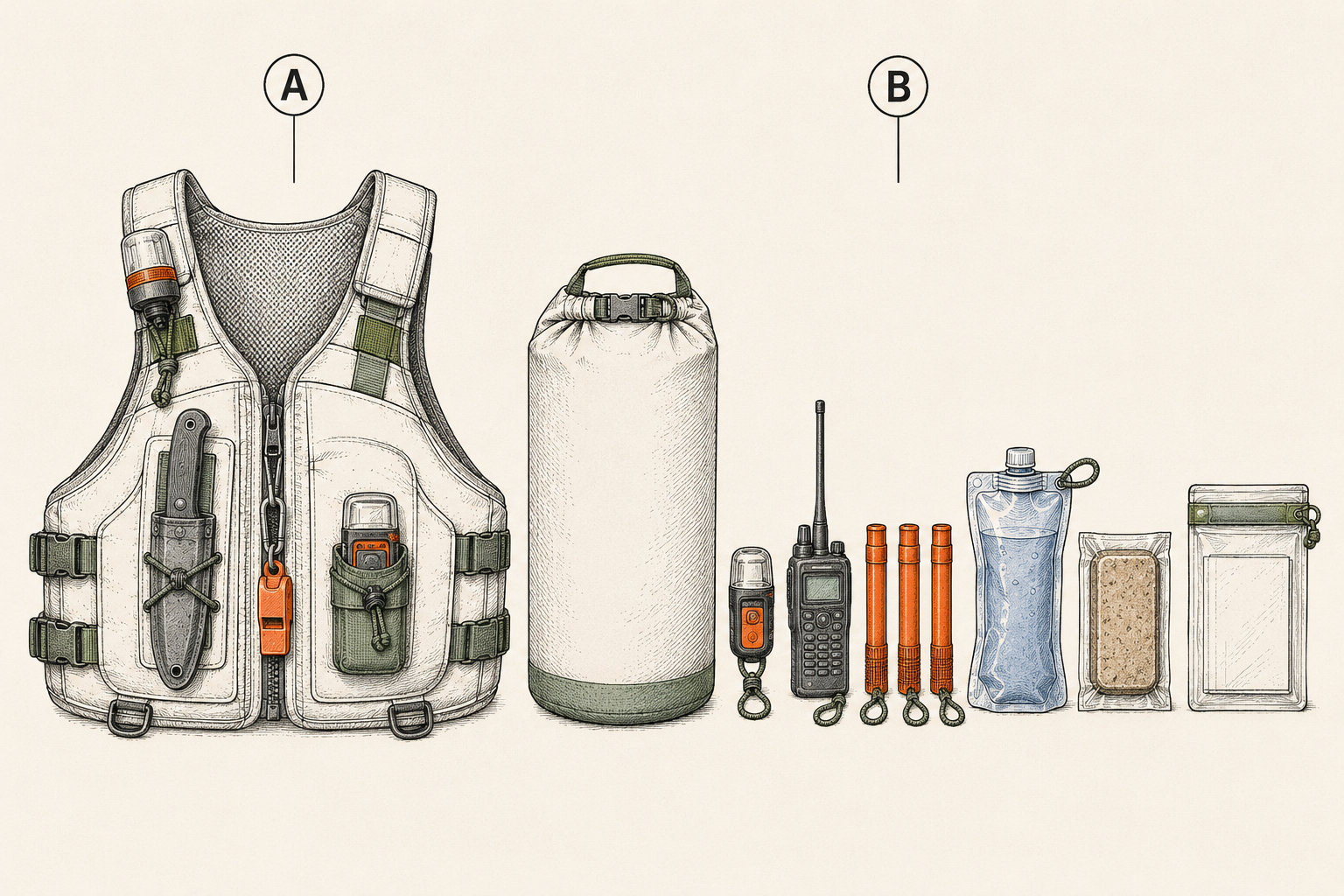
The PFD is the water world’s Layer 1: a whistle on its zipper, a strobe or light clipped high, a knife or shears reachable by either hand, a signal mirror in the pocket, and (for open water or cold seasons) the PLB of Chapter 17 in its dedicated pouch. Rigged once, checked each season.
The rigging logic item by item: the whistle (pealess, per Chapter 16) because voices don’t carry over water and engines; the light/strobe (Chapter 17‘s last-mile tool) mounted at the shoulder where waves won’t shadow it; the cutting tool (blunt-tip rescue knife or shears) for the entanglement scenarios (line, nets, rigging) that water uniquely offers, mounted for either hand because entanglement chooses sides; the mirror for daytime reach; and the PLB because a person in the water is the hardest search target there is, and Chapter 17‘s beacon converts that search into a bearing.
Fit doctrine completes it: snug enough that lifting the shoulders doesn’t lift the vest past your ears (the child-fit test doubly so), bright colors per Chapter 16‘s contrast law, and the seasonal check (webbing, zippers, the light’s battery) folded into Chapter 41‘s calendar.
Paddle craft: dry storage and the swim plan
Kayaks and canoes carry kits in three tiers: the worn PFD layer, the deck-reachable dry bag (leashed), and the hull’s storage for camp gear: each tier assuming the tiers above it just swam away. Everything meaningful is in a real dry bag, and every dry bag is clipped to the boat.
The paddler’s allocation: on the body, the rigged PFD plus the pouch kit of Chapter 31 in its dry-bag variant; on deck or under the seat, the day bag (water, food, insulation layer, fire kit doubled per wet-cold rules, first aid) roll-topped and leashed with a carabiner (Chapter 5‘s dry-bag section was written for this paragraph); in the hull, the overnight gear that can afford to be inaccessible mid-crossing.
The doctrine that gear can’t replace: dress for the water temperature, not the air (cold-water immersion in street clothes ends paddling careers), keep the swim plan honest (distance-to-shore is measured in cold-water minutes, not optimism), and practice the re-entry (Chapter 40‘s water homework: an unpracticed self-rescue is a theory, and theories drown). Group spacing and the float plan (Chapter 17‘s trip plan, marine edition) close the loop.
The ditch bag: the powerboat’s go-bag
A ditch bag is the go-bag concept marinized: one grab-handled, floating, waterproof bag holding the abandon-ship layer: EPIRB or PLB, handheld VHF, flares and signals, water, rations, first aid, and the documents, staged where the helm can reach it in seconds.
The contents, tiered by what ends emergencies: rescue electronics first (the registered EPIRB or PLB, a waterproof handheld VHF radio: channel 16 is the marine mayday channel, and a backup handheld GPS or the phone in a float case); visual signals (the legally required flare set, current-dated, plus LED strobes and the mirror); survival (water pouches, ration bars, mylar bags: sized to your waters; offshore scales everything up toward life-raft doctrine that’s beyond this book’s scope); paper (vessel documents, licenses, the Chapter 33 contact logic, cash) in their own sealed pouch.
Staging is the build’s other half: mounted or clipped at the helm or companionway (never buried in a locker), handle out, floating verified (test it loaded in calm water once: buoyancy claims meet physics), and every regular crew member briefed on its location and the radio’s mayday script: vessel name, position, souls aboard, nature of distress.
ATVs and backcountry machines
The ATV kit follows the snowmobile split from Chapter 36: survival on the rider (worn pouch kit, helmet, the satellite layer for remote country), repair on the machine (tools, plugs, tow strap, the winch’s supporting cast), and the group-and-plan doctrine that machines make people forget.
What machines change: they carry you fast past your walk-out radius (an hour’s ride is a multi-day walk), they break in machine-specific ways (hence the machine bag: plug kit and pump, drive-line spares per your model, tow strap, the folding saw for deadfall that blocks trails), and they hurt people at machine speeds (the first aid module upgrades toward Chapter 26‘s full trauma layer, and the helmet-and-gear doctrine is kit as clothing).
The recovery-gear ladder mirrors Chapter 35‘s: tow strap and shackle points known; a come-along or compact winch where terrain earns it; and the two-machine rule for remote riding, because the most reliable ATV recovery device ever manufactured is a second ATV. Plans filed, per the eternal Chapter 17 sentence.
Small aircraft: the survival scenario nobody plans twice
Light-aircraft kits assume the ELT did its job and build for the wait: a crashworthy-stowed bag per the useful-load budget holding shelter, water, fire, signaling, and trauma supplies for occupants in the terrain actually overflown. The regulation layer (ELT, and gear mandates in some northern jurisdictions) is the floor, not the plan.
The aviation build’s logic borrows from every chapter at once: the scenario is remote terrain, possible injuries, and a wait measured in hours-to-days (modern ELTs plus Chapter 17‘s registered-beacon doctrine have shortened searches dramatically: carry the personal PLB anyway; aircraft ELTs fail in exactly the crashes that need them); the contents follow the go-bag skeleton weighted toward trauma (Chapter 26 doubled), shelter for the overflown climate (the mountain crossing’s kit is not the coastal hop’s), signaling (the mirror earns its aviation fame here), and water; the stowage is secured-but-reachable, because unsecured cabin weight becomes ballistics in the arrival this kit exists for.
Pilots’ checklists culture is the transferable lesson for every reader: the aviation kit gets inspected on a schedule because aviation normalized schedules: which is Chapter 41‘s whole argument, pre-adopted by an entire industry.
The common doctrine: separation-proofing
Across water and machines, one principle organizes everything: assume separation. Body gear survives everything; leashed gear survives most things; stowed gear survives only calm endings. Build every fast-vehicle kit as those three concentric bets.
This is Chapter 3‘s layering doctrine at its sharpest, and it converts into a simple audit anyone can run on any boat, sled, or machine in two minutes. Point at each survival function and ask where it lives: If I and this vehicle part company ungracefully, what’s still with me? Fire, signaling, and the beacon should answer “body.” Water, shelter, and first aid should answer “leashed or grabbed in seconds.” Only comfort should answer “stowed.”
Run the audit on your actual setup and the gaps announce themselves: the whistle in the tackle box, the beacon in the console, the first aid under the rear rack bolted down by bungee archaeology. Move three items and the kit’s real-world performance doubles: the cheapest upgrade in Part III.
Pack This Chapter
- Water rules: PFD worn always, survival core rigged on it (whistle, light, cutter, mirror, PLB), and everything else floating, leashed, or presumed lost.
- Paddlers tier by separation: body, leashed deck bag, hull storage: and dress for water temperature, with re-entry practiced.
- The ditch bag is the marinized go-bag: beacon, VHF (channel 16), current flares, water, rations, documents: floating, grab-staged, crew-briefed.
- Machines split kits: survival on the rider, repair on the machine, trauma module upgraded, two-machine rule for remote country.
- The separation audit organizes it all: body, leashed, stowed: point at each function and ask where it lives.
Where Kits Fail
- The stowed PFD. Aboard, dry, and useless in the water it was bought for. Worn is the entire spec.
- The unleashed dry bag. Waterproof, floating, and a quarter mile downwind after the capsize. A carabiner is the whole fix.
- Expired flares, buried bag. Legal minimums aged into decorations, stowed under a season of gear. Current dates, helm-reach staging.
- The machine as heir. Kit bolted to the sled that’s now in the creek. Survival gear rides the body; the audit takes two minutes.
Frequently asked
What safety gear is required on a boat?
Law sets the floor and varies by jurisdiction and craft: typically wearable PFDs per person (worn is the smart version of “carried”), a sound device, visual distress signals with current dates, and fire extinguishers by vessel class. Verify your local current rules, then build past the floor with this chapter’s worn-layer and ditch-bag doctrine.
What goes in a ditch bag?
Rescue electronics first: registered EPIRB or PLB and a waterproof handheld VHF: then current flares and LED strobes, a signal mirror, water pouches and rations, a compact first aid kit, and vessel documents with cash in a sealed pouch, all in a floating grab-handled dry bag staged at the helm.
How is a kayak safety kit different from a boat’s?
It’s worn and leashed rather than stowed: the rigged PFD carries the survival core, a leashed deck dry bag carries the day layer, and hull storage gets only what can afford to be unreachable. Paddlers add the immersion doctrine: dress for water temperature and practice re-entry before trusting any of it.
What should an ATV survival kit include?
On the rider: the worn pouch kit (fire, whistle, mirror, bivvy, first aid) plus a satellite communicator for remote country and a trauma module scaled to machine speeds. On the machine: tire plugs and pump, model-specific spares, tow strap, folding saw, and the two-machine rule as standing policy.