Can you carry a survival kit through airport security?
Most of one: the blade, the big lighter, and a few chemistry items stay home, but fire (one lighter), light, cordage, first aid, water capacity, documents, cash, and power all fly in carry-on legally. The travel kit is the home kit re-edited for checkpoints, hotel rooms, and distance from your own systems.
Travel strips your layers (Chapter 3‘s outer rings stay in the garage) and drops you into unfamiliar infrastructure, which is exactly when a pocket-scale kit earns its keep. The design constraints: security rules (this section), luggage separation risk (core kit rides carry-on, always), and the destination’s actual hazards (Chapter 4‘s audit, applied to somewhere you’ve never been).
The rules themselves change and vary by country, so the doctrine is categories plus verification: check the current official list before flying, and know the classic dispositions: blades of nearly any kind, no (checked bags only); lighters, one common disposable on your person, generally yes (torch lighters no; spare fuel no); matches, one book of safety matches on person historically allowed, strike-anywhere prohibited: and rules drift, so verify; batteries and power banks, carry-on only (never checked), within capacity limits; liquids, the familiar volume limits govern sunscreen and repellent sizes; multitools, bladeless ones generally pass, anything with a blade doesn’t; trekking-pole-adjacent and blunt items, checked.
The carry-on core
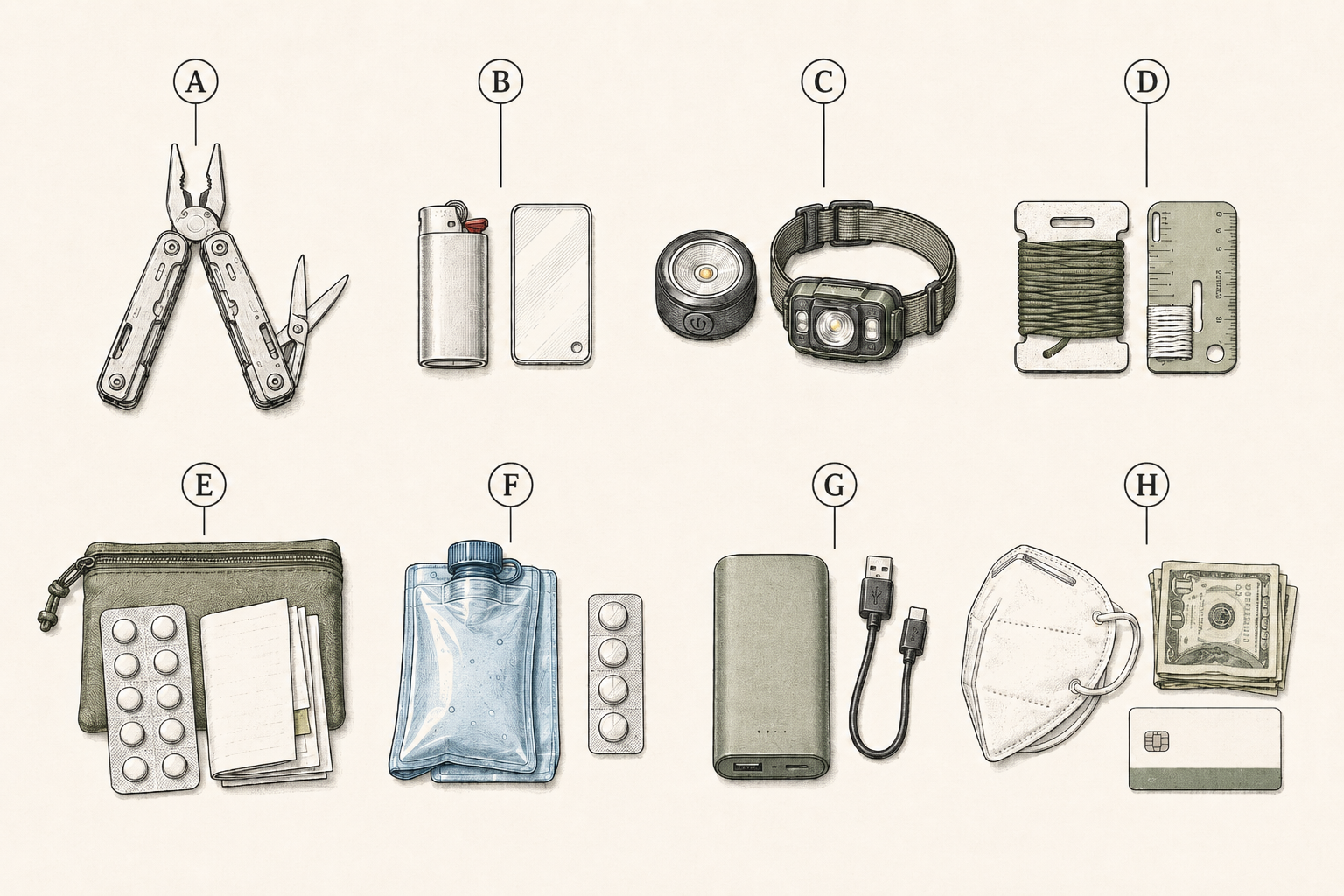
The flying kit: a bladeless multitool, one disposable lighter plus a Fresnel lens, a button light and headlamp, 20 ft (6 m) of paracord flat-wound, duct tape card, the Chapter 25 med core with documents, a folding water pouch plus tablets (or a filter bottle), power bank and cables, cash, and the contact card. Under 1.5 lb (700 g), zero checkpoint drama.
The re-edits explained: cutting capability drops to scissors-class (the bladeless multitool) and gets rebuilt at the destination if genuinely needed (a cheap knife costs less than a checked bag fee; gift it or bin it before the return leg). Fire drops to the lighter-and-lens pair. Water treatment travels as tablets or the filter-bottle class (empty through the checkpoint, filled after: and Chapter 11‘s virus note makes tablets or UV the pick for much international travel). First aid flies intact minus sharp scissors; medications ride in original packaging with the documentation habit doubled for international borders (some common OTC and prescription drugs are controlled elsewhere: the pre-trip check is part of the kit).
The document layer grows abroad: passport copies (paper and encrypted digital), embassy contact, travel insurance details, and the card-loss plan (a second card stored separately from the wallet). Chapter 33‘s paper doctrine, internationalized.
Hotel and high-rise habits
The lodging kit is mostly behavior: count the doors to both exits the night you arrive, stage shoes-light-key-phone at the bedside, ground-truth the assembly point, and let the room’s kit (your carry-on core) sleep staged rather than scattered.
The exit count is the habit that pays in smoke: corridors in smoke are navigated by feel and count, not sight, so the twenty-second walk (both directions, touching the stairwell doors) on arrival night is the entire fire plan. The bedside stage (shoes, the headlamp, room key, phone) answers the 3 a.m. alarm without a scavenger hunt. The behavioral footnotes that earn their sentence: elevators are out during fire alarms (stairs, always), hotel windows and balconies are not exits in any plan you should rely on, and the room door’s peephole-and-chain habits travel well everywhere.
High-rise offices run the same drill with Chapter 33‘s get-home bag staged at the desk: the stair descent in a regional event is long, dark, and crowded, which is why the desk bag’s flashlight and shoes outrank its granola bars.
The urban get-home layer, abroad or at home
Urban emergencies are walking problems wearing city clothes: the get-home logic of Chapter 33 travels intact: shoes you can walk miles in, water, weather layer, light, mask, cash, and the offline map of a city you don’t know (Chapter 19‘s download habit, applied at the departure gate).
What cities change: distances are walkable but crowded (transit failures dump everyone onto the same sidewalks), infrastructure is dense but interdependent (one grid event cascades), and the hazards are documentable in advance (the destination audit: is this earthquake country, hurricane season, protest-prone, altitude?). The traveler’s version compresses to the daypack that’s already your personal item: the carry-on core plus walking shoes worn or packed, the city’s offline map downloaded before landing, and the rally logic adapted (your out-of-area contact works internationally; the meeting point becomes the hotel, with the embassy as the deep fallback).
The mask note earned by recent decades: an N95-class mask folds flat, weighs nothing, and answers smoke, dust, and the crowded-shelter scenario: it’s a permanent resident of the travel core now.
Rebuilding capability anywhere
The traveler’s superpower is the rebuild list: any drugstore, supermarket, or hardware shop restores a working kit in twenty minutes: knife, lighter, water, bags, tape, light, food: for pocket money. Knowing the list is carrying it.
The rebuild, aisle by aisle: cutting (a paring knife or utility blades: the humblest knife outperforms no knife); fire (lighters at every register); water (bottled to drink, bleach or boiling per Chapter 11‘s improvised tier, any bottle as the vessel); shelter-and-rain (trash bags, the eternal Chapter 27 answer, plus a cheap umbrella’s honest value); repair (tape, ties, sewing notions); light (a cheap LED flashlight and batteries); food (Chapter 13‘s familiar-and-dense rules work in any language); first aid (bandages, tape, and the local pharmacy’s version of the med core: with the name-brand cheat sheet for your prescriptions from the document pouch).
This list is also the checked-bag insurance policy and the “arrived, luggage didn’t” protocol, which is the travel emergency people actually experience. Twenty minutes and twenty dollars, and the layers exist again.
Pack This Chapter
- The travel kit is the home kit re-edited: blades and big fire out, everything else flies carry-on. Verify current rules per country; batteries never in checked bags.
- The core: bladeless multitool, lighter and lens, lights, cord and tape, med kit with documents, water capacity and tablets, power, cash, mask. Under 1.5 lb (700 g).
- Lodging habits are the kit: count doors to both exits on arrival night, stage shoes-light-key-phone bedside, stairs never elevators.
- The urban layer is a walking problem: shoes, water, offline map downloaded before landing, out-of-area contact internationalized.
- The rebuild list is carried knowledge: any drugstore restores the layers in twenty minutes when rules or airlines strip them.
Where Kits Fail
- The confiscation surprise. The heirloom knife meets the checkpoint. Categories checked against current official lists, every trip, every country.
- The checked-bag kit. Core capability rides in the bag that went to the wrong continent. Carry-on is the only staging that counts.
- The uncounted corridor. Smoke removes sight; only the door count remains. Twenty seconds on arrival night.
- Medication borders. Common pills, controlled elsewhere, discovered at customs. Original packaging plus the pre-trip legality check.
Frequently asked
What survival items can you take on a plane?
In carry-on, generally: one common disposable lighter (on your person), a bladeless multitool, flashlights, power banks (carry-on only, within limits), cordage, tape, first aid minus sharp scissors, water purification tablets, an empty filter bottle, and food. Blades, torch lighters, and fuel go checked or stay home. Verify current official lists per country.
What should a travel emergency kit include?
The checkpoint-legal core: light, fire (lighter plus Fresnel lens), water capacity and tablets, med kit with documentation, bladeless multitool, cord and tape card, power bank, N95 mask, cash, and the document pouch (passport copies, insurance, embassy, contact card): all under 1.5 lb (700 g) in your personal item.
What’s the first thing to do in a hotel for emergencies?
Count the doors to both exits, in both directions, the night you arrive: touching the stairwell doors: because smoke navigation runs on feel and count. Then stage shoes, a light, the room key, and your phone at the bedside. Twenty seconds and one habit cover the realistic hotel emergency.
How do you build an emergency kit while traveling?
From any drugstore and hardware aisle: a paring knife or utility blades, a lighter, bottled water plus bleach-or-boil knowledge, trash bags, duct tape, a cheap LED light with batteries, dense familiar food, and pharmacy first aid basics. Twenty minutes and pocket money rebuilds every layer the airline or checkpoint removed.