How do kits change for kids, elders, and pets?
The functions never change; the interfaces do. Kids need gear they can operate plus drilled behavior; elders need the medication, mobility, and vision layers hardened; pets need identification, restraint, and their own consumables. The household kit is finished when its least-able member is covered.
This chapter closes Part III by auditing the builds against the people they actually serve, because kits default to being designed by and for the household’s strongest adult. The corrective questions: Who can’t carry their bag? Who can’t work the ferro rod, hear the alarm, or read the manifest? Who has a medical dependency with a clock on it? Who has four legs and no evacuation rights at some shelters?
The pattern in every answer below: capability moves inward (to the person, scaled to their hands) and documentation moves outward (onto their body, for the responders and helpers who may be operating without you).
Kids’ kits: gear they can actually use
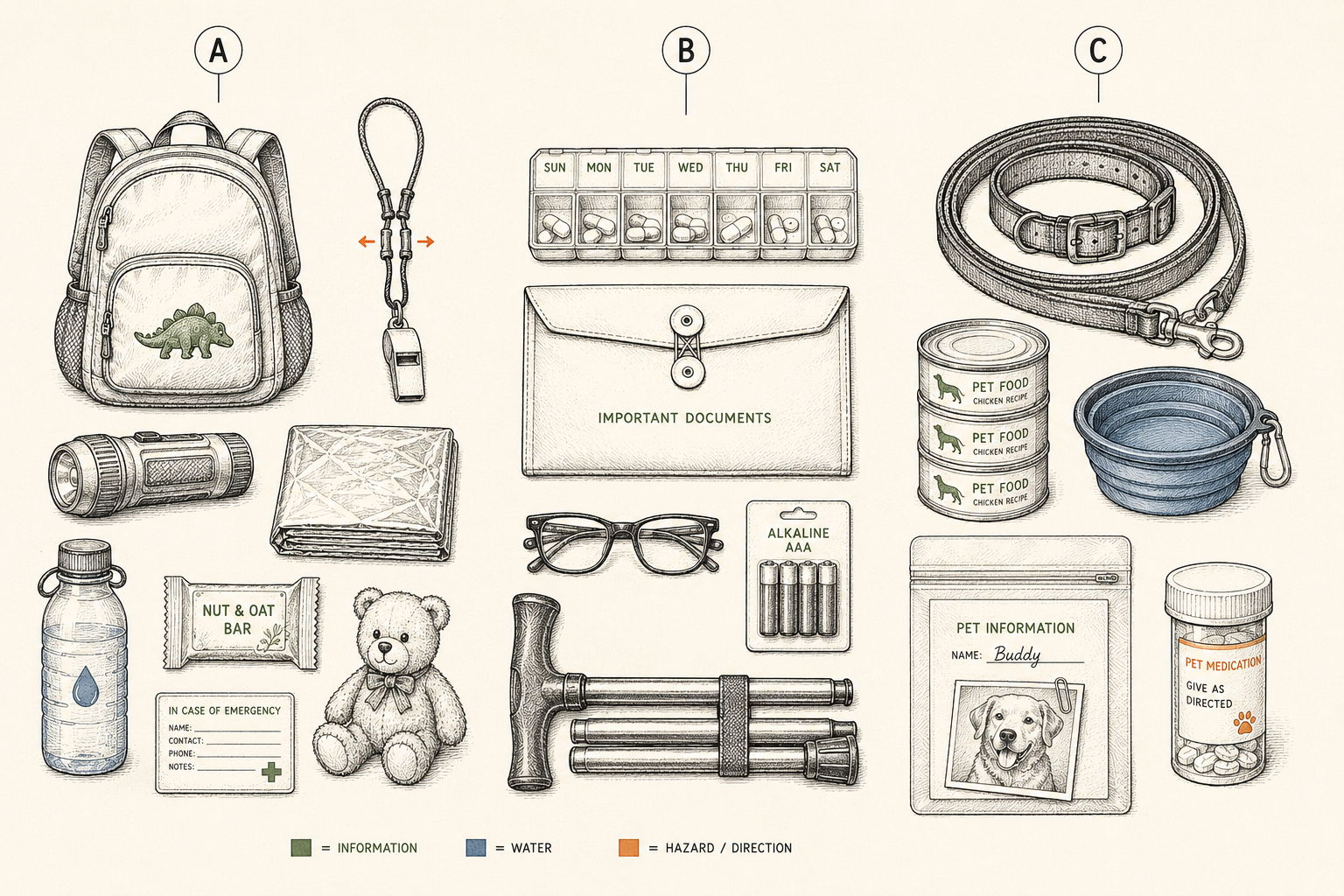
A child’s kit is built around what small hands can operate under stress: a whistle on a breakaway lanyard, a simple squeeze or twist light, a mylar blanket, water and a familiar snack, a laminated ID card, and a comfort item: plus the training that outperforms all of it.
The build by age band, honestly: preschool carries almost nothing (the whistle-and-card stage; their kit is really the adult’s kit plus identification on the child); elementary carries the list above in a small pack they’ve practiced opening (weight under 10% of the child; make the pack theirs: ownership drives carrying); middle-and-up graduates toward Chapter 32‘s real Essentials with fire tools arriving alongside demonstrated maturity, under supervision, per family judgment.
The card outranks the gear: child’s name, parents’ names and numbers, the out-of-area contact, allergies and medications, laminated, in the pack and (for younger kids in crowds or evacuations) on the child (wristband or tag). Reunification is the child-scenario’s actual problem, and responders can’t call a number the child can’t recite.
The comfort item is not sentimental engineering: a scared child who can be calmed is a child who can follow the plan, and a familiar small toy or photo does measurable work in shelters and long nights. It’s morale doctrine (Chapters 1 and 13), pediatric edition.
Training the smallest humans
The drilled behaviors: lost means stop: stay put, hug a tree (or one spot indoors), blow three whistle blasts, answer adults who call your name even if strangers. Plus the family plan’s kid-sized version: the meeting points, the contact’s number recited, and “firefighters in gear look scary; go to them.”
Why behavior outranks gear at this scale: lost-child incidents resolve fastest when the child stops moving (search areas grow with the square of wander time) and makes noise. The hug-a-tree protocol (stay, whistle threes, answer calls) is teachable as a game from preschool age and rehearsed on ordinary hikes: hide-and-whistle drills that build the reflex under fun instead of fear.
The dark-and-scary inoculations matter too: practice the whistle loud (kids often won’t blow hard without permission-by-practice), meet the smoke-mask and the alarm sound at home in daylight, and one flashlight-lit family “camp night” indoors turns the blackout from terror into a remembered adventure. Chapter 40‘s family drills carry the schedule.
Elders and the medical-dependency layer
The senior kit hardens three systems: medications (the 7-day rotating supply plus the list-and-labels doctrine of Chapter 33, doubled), sensory equipment (spare glasses, hearing-aid batteries, the large-print manifest), and mobility (the cane or walker staged with the kit, the evacuation plan that doesn’t assume stairs at speed).
The medication layer at this scale is the difference between inconvenience and crisis: multi-drug regimens with timing (the weekly organizer is kit gear), cold-chain drugs with their cooler plan (Chapter 33), and the documentation set that lets an unfamiliar pharmacy or shelter nurse reconstruct the regimen: drug names with doses (brand and generic), prescribers’ numbers, pharmacy, insurance, and the medical-history one-pager (conditions, surgeries, allergies) that emergency medicine calls gold.
The mobility audit runs the household’s actual geometry: who needs how long to descend the stairs, whether the go-bag’s weight works with a walker (it usually means a rolling bag or a family porter assignment), where the spare cane lives, and: the item this book insists on: whether the alarm systems (smoke, CO, phone alerts) are perceivable: bed-shaker and strobe alarm accessories exist for hearing loss and cost less than one night of the alternative.
The neighbor protocol formalizes what good streets do informally: for elders living alone, a check-in agreement (who knocks after events, who holds a key, whose number is on the fridge) is kit infrastructure as surely as the water is.
The pet module
The pet kit: restraint (leash, harness, carrier per cat-sized animal), consumables (food and water for the household’s planning window, bowls, meds), and documentation (vaccination records, license, microchip info, a current photo with the family, and the carrier-friendly shelter list): staged with the household’s go-gear.
The realities that shape it: many emergency shelters restrict animals (the pre-mapped pet-friendly list: hotels, kin, boarding: is the module’s most valuable page), evacuations fail when pets can’t be caught and contained fast (the crate-comfortable cat is a drill outcome, not a personality trait: feed them in the carrier for a month and watch the phobia dissolve), and lost-pet reunification runs on the photo-plus-microchip pair (chip registered to a current number; the photo shows the animal with its people, which settles ownership disputes at shelters).
Consumable math mirrors the humans’: food in rotated sealed portions (per Chapter 13‘s familiar-beats-novel rule: diet switches produce digestive drama at the worst time), water counted into the household total (a large dog drinks like a person), meds and preventives in the rotation, and the sanitation add-ons (litter and pan for cats, bags for dogs) that keep shelter-in-place civilized.
Working the plan: the pet’s job in the family drill is being findable and containable: leash by the door, carrier not buried in the garage, and the five-minute-warning rehearsal including the actual cat, who will teach you things about your timeline.
Special dependencies: the honest audit
Beyond age and species, dependencies deserve their named audit: infant supplies (formula, diapers: the fastest-aging module in the book), medical devices (CPAP and oxygen with their power plans per Chapter 10 and 34), dietary constraints (allergy-safe stores where cross-contamination kills), and the language-and-cognition layer (plans and cards written for the people who’ll read them).
The audit method is one pass through the household asking “what does this person need daily that the world provides automatically?”: then packing the three-day-to-two-week answer. Infants: formula (sealed, rotated aggressively: months, not years), diapers a size up (they age forward), wipes, and the feeding gear that doesn’t assume a working kitchen. Powered medical devices: the battery-hours math done in advance, the power station sized to it (Chapter 34‘s decision, now non-optional), and the paper backup (the CPAP user’s pressure settings, the oxygen supplier’s emergency line). Allergies: the safe-food store kept genuinely separate, the auto-injector doctrine from Chapter 25 (locations known to everyone, dates watched), and the card on the person who can’t speak for themselves.
The cognition line applies to every card and plan in this book: written plainly, large type where eyes need it, the household’s languages where it’s read, and rehearsed with the people who process differently: because a plan that lives only in the planner’s head fails its most vulnerable readers first.
The household as a system
Assembled, the household’s kits form one system: per-person bags scaled to their carriers, the shared home kit underneath, documentation on every body, and drills that include everyone: the toddler, the grandmother, the cat. The strongest adult’s kit is now the household’s smallest problem.
The closing audit for all of Part III, run as questions: Can every member operate their own layer (light, whistle, water) at their own scale? Does every body carry its documentation (cards, meds lists, chips)? Does the weight math work (who carries the toddler, who porters for the walker)? Do the drills include the hard members (the cat, the sleeper, the teen with headphones)? Does the plan read correctly to its least-able reader?
Five yeses and Part III is genuinely done: the builds exist, and they fit the people they protect. What remains is Part IV’s whole argument: keeping all of it alive.
Pack This Chapter
- Functions constant, interfaces resized: capability moves inward to each person’s hands; documentation moves outward onto their bodies.
- Kid kits: whistle (breakaway lanyard), simple light, mylar, water, snack, laminated ID, comfort item: under 10% of body weight: plus hug-a-tree drilled as a game.
- Elder module: 7-day med rotation with full documentation, spare glasses and hearing batteries, mobility-honest evacuation math, perceivable alarms, neighbor protocol.
- Pet module: restraint staged, familiar food rotated, records-photo-microchip current, pet-friendly shelter list pre-mapped, carrier drills run.
- Dependencies audited by name: infant consumables age in months; powered medical devices get battery-hours math; allergy stores stay separate; every card written for its actual reader.
Where Kits Fail
- The strongest-adult default. Every kit designed for the one person who needed it least. The least-able member is the design case.
- The unrecited number. A lost child who can’t produce a phone number, and no card to speak for them. Laminate, attach, rehearse.
- The month-old formula assumption. Infant modules age faster than any gear in this book. Aggressive rotation or false comfort.
- The theoretical cat. Carrier in the rafters, cat under the bed, warning at five minutes. The drill includes the animal or the plan doesn’t include the animal.
Frequently asked
What should be in a survival kit for kids?
A whistle on a breakaway lanyard, a simple squeeze or twist flashlight, a mylar blanket, water, a familiar snack, a laminated card (name, parents’ numbers, out-of-area contact, allergies), and a small comfort item, in a pack under 10% of the child’s weight: paired with the hug-a-tree training that matters more than any of it.
What goes in a pet emergency kit?
Leash and carrier staged reachable, several days of familiar food in sealed rotated portions, water counted into the household total, bowls, medications, sanitation supplies, and the document sleeve: vaccination records, license, microchip details, and a current photo of the pet with the family: plus a pre-mapped list of pet-friendly shelters and hotels.
How do you prepare an elderly person’s emergency kit?
Harden three systems: medications (7-day rotating supply, complete list with doses and prescribers, cold-chain plan if needed), senses (spare glasses, hearing-aid batteries, large-print documents, perceivable alarms), and mobility (staged cane or walker, rolling bag if carrying fails, an evacuation plan timed to their actual pace, and a neighbor check-in agreement).
What’s the most important emergency skill to teach a child?
The lost protocol: stop where you are, stay put, blow three whistle blasts, and answer any adult calling your name: rehearsed as a game until it’s reflex. A child who stops and makes noise is found fast; a child who wanders grows the search hourly. The whistle and the recited phone number complete it.