What should be in a survival kit?
A survival kit holds tools for six jobs: making fire, treating water, sheltering your body, signaling for rescue, finding your way, and treating injuries. Every kit, from a mint tin to a truck box, is judged by how well it covers those six functions at its size.
That answer sounds tidy, and the tidiness is the point. Kits fail when people pack objects instead of functions. A bag with three flashlights and no way to purify water isn’t a small kit; it’s an unbalanced one. Hold every candidate item up against the six functions and ask which job it does. If the answer is “none, but it looks rugged,” put it back.
Food gets a seat at the table as kits grow. So does electrical power, which is this century’s addition: keeping a phone alive is now a legitimate survival function, because the phone is a map, a light, a flare, and a lifeline in one slab of glass. But in the smallest kits, the six core functions come first. You can be hungry for a long time. You can’t be freezing wet for very long at all, and Chapter 2 explains why the order runs that way.
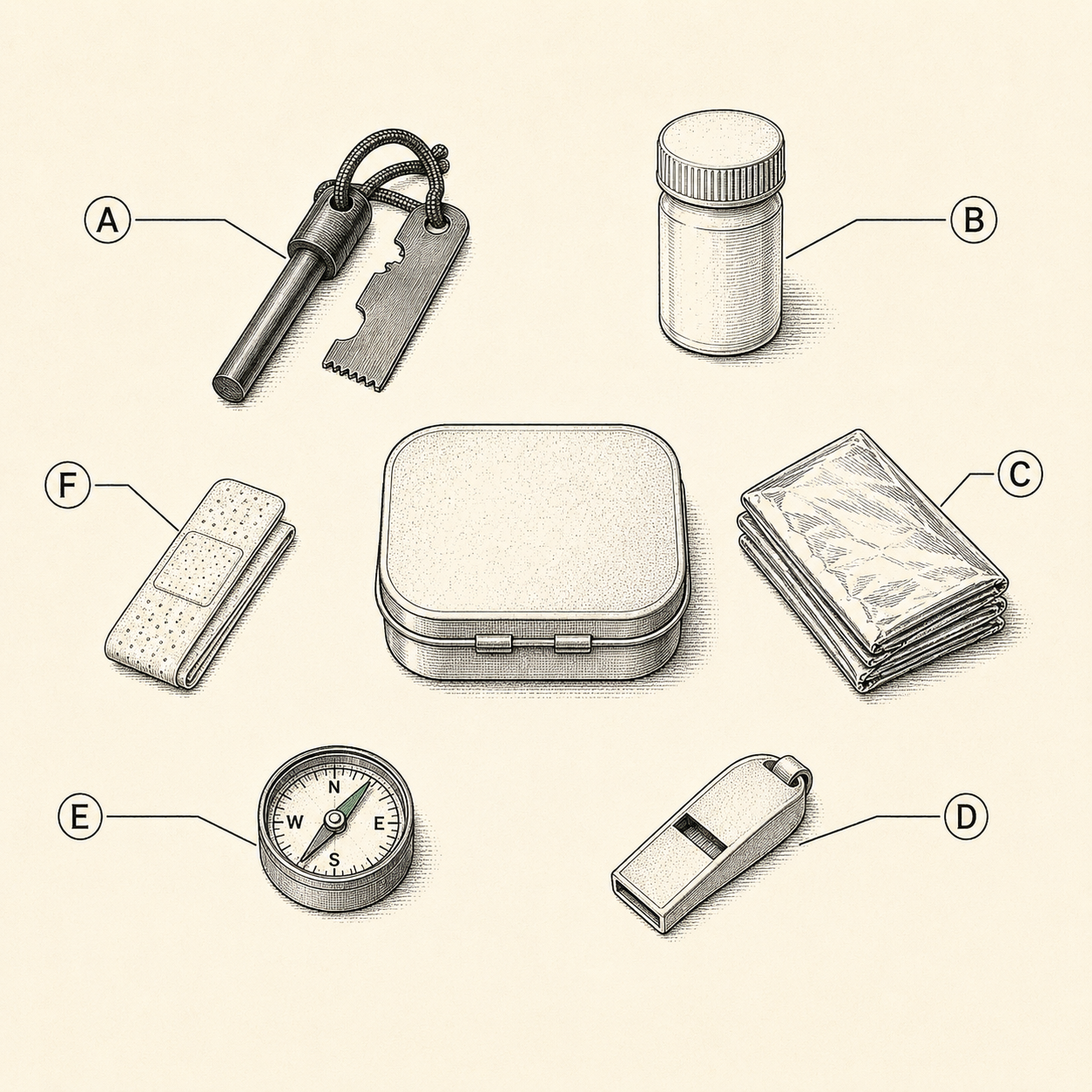
What does a survival kit actually do?
A kit is a smoke alarm you carry: it does nothing at all on the good days, and on one bad day it changes everything after it. Its job is to buy time, comfort, and options until you can rescue yourself or be rescued.
Be honest about what that means. A kit doesn’t make you an outdoorsman, and it doesn’t make a dangerous situation safe. What it does is convert a crisis into a problem. Stranded with no fire, no water, and no shelter, you’re spending your body’s reserves against the clock. Stranded with those three covered, you’re camping badly. Camping badly is survivable almost indefinitely.
The other thing a kit does is quiet your head. Panic drives most of the worst decisions in survival situations, and panic feeds on helplessness. The moment your hands have a task (light the stove, rig the blanket, blow the whistle in threes) your brain gets back to work. Several items in this book earn their place partly as morale: a candle, a sweet, a hot drink. That isn’t softness. A calm person with average gear outlasts a panicked person with excellent gear.
Why the kit you carry beats the kit you own
The best survival kit is the one within reach when trouble starts. An excellent kit at home serves you exactly as well as no kit at all.
This is the oldest lesson in the subject and people keep relearning it the hard way. Trouble doesn’t schedule itself for the days you packed. A driver pulls over to look at a flooded creek, slips down the bank, and spends the night with a broken ankle thirty feet below a car that has blankets, water, and a phone charger in it. Nothing in that trunk mattered. The only equipment that counted was whatever rode in his pockets.
So this book pushes you, over and over, toward smaller and closer. A modest kit that lives on your person outranks a magnificent one that lives in a closet. That’s also why Part III starts with pocket kits rather than go-bags, and why Chapter 3 treats your pockets as the innermost layer of a system. Size decides carry, carry decides presence, and presence is everything.
Should you buy a kit or build one?
Build it. A self-built kit costs about the same as a mid-grade commercial kit and beats it on the three things that matter: component quality, your familiarity with the contents, and fit to your actual risks.
Commercial kits have one structural problem: the whole bag has to hit a retail price, so every component inside is chosen by cost. The flashlight is the flashlight that kept the kit under budget. That’s survivable for cheap redundant items, and it’s a bad bet for the items your life leans on, which is where you should be spending deliberately (Chapter 6 maps exactly where quality matters and where it doesn’t).
There’s a respectable middle path: buy a decent commercial kit as a starting skeleton, then strip it. Keep the case and the acceptable pieces, replace the water treatment, the light, and the blade with components you chose, and add what your situation needs. You get the packaging convenience without inheriting the compromises. If you do carry any kit someone else packed, open it, learn it, and test it before the day you need it. An unfamiliar kit is a puzzle box, and emergencies are a poor time for puzzles.
The 10-item baseline
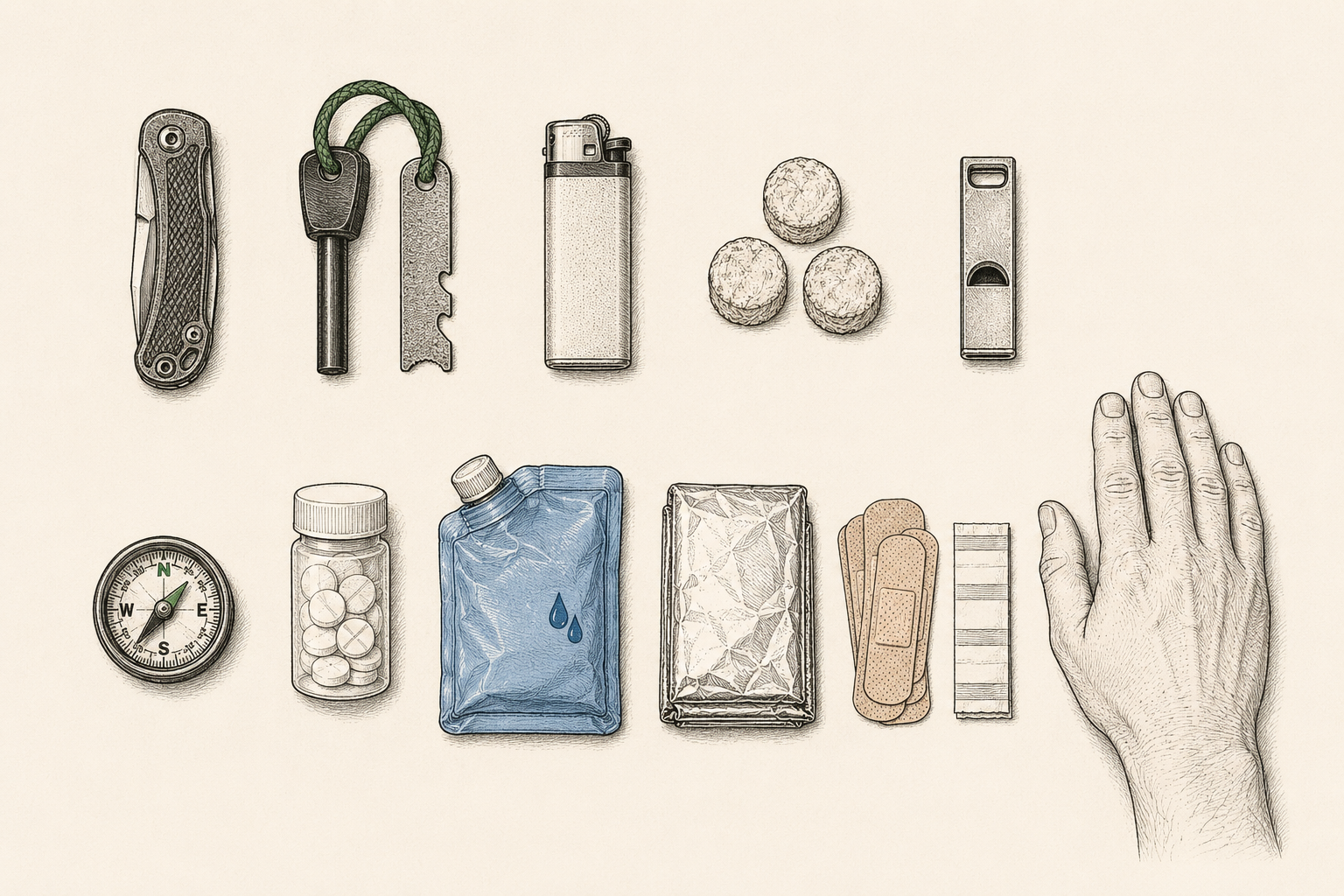
If a kit covers the six functions in ten items, it’s a real kit, whatever its size. Here is the baseline this book builds from:
- A knife. One good blade, even a small one. It makes tinder, cuts cordage, and builds what you didn’t carry.
- A ferro rod and striker. Sparks in any weather, thousands of them, no fuel to leak or evaporate.
- A lighter. Because when your hands are shaking, a flame beats a spark. Carry both; they fail differently.
- Ready tinder. A few waterproofed starters. Found tinder is a gamble; carried tinder is a certainty.
- A whistle. Flat, pealess, loud. Your voice quits in an hour; a whistle doesn’t.
- A button compass. Not for wayfinding so much as for walking a straight line, which panicked people cannot do unaided.
- Water treatment tablets. Grams in weight, and they turn almost any freshwater into drinking water.
- A collapsible water container. Treatment means nothing without something to treat water in.
- A mylar blanket. The cheapest shelter that exists: windproof, rainproof, and it hands your own heat back to you.
- Wound basics. A few bandages, closure strips, and antibiotic ointment. Small injuries degrade you fast in the field.
Twenty items deep, you’d add cordage, duct tape, aluminum foil, a small light, fishing hooks and line, a poncho, a bandana, safety pins, needle and thread, and a morale item or two. Every one of these gets its own treatment in Part II. The list above isn’t sacred. It’s a floor, and it fits in a tin.
What will it cost and weigh?
A serviceable pocket kit built from this book runs roughly $40–80 and weighs less than a smartphone. A full day-pack kit lands near $150–300 and 2–4 lb (0.9–1.8 kg). Neither number should stop anyone.
The dollar figures are 2026 street prices for decent-quality components, and Chapter 6 breaks them into tiered builds with exact contents. The weight figures matter more than the money, honestly, because weight is what makes people leave kits behind. Every build chapter in Part III lists its finished weight, and keeping that number low is a design goal on par with capability. An ounce you won’t carry protects nobody.
One caution on cheapness in both directions. Underspending on the life-critical few (water treatment, your blade, anything electronic you’ll bet on) buys failures. Overspending on everything is its own trap: a $600 kit becomes too precious to open, and a kit you won’t open is a kit you won’t practice with. Spend unevenly, on purpose.
How to use this book
Read Part I in order; it’s short and everything after leans on it. Then go straight to whichever Part III build matches your life, and let its needs send you back into Part II’s component chapters.
That’s the honest path, because almost nobody reads a reference book front to back, and this book is built to be entered sideways. Every component chapter stands alone. Every build chapter tells you which component chapters it draws on. If you do exactly one thing, do this: build the tin kit in Chapter 30 this week. It costs little, it teaches the whole method in miniature, and it puts a working kit in your pocket while you think about the bigger ones.
Pack This Chapter
- A kit is judged by six functions: fire, water, shelter, signaling, navigation, first aid. Pack functions, not objects.
- Small and carried beats large and stored. Presence is the first spec of any kit.
- Build rather than buy, or buy and strip. You need chosen quality in the few items your life leans on.
- The 10-item baseline is the floor: knife, ferro rod, lighter, tinder, whistle, compass, tablets, water bag, mylar blanket, wound basics.
- Budget $40–80 for a pocket kit. Weight, not money, is what makes kits get left behind.
Where Kits Fail
- The kit that stayed home. The single most common failure in this subject. Cut your kit’s size until it goes where you go.
- Objects instead of functions. Three fire tools and no water treatment. Audit against the six functions before you call anything done.
- The sealed mystery bag. A commercial kit carried for years and never opened. If you can’t list its contents from memory, you don’t have a kit; you have luggage.
- The museum kit. So expensive it never gets opened, practiced with, or restocked. Gear you protect from use will protect nothing.
Frequently asked
What are the 10 most important items in a survival kit?
A knife, a ferro rod, a lighter, ready tinder, a whistle, a button compass, water purification tablets, a collapsible water container, a mylar emergency blanket, and basic wound supplies. Those ten cover all six survival functions and fit in a pocket tin. Everything else is expansion.
What are 20 items in a survival kit?
Start with the 10-item baseline, then add cordage, duct tape, heavy-duty aluminum foil, a small flashlight, fishing hooks and line, an emergency poncho, a bandana, safety pins, a sewing needle with thread, and a couple of high-energy food items. That twenty covers the six functions with redundancy in fire, shelter, and food.
What’s the difference between a survival kit and a 72-hour kit?
Scale and scenario. A survival kit covers the six functions at pocket-to-pack size for unexpected trouble. A 72-hour kit (Chapter 33) is an evacuation bag: food, water, documents, medications, and shelter for three days away from home. The small kit rides inside the big one.
Are premade survival kits worth it?
As a starting skeleton, sometimes. As a finished product, rarely. The retail price caps every component’s quality, and you won’t know the contents under stress. If you buy one, strip it, upgrade the water treatment, light, and blade, and repack it yourself so your hands learn where everything lives.