What is layered carry?
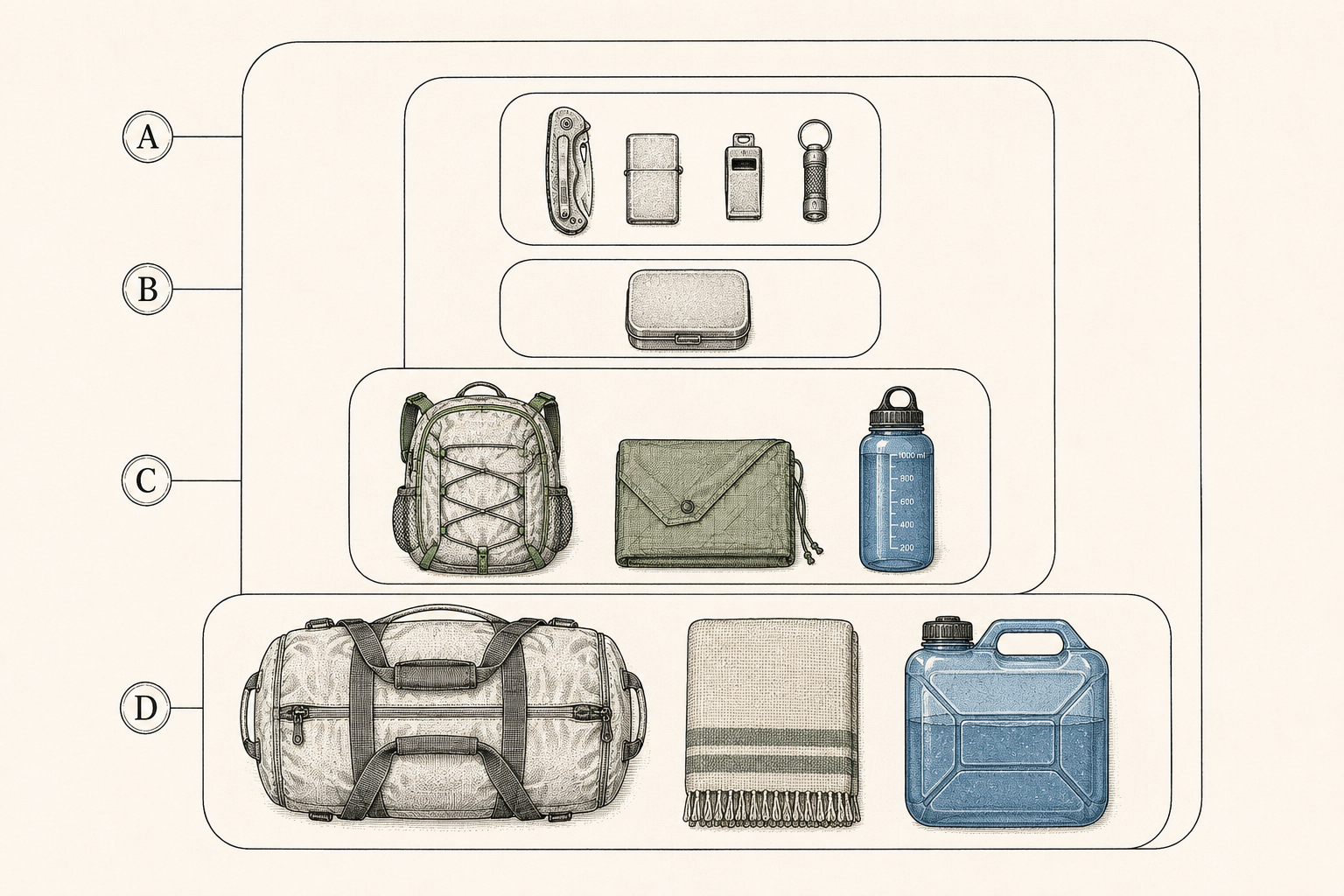
Layered carry means spreading survival capability across zones that travel with you at different ranges: your pockets, a small kit, a pack, and your vehicle or home. Each layer works alone, and each assumes the outer layers might be gone.
The logic is the same as any good backup scheme. Trouble rarely takes everything at once, but it often takes the thing you assumed you’d have. The pack stays on the far bank of the creek. The car is a mile behind you when the weather turns. If your capability lives entirely in one container, one bad minute empties it. Spread across four layers, the same bad minute costs you a layer, and the inner layers still cover the six functions at reduced scale.
There’s a quieter benefit too. Layering kills the excuse that a “real” kit is too much to carry daily. Nobody carries a go-bag to the grocery store, and nobody has to. The innermost layers weigh ounces and never leave you. The outer layers wait where outer layers belong.
Layer 0: what’s already on you
Before any gear, you carry three assets everywhere: your skills, your judgment, and your phone. Layer 0 is the layer you should invest in first, because it multiplies every other layer.
Skills and judgment are Chapter 40‘s territory, but the phone deserves a hard look right here, because it quietly became the single most capable survival object most people own. It’s a map with your position on it, a flashlight, a signal device, a reference library, and a line to every rescue service in the region. Recent phones can reach satellites for emergency messaging with no cell coverage at all (Chapter 17 sorts out what that does and doesn’t replace).
The phone also has the failure profile of all electronics: it dies of cold, water, drops, and above all an empty battery. Layer 0 doctrine is therefore short: keep it charged, keep it on your body rather than loose in a bag, keep it dry, and never let it be your only copy of anything that matters. The paper map and the real flashlight exist because the phone is mortal.
Layer 1: pocket everyday carry
Layer 1 is what lives in your pockets and on your keys every single day: at minimum a knife or cutting tool, a lighter, a small flashlight, and a whistle. These four cover cutting, fire, light, and signaling before any “kit” exists.
The standard for this layer is brutal and useful: if it doesn’t go with you daily, it isn’t Layer 1. That standard drives everything toward small and ordinary. A three-inch folding knife you actually pocket beats the fixed blade in your dresser. A keyring light the size of a grape beats the thousand-lumen bar you left charging. Comfort and habit decide this layer, not capability sheets.
A reasonable Layer 1, all of it disappearing into normal clothes:
| Item | Rides where | Job |
|---|---|---|
| Folding knife or small multitool | Cutting, repair, food prep | |
| Butane lighter | Fire, instantly | |
| Keyring flashlight | Keys | Light where you are, not where the kit is |
| Flat pealess whistle | Keys | Being heard a mile past your voice |
| Phone | Map, comms, light, library |
Add a ferro rod bead on the keyring and a few feet of duct tape wrapped flat around an old gift card in a wallet, and Layer 1 quietly covers half the six functions.
What everyday carry is not
EDC is a set of small tools for ordinary life that also serve in emergencies. It isn’t a costume, a fighting stance, or a competition, and gear chosen to look serious usually loses to gear chosen to be carried.
The everyday-carry world attracts a certain amount of theater: heavy “tactical” gear, aggressive styling, pocket loadouts that weigh like plumbing. The practical cost of the theater is real. Heavy items migrate out of pockets within weeks, and styling that reads as weaponry complicates your life at schools, courthouses, airports, and borders. Choose items that look like what they are: tools. A knife selected for opening boxes and making fuzz sticks will be with you on the day it matters. That’s the entire game of Layer 1.
Knife-carry law, state by state
That warning is worth making concrete. Here is how all fifty states and the District of Columbia currently treat everyday knife carry — the kind of folder or fixed blade this book actually recommends.
| State | Preempt | Autos / switchblades | Length triggers | Concealed-carry & key notes |
|---|---|---|---|---|
| Alabama | No | Legal | None | Open and concealed carry both legal, no restricted types; check city codes |
| Alaska | Yes | Legal | None | Open carry legal; concealed carry of certain knives restricted (age/notification rules) |
| Arizona | Yes | Legal | None | One of the most permissive states — no blade limits, all types, both carry methods legal |
| Arkansas | Yes | Legal | None | Broadly permissive; preemption recently enacted, wiping local restrictions |
| California | No | Under 2″ blade only | 2″ (autos); local limits | Concealed dirks/daggers (fixed blades) is a crime; balisongs treated as switchblades; LA and other cities add rules. Folders legal concealed when closed; fixed blades are open carry in a sheath |
| Colorado | No | Legal to own; under 3.5″ for concealed | 3.5″ concealed | Ballistic knives banned; Denver has its own ordinances |
| Connecticut | No | Only ≤1.5″ blade | 4″ general cap; 1.5″ for autos | Carry limits apply on or off your person outside the home; ownership itself is fine |
| Delaware | No | Legal since July 2025 (SB 108); ≤3.75″ unrestricted | 3.75″ | Folding knives ≤3.75″ fine concealed; larger or fixed blades concealed require a CCDW license |
| D.C. | — | Banned | 3″ | Most restrictive jurisdiction; both carry methods restricted; treat as a no-carry zone |
| Florida | No | Legal; no limits on ownership or open carry | ~4″ “common pocketknife” (case law) | Common pocketknife OK concealed; other knives need a FL concealed-weapon license; ballistic banned |
| Georgia | Yes | Legal | 12″ — above needs a weapons carry license (raised from 5″ in 2018) | Under 12″, both carry methods free |
| Hawaii | No | Legal since May 2024 (Act 21); open carry legal, concealed restricted | None | 2024 law repealed bans on balisongs, switchblades, and gravity knives — but concealed carry of deadly weapons stays criminal. Older guides are badly outdated here |
| Idaho | Yes | Legal | None | Both carry methods legal, no blade limits, all common types legal |
| Illinois | No | Legal with a valid FOID card | Chicago: 2.5″ carry limit | State law is moderate; Chicago is the problem. Ballistic banned |
| Indiana | Yes | Legal | None | Permissive; ballistic knives banned |
| Iowa | Yes | Legal to own; concealed rules apply | 5″ in some contexts | Blades over 5″ fall under the dangerous-weapon/permit framework for concealed carry; ballistic banned |
| Kansas | Yes | Legal | None | No restrictions on carry type or blade length; all common types legal |
| Kentucky | No | Legal; must be 21+ to carry | None | Permitless concealed deadly-weapon carry for 21+ |
| Louisiana | Yes | Legal | None | 2024 preemption law repealed dozens of local knife restrictions |
| Maine | No | Legal | None | Autos legal; concealed carry of dirks/stilettos/daggers still restricted |
| Maryland | No | Legal to own and open carry; concealed prohibited | None | Concealed “dangerous weapons” (dirk, bowie, switchblade) banned; folding penknives OK; Baltimore stricter |
| Massachusetts | No | In transition — Aug 2024 ruling (Commonwealth v. Canjura) found the switchblade ban unconstitutional | 1.5″ auto statute (struck down) | Dirk/dagger/double-edged carry still restricted; assisted-openers legally complex; verify current statute |
| Michigan | No | Legal (since 2017) | None | Concealed carry of dirks, daggers, stilettos, and double-edged fixed blades banned; folders fine |
| Minnesota | No | Illegal for civilian possession | None | One of the last four auto holdouts; other knives mostly legal, intent-based |
| Mississippi | Yes | Legal to own | None | Open carry legal; concealed bowie/dirk/switchblade needs a permit or exemption |
| Missouri | No | Legal | ~4″ (“ordinary pocketknife” line) | Broadly legal since the permitless-carry era; watch restricted locations |
| Montana | Yes | Legal | None | Repealed its ban on concealed carry of 4″+ knives, dirks, and daggers; now fully permissive |
| Nebraska | Yes | Legal | 3.5″ in some contexts | Blades over 3.5″ count as a “knife” under weapons statutes for concealed carry |
| Nevada | No | Legal | None statewide | Concealed machete/dirk/dagger needs a sheriff’s permit; Clark County/Las Vegas add rules |
| New Hampshire | Yes | Legal | None | Fully permissive since its 2010 repeal — the first modern knife-law repeal state |
| New Jersey | No | Possession only with a “lawful purpose”; sales restricted | None | Carry can be prosecuted without an explainable lawful purpose — one of the highest-risk states. Practical advice: don’t EDC here |
| New Mexico | Yes | Illegal to carry | None | Switchblades and balisongs banned; concealed carry of listed knives restricted |
| New York | No | Carry needs a valid hunting/fishing license or lawful purpose | NYC: under 4″ | Gravity knives legalized statewide in 2019; ballistic/cane-sword types banned; NYC bans visible carry (incl. pocket clips) and enforces aggressively |
| North Carolina | No | Legal to own and open carry; concealed restricted | None | Concealed = “ordinary pocketknife” only; bowies/dirks/autos concealed banned; ballistic banned |
| North Dakota | No | Legal to own; concealed needs a concealed-weapons license | ~5–6″ threshold (sources conflict — verify §62.1-01-01) | Longer blades and autos count as “dangerous weapons” for concealed purposes |
| Ohio | Yes | Legal (since 2021) | None | Knives carried as tools no longer presumed weapons; ballistic banned |
| Oklahoma | Yes | Legal | None | Fully permissive; both carry methods, all types |
| Oregon | No | Legal to own; concealed autos prohibited — open carry fine | None | Concealed spring/centrifugal-opening knives and dirks/daggers barred; Portland has rules |
| Pennsylvania | No | Legal (ban repealed Jan 2023); Philadelphia’s ordinance ruled unenforceable July 2023 | None | A “no common lawful purpose” catch-all remains for exotic items |
| Rhode Island | No | Legal (never banned); 3″ concealed limit | 3″ concealed | Blade over 3″ concealed banned; open carry OK |
| South Carolina | Contested | Legal | 2″: over 2″ on K-12 school property is a felony | The concealed-carry statute (§16-23-460) was repealed March 2024 — no general restrictions remain; Columbia, Charleston, and Greenville ordinances are a gray area |
| South Dakota | No | Legal | None | Permissive laws, but no statewide preemption per most sources |
| Tennessee | Yes | Legal | None | Fully permissive since 2014; the carry permit extends to knives — one of only a few states to do so |
| Texas | Yes | Legal | 5.5″: over 5.5″ limited by location (schools, bars, polling places), but everyday carry is fully legal | Post-2017, arguably the most knife-friendly big state — swords and bowies included |
| Utah | Yes | Legal | None | Permissive; restrictions mainly for prohibited persons |
| Vermont | Yes | Fully legal since June 2025 — Act 64 repealed the old 3″+ switchblade ban | None | The repeal included expungement of prior convictions — a national first |
| Virginia | No | Fully legal — possession legalized 2022, carry and sale restrictions repealed 2023 | None | Concealed bowie/dirk/machete still banned; folders OK concealed; ballistic banned |
| Washington | No | Still illegal — spring-blade knives prohibited under RCW 9.41.250 | Seattle: 3.5″ | Concealed dirk/dagger and “alarming” open carry restricted; the Seattle ordinance is the practical limit |
| West Virginia | Yes | Legal; must be 21+ to purchase | 3.5″ (“deadly weapon” threshold) | Adults 21+ carry concealed freely; under-21 restrictions on blades over 3.5″ |
| Wisconsin | Yes | Legal (since 2016) | None | The carry permit extends to knives; concealed knife carry legal unless you’re a prohibited person |
| Wyoming | Yes | Legal | None | Permissive; permitless concealed carry for those who qualify |
Four things to carry in your head
Layer 2: the pocket kit
Layer 2 is a self-contained kit the size of a deck of cards: the tin or pouch that covers all six functions at miniature scale. It’s the smallest thing in your system that deserves the name “survival kit.”
Where Layer 1 items are loose tools woven into daily life, Layer 2 is deliberate: one sealed container, packed once, carried whole, and opened only for practice or trouble. That separation matters. Loose pocket gear gets borrowed, loaned, and left on workbenches. The kit stays intact because it’s a kit, with a taped seam that makes borrowing feel like what it is.
Layer 2 goes where a jacket goes: the coat pocket, the daypack lid, the glovebox on errand days, your carry-on (contents permitting; Chapter 38 handles the checkpoint problem). Chapters 29–31 build this layer three ways. The tin build in Chapter 30 is the classic for a reason, and it’s this book’s recommended first project.
Layer 3: the pack
Layer 3 is a real bag: the day-hike kit, the get-home bag, or the 72-hour go-bag. It’s where the six functions get depth: actual insulation, real quantities of water, food, a proper first aid kit, and tools with leverage.
This is the layer most people picture when they hear “survival kit,” and it’s the layer that does the heavy lifting in any emergency that lasts overnight. It’s also, not coincidentally, the layer most likely to be somewhere else when trouble starts. That’s not a flaw; it’s the design. Layers 0–2 exist precisely so that being separated from Layer 3 is an inconvenience instead of a catastrophe.
Build Layer 3 for your actual life. If you hike, it’s the day-pack kit of Chapter 32. If your risk is an earthquake or evacuation order, it’s the go-bag of Chapter 33. If your exposure is a long commute through empty country, it’s a get-home bag that lives in the trunk and assumes you might walk. Same layer, different costume.
Layer 4: vehicle and home
Layer 4 is stored capability: the vehicle kit and the home kit. Weight stops mattering, so this layer carries the things no one packs: gallons of water, real blankets, tools, days of food.
The vehicle kit (Chapters 35–37) rides everywhere your car goes, which for most adults means it’s the layer most often within a hundred feet. The home kit (Chapter 34) covers the most likely emergency of all: infrastructure failure, when the house stands fine but the power, water, or roads don’t. Layer 4’s danger is neglect. Stored gear ages invisibly: water jugs weep, batteries leak, food expires, and July cooks everything you packed in January. Chapter 41‘s rotation calendar exists mostly for this layer.
One rule joins Layer 4 to the rest of the system: the car kit and home kit each contain a grab-ready core, so that abandoning the vehicle or evacuating the house doesn’t mean starting from zero. A duffel you can lift with one hand beats a trunk full of loose supplies you’d have to triage in a hurry.
Redundancy across layers, not inside them
Duplicate the life-critical functions across layers instead of stacking spares in one bag. Fire in all four layers beats four lighters in one pouch.
Redundancy has a cost (weight, space, money) and a budget, and the budget goes furthest spread outward. The lighter in your pocket, the matches in the tin, the ferro rod in the pack, and the road flares in the trunk are four fire sources that cannot all be lost in the same moment. Four fire sources zipped into the same pack pocket can. The functions that earn cross-layer duplication are the fast ones from Chapter 2: fire, exposure protection, signaling, and light. Water treatment earns it in any wet climate. Food doesn’t.
You feel the system’s worth the day it works. The creek crossing goes wrong at the second boulder, and the pack you tossed to the far bank stays there while the current walks you thirty yards downstream. You wade out soaked, on the wrong side, with dusk coming. What’s left is what’s on you: knife, lighter, whistle, the tin in your jacket, a phone in a zip bag that stayed sealed. That’s fire, cutting, signaling, treatment tablets, and a map. Wet trip. Survivable evening.
Auditing your layers
Audit each layer against the six functions, alone, as if every other layer were gone. Ten minutes with a notepad finds the holes that matter.
Lay out a layer’s contents and check them against fire, water, shelter, signaling, navigation, and first aid. Most audits find the same three holes: no water treatment anywhere near the body (tablets weigh nothing; fix it), signaling that assumes a working phone (add the whistle), and shelter that lives only in the outermost layer (a folded mylar blanket flattens into any jacket pocket). Then check the duplication of fire and light across layers, and you’re done. Do the audit again when seasons change; Chapter 4 explains why.
Pack This Chapter
- Capability lives in layers: Layer 0 (skills and phone), Layer 1 (pocket EDC), Layer 2 (pocket kit), Layer 3 (pack), Layer 4 (vehicle and home). Each stands alone.
- Layer 1’s only standard is daily carry. Small, ordinary, and present beats capable and absent.
- Layer 2 is a sealed, deliberate kit the size of a deck of cards; build it first (Chapter 30).
- Duplicate fire, shelter, signaling, and light across layers, not inside one bag.
- Audit every layer against the six functions as if the others were gone.
Where Kits Fail
- The one-basket system. Everything lives in the pack, and the pack is exactly the thing you lose. Spread the critical functions inward.
- Tactical pocket theater. Gear chosen for looks migrates out of pockets in weeks and draws attention you don’t want. Boring tools stay carried.
- Phone as sole plan. One battery, one drop, one river. The phone is Layer 0’s crown jewel and still just one layer.
- The borrowed-out kit. Loose pocket gear wanders. The taped tin survives because opening it feels deliberate.
Frequently asked
What should I carry every day for emergencies?
Four things cover the ground floor: a small knife or multitool, a butane lighter, a keyring flashlight, and a flat whistle, plus the phone you already carry. Together they handle cutting, fire, light, and signaling. A pocket-size kit (Chapter 30) rides along whenever you wear a jacket or carry a bag.
Is an EDC kit the same as a survival kit?
No. EDC items are loose tools integrated into daily life; a survival kit is a sealed, complete container covering all six functions. The layers complement each other: EDC answers the first minutes, the kit answers the first night. You want both, and they should assume each other’s absence.
How much should everyday carry weigh?
Light enough that you never debate it. For most people that’s under 8 oz (230 g) across pockets and keys. The moment an item makes you reconsider your pants, it stops being everyday carry and becomes occasional carry, which is a different and much less reliable thing.
Do I really need a kit if I live in a city?
Cities are where the layers earn rent most often: blackouts, stalled transit, weather that strands commuters. Urban trouble is usually infrastructure failure, so Layer 4 (home kit, Chapter 34) and a get-home bag matter more than wilderness gear. The pocket layers stay identical everywhere.