What’s the best tinder to carry?
Cotton balls worked full of petroleum jelly: they light from a single spark, burn for several minutes, cost pennies, and a film canister holds a dozen fires. Every kit in this book carries them or a commercial equivalent.
Tinder is the unglamorous half of fire making, and it’s the half that decides. A spark is a quarter-second event at a few thousand degrees and almost no total heat; it needs material fine enough, dry enough, and fluffy enough to catch that instant and grow it. Nature provides such material sometimes. Rain, snow, and dark revoke the offer exactly when you need it most, which is the entire argument for carrying tinder: found tinder is a gamble, carried tinder is a certainty.
The fire triangle you build from there hasn’t changed since anyone’s grandfather: tinder catches the spark, kindling (pencil-to-thumb wood) catches the tinder, fuel wood catches the kindling. Kits carry stage one because stage one is the bottleneck.
Petroleum jelly cotton balls
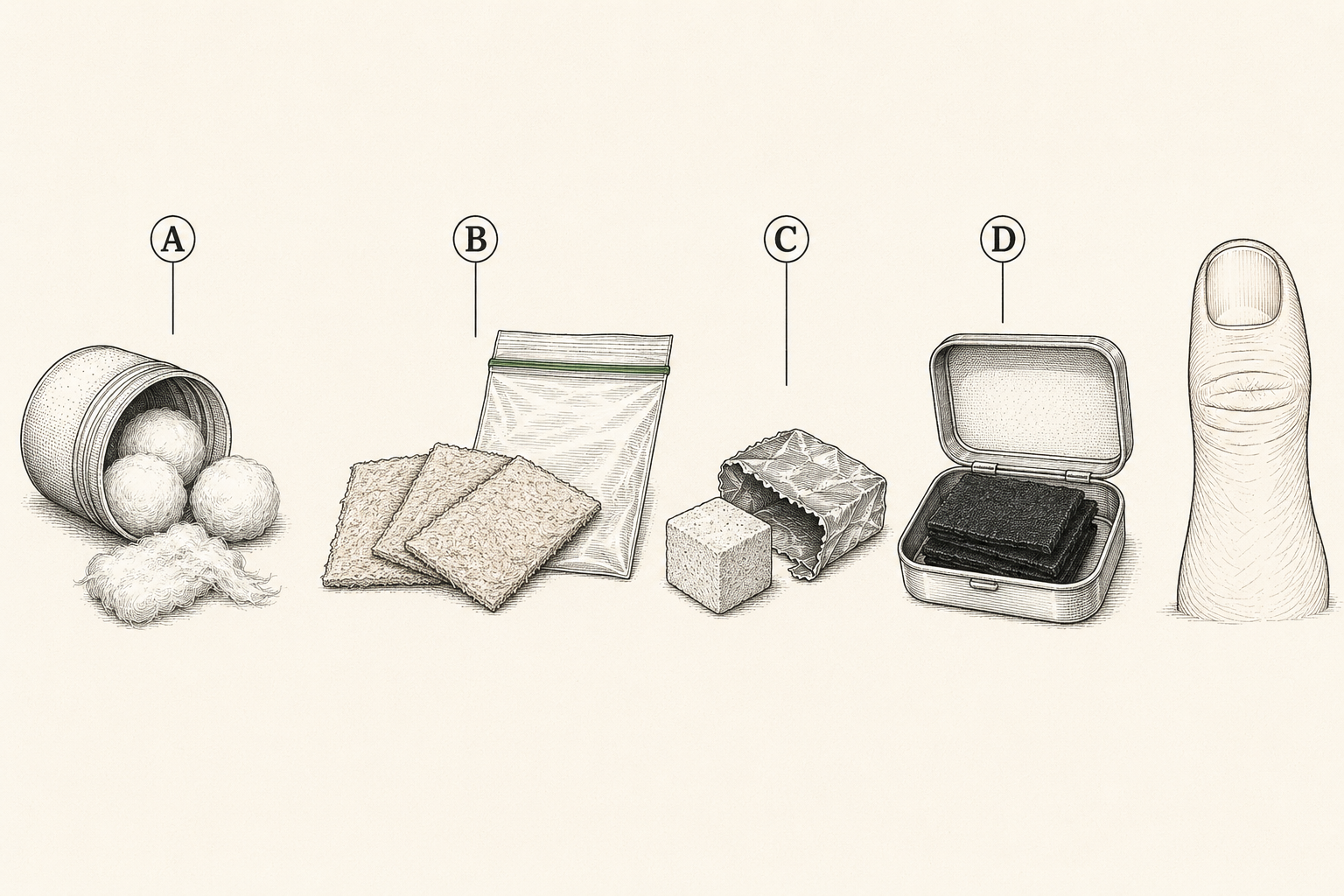
Work petroleum jelly into 100% cotton balls until saturated but not dripping, and you’ve made the best value in survival gear: a spark-catching wick that burns several minutes per ball.
The jelly does two jobs: it waterproofs the cotton against humidity, and it acts as lamp fuel, with the cotton as wick. Preparation is a kitchen chore. Knead a spoonful of jelly into each ball, squeeze out the excess, and pack them into something waterproof (a film-style canister, a small zip bag, a straw segment sealed at both ends with pliers and a lighter for single-serving versions).
Use is where beginners stumble, so:
- Pull the ball apart first. Tear it half open and fluff the dry inner fibers into a bird’s nest. Sparks catch fluff, not a greasy lump.
- Spark into the fluff. One good ferro-rod pass lights it. The flame starts small, then the jelly joins in and settles into a steady candle-like burn.
- Build over it, not on it. Bridge your kindling above the flame so the ball keeps breathing.
The one spec that matters at the store: real cotton. Synthetic “cosmetic puffs” melt into a smolder instead of flaming. Check the bag.
Commercial tinder: tabs, cubes, and pastes
Commercial tinders trade a little money for cleanliness and shelf life. Fiber-based tabs are the pick for tiny kits: dry, light, packable into corners, and each tab fluffs open to catch a spark and burn a few minutes.
The market has three families. Fiber tabs (wax-impregnated fiber, sold under several names) behave like a dry, tidy cotton ball; they also wedge into a tin’s empty corners, which quietly stops the kit from rattling. Solid cubes light even soaked and shave into a pile for a faster catch, but a few brands dry out over years if their foil pouch is breached; date them. Pastes and gels work but bring the failure mode of every tube in a kit: puncture, and everything you own is flammable and greasy.
Recommendation: fiber tabs in the sealed tin because they don’t age meaningfully, cotton balls everywhere space allows because nothing beats the cost. Cubes for wet-climate packs. Skip the tubes.
Char cloth: the heirloom option
Char cloth is cotton fabric baked into black carbon in an airtight tin. It catches the faintest spark as a growing ember rather than a flame, and you can make an endless supply from worn-out T-shirts.
Making it is a campfire craft: squares of 100% cotton go into a small tin with a nail hole in the lid, the tin goes into coals, smoke jets from the hole for several minutes, and when the smoke stops, the cloth inside has become fragile black squares. A spark that would die on almost anything else lands on char cloth and spreads as a glowing edge; you fold the ember into a tinder bundle and blow it to flame.
Be honest about its role in a modern kit. Char cloth needs a dry bundle and breath technique, it crumbles under rough carry, and everything it does, a jelly ball does with less ceremony. It stays in this book for two reasons: it’s the natural companion to sparking methods when your other tinder is spent, and making it teaches fire behavior better than any paragraph. Craft skill, not core equipment.
Candles: the flame that waits
A candle converts one match into unlimited tries. Light the candle first, then light the fire from the candle, and wind gusts stop costing you matches.
That match-multiplier role is the survival case for candles, and it’s why a stub lives in even tin kits. The supporting résumé is long: steady light for camp chores, a morale fixture on a bad night, gentle heat that dries damp tinder held above it, and wax that waterproofs thread and lubricates zippers. In a vehicle kit, a squat multi-wick candle in a can plus a cracked window provides real warmth in a stranded car (with the carbon monoxide respect Chapter 2 taught).
Picks by kit: birthday-candle stubs or a trimmed votive for tins (trim any candle to fit; wax doesn’t care), standard emergency candles for packs, canned multi-wick for vehicles. Skip anything scented, and skip “windproof relighting” novelty candles; the job is a tame flame, not a stubborn one.
Natural tinder: know it, don’t count on it
Learn five natural tinders for your region and treat them as extenders for the tinder you carry. Dry grass heads, birch bark, conifer resin, fatwood, and the fluff of seed down cover most of North America.
The carry-tinder doctrine isn’t an excuse to stay ignorant; it’s insurance while you learn. Birch bark’s oils burn hot even damp, and gathering it from deadfall costs the tree nothing. Fatwood (resin-saturated pine heartwood from old stumps) shaves into shavings that light like a ferro rod’s dream. Standing dead grass, cattail down, and finely shredded inner bark of dead branches all catch well on a dry day. The craft that binds them: everything fine, everything dead-dry, fluffed into a fist-size nest, gathered before you’re desperate, and doubled in quantity because the first attempt is rarely the last.
Rain flips the menu. After a day of weather, dry material lives inside things: split open dead standing wood for its dry heart, shave the damp exterior off twigs, look under overhangs and dense evergreens. That work takes time, energy, and a good blade, which is to say: it’s exactly the bill your carried tinder pays so you don’t have to.
How much to carry
Count fires, not grams: one ball or tab equals one fire attempt, so carry at least six attempts in a tin kit and a dozen or more in a pack, doubled in wet climates.
Tinder is nearly weightless, which makes under-packing it pure oversight rather than tradeoff. The math above already includes honesty about failure: wind steals an attempt, wet kindling eats another, and a real bad night might spend three attempts on one eventual fire. Rotate nothing except cubes with dates and any candle that summered in a hot car (they warp into modern art but still burn).
Wedge tabs into kit corners, flatten a foil-wrapped jelly ball into the wallet, tape a birthday candle inside the tin lid. Tinder’s other virtue is that it fits where nothing else does.
Pack This Chapter
- Carried tinder converts a spark into a certainty. Found tinder is a skill and a gamble; keep both, trust one.
- Petroleum jelly cotton balls: pennies each, several minutes of flame, fluff before sparking. Verify 100% cotton.
- Fiber tabs for sealed tins (ageless, corner-filling), cubes for wet climates, no tubes of paste in kits.
- A candle stub multiplies matches: light the candle, light the fire from the candle.
- Six fire attempts in a tin, a dozen in a pack, double in wet country.
Where Kits Fail
- A spark tool and nothing to spark into. The ferro rod rides for years next to zero prepared tinder. Attempts, not equipment.
- The greasy lump. An unfluffed jelly ball shrugs off a dozen strikes. Tear it open; sparks want fibers.
- Synthetic cotton balls. They melt and smolder. Read the bag: cotton, not “cosmetic fiber.”
- The punctured paste tube. One pinhole and the kit is a lubricated fire hazard. Solids only in packed kits.
Frequently asked
What’s the best homemade fire starter?
Cotton balls saturated with petroleum jelly, packed in a waterproof canister. Each ball lights from a single ferro-rod spark and burns several minutes, long enough to dry and ignite marginal kindling. A bag of cotton and a jar of jelly makes years of them for a few dollars.
How do you make char cloth?
Put squares of 100% cotton in a small tin with one nail hole in the lid, set it in campfire coals, and let it smoke until the jet stops, usually several minutes. Cool it sealed. The black squares inside catch even weak sparks as a spreading ember you fold into a tinder bundle.
Why put a candle in a survival kit?
It converts one match into unlimited attempts: light the candle once, then feed the fire from a flame the wind can’t easily kill. It’s also steady light, a tinder-dryer, and real warmth in a stranded vehicle. A trimmed stub costs nothing and fits any tin.
What natural tinder works when everything is wet?
Birch bark and fatwood are the wet-day champions: both carry flammable resins that burn regardless of surface damp. Otherwise, dryness hides inside things: split standing deadwood for its heart, shave twigs past the wet layer. All of it costs time and blade work, which carried tinder exists to spare you.