What power does an emergency kit need?
A 10,000 mAh power bank, the right cables, and disciplined spare batteries cover the power function for most kits. The phone is the device you’re really provisioning for; everything else is secondary.
Power is the newest survival function and the easiest to get wrong, because it hides in plain sight. Nobody forgets fire; everybody forgets that the map, flashlight, signal mirror, and rescue line in their pocket all die together at 0%. Chapter 3 made the phone Layer 0’s crown jewel. This chapter is the maintenance contract: the stored energy, connectors, and habits that keep it, and the rest of your electronics, alive through the event.
Size the function to the kit like everything else: a charged bank and cable in the day pack, a bigger bank plus spare cells in the go-bag, and the vehicle turned into the generator it already is.
Sizing the power bank
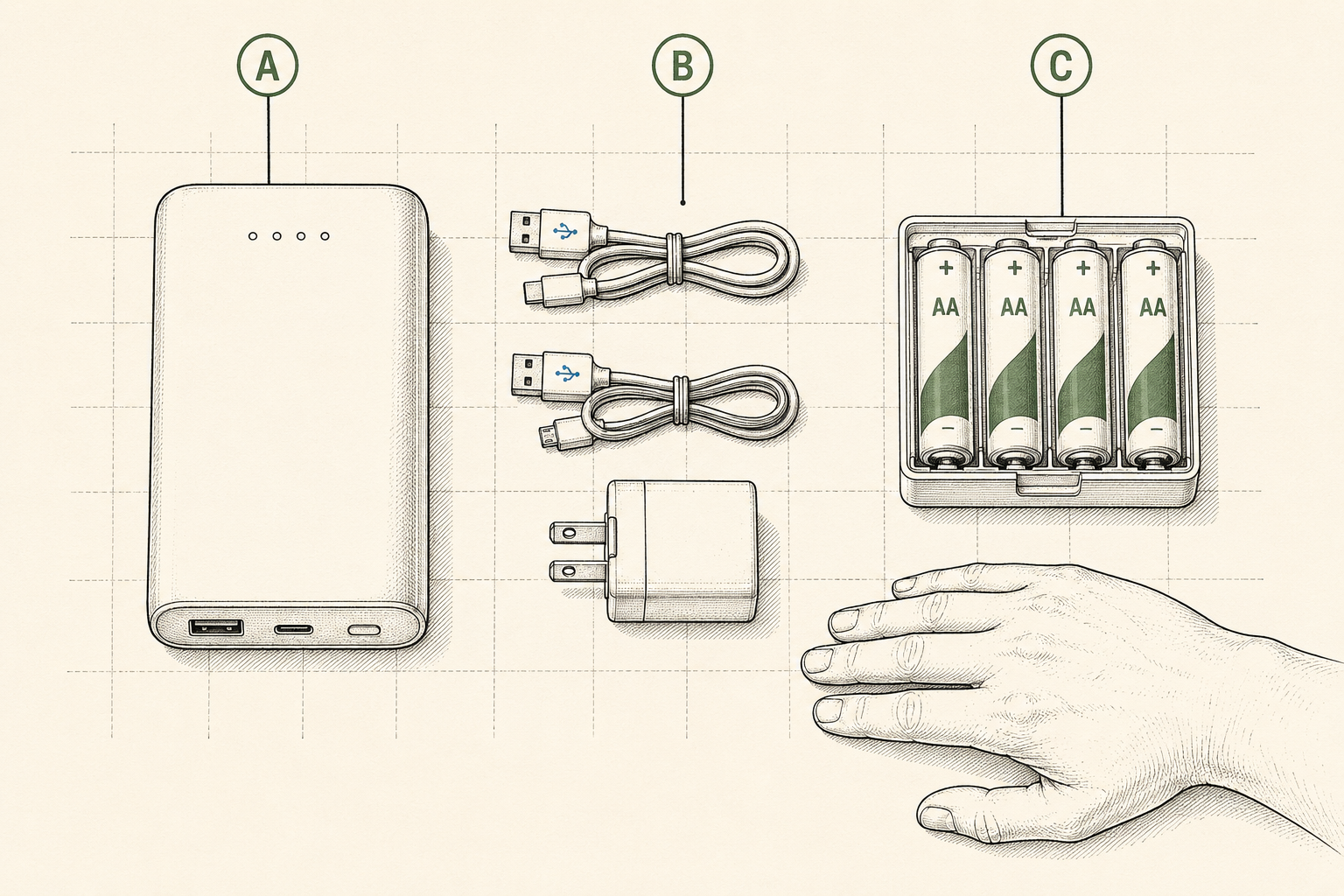
A 10,000 mAh bank recharges a typical phone one to two times and weighs about half a pound (230 g); that’s the day-pack and go-bag sweet spot. Match the bank to days of need, not to the biggest number on the shelf.
The honest math first: a bank’s rating measures its cells, and conversion losses mean you deliver roughly 60–70% of it to a device. A modern phone holds on the order of 4,000–5,000 mAh, so 10,000 nominal yields one to two real refills, 20,000 yields three to four and doubles the weight. The failure profile is storage decay: banks self-discharge over months, so a stored bank is a scheduled item, recharged on the same calendar that rotates your water (Chapter 41). Store them around half charge or better, cool, and never loose against metal objects.
Buying tells, per Chapter 6: mass is hard to fake (a feathery “20,000 mAh” bank is lying), and established electronics brands beat marketplace mystery boxes for the one item in your kit that is literally a box of stored fire.
Cables and connectors: the cheap failure
A power bank without the right cable is dead weight, so the kit carries its own short cables, chosen for your actual devices, and audited whenever a device changes. Ten dollars of cable discipline saves the whole function.
USB-C has mercifully conquered most of the world (phones, headlamps, banks, even recent satellite messengers), which makes the baseline kit loadout simple: one short C-to-C cable, one legacy adapter for whatever stragglers you own, and a wall plug for the recharge phase after the emergency. Short cables beat long in kits: less tangle, less weight, fewer failure points. Tape a spare cable flat somewhere it can be forgotten safely; cables fray, walk away, and get borrowed with the best intentions.
The audit habit matters more than the initial packing. Devices turn over every few years; kits sleep longer than that. When any household device changes connector, the kit’s cable bag gets ten seconds of attention. Write it into the seasonal swap.
Phone doctrine in an emergency
Stretch a phone’s battery by treating it as a beacon, not an entertainment center: low-power mode, airplane mode with GPS on when navigating, screen dim, and long check-in intervals instead of a live connection.
The phone’s radios are its appetite. In dead or fringe coverage, the cell radio hunts towers at full power and can drain a battery in hours doing nothing useful; airplane mode ends the hunt while leaving GPS (a receive-only system) available to your offline maps (Chapter 19). The working rhythm in an extended event: airplane mode as home state, brief scheduled windows for calls or texts, texts favored over calls (they need seconds of connection and queue for delivery), screen at minimum, and the phone kept warm in cold weather, because lithium chemistry sags in the cold and a “dead” freezing phone often revives against your body.
Signal doctrine belongs to Chapter 17, but its power corollary lives here: the moment you suspect a long event, the phone goes on rations. Half a battery managed well outlasts a full battery spent like a normal Tuesday.
Spare cells: the standardization payoff
Carry spares only in the one cell size you standardized on in Chapter 9, as lithium primaries, in a case that keeps terminals apart. A dozen loose mixed batteries is not a power plan; it’s a drawer.
The doctrine compounds nicely. One size means every spare feeds every device, means you can count capability at a glance (four AAs = two headlamp reloads = so many nights), means rotation is one purchase instead of a scavenger hunt. Lithium primaries earn the stored-kit slot on shelf life (roughly 20 years) and cold performance; the premium over alkaline is the cheapest insurance in the power function. Terminal protection isn’t fussiness: loose cells shorting against keys or steel wool (Chapter 7 already warned you) is a real ignition source, and a two-dollar plastic caddy retires the risk.
Devices with built-in proprietary batteries (most modern messengers, some headlamps) get a different discipline: they join the power bank on the recharge calendar, and the bank becomes their spare.
Solar, honestly
A small folding solar panel is a trickle tool for multi-day events, not a rescue for a dying phone this afternoon. It earns space in home kits and extended go-bags; it rarely earns day-pack weight.
The physics sets expectations. A packable 10–20 watt panel in real conditions (angle drift, haze, short winter sun) delivers a fraction of its rating; a day of decent sun might refill a phone once or feed the power bank meaningfully. That’s genuinely valuable across a week-long grid outage and nearly irrelevant across one bad night, which is why the recommendation tracks duration: home kit yes, 72-hour bag optional, day kit no (the bank simply wins at that timescale).
Usage craft, quickly: charge the bank rather than the phone directly (banks tolerate solar’s fickle output better and bank the sun for night), angle the panel at the sun rather than flat, expect cold sun to beat hot haze, and buy from the same honest-brand shelf as the bank. Hand-crank chargers, while we’re being honest: a workout that buys minutes of phone. Weather radios with crank charging are fine as radios; as chargers, they’re morale equipment.
The vehicle as power plant
Your car is a generator with seats: a 12-volt outlet and a small inverter or USB adapter turn a quarter tank of fuel into days of phone and light charging. The vehicle kit’s power module is an adapter, a cable set, and a jump pack.
Idling for charge is the technique to know before the night you need it. A modern engine idled for 15–20 minutes now and then keeps devices and the jump pack topped while burning modest fuel; the carbon monoxide law from Chapter 2 applies in full (exhaust clear, ventilation cracked, never in a closed garage). The lithium jump pack itself is the vehicle kit’s quiet star: it starts the car without a second vehicle, and its USB ports make it a jumbo power bank between rescues. It joins the recharge calendar like every stored battery.
For home kits scaling past this chapter: dedicated power stations (big lithium banks with AC outlets) are the current answer to multi-day outages, sized in watt-hours and priced accordingly. They’re covered with the home build in Chapter 34; the doctrine is identical, only heavier.
Pack This Chapter
- Power is a survival function now. Provision the phone first: bank, correct cables, doctrine.
- 10,000 mAh is the pack sweet spot (one to two phone refills); expect 60–70% of any rating to reach the device.
- Lithium primaries in stored kits, one standardized size, terminals protected. Banks and rechargeables live on the rotation calendar.
- Phone rationing: airplane mode home state, GPS-only when navigating, scheduled text windows, keep it warm.
- Solar is for multi-day events; the car is the real generator (with CO respect); the jump pack is a power bank that starts engines.
Where Kits Fail
- The right bank, the wrong cable. Full charge, incompatible plug. Audit cables when any device changes.
- The bank that slept a year. Self-discharge finished it quietly. Stored electricity is a calendar item, not a purchase.
- Loose cells in a junk pouch. Mixed sizes, touching terminals, one steel-wool neighbor away from being Chapter 7. Caddy, one size, lithium.
- Streaming through the outage. A phone spent like a normal Tuesday dies by midnight of day one. Rations start when the event does.
Frequently asked
How big a power bank do I need for emergencies?
10,000 mAh covers a day pack or 72-hour bag: one to two full phone charges after conversion losses. Go 20,000 for multi-person bags if the doubled weight is acceptable. Past that, you’re into solar-plus-bank or a vehicle charging routine rather than a bigger brick.
Do solar chargers actually work for survival kits?
Over days, yes; over hours, no. A packable panel in honest sun can refill a phone or feed your bank daily, which matters in a week-long outage. It cannot rescue tonight’s dying phone. Match it to duration: home kit yes, go-bag maybe, day kit skip.
How should I store batteries long term?
Lithium primary cells, one standardized size, in a caddy that separates terminals, kept cool and dry inside the kit. They hold roughly 20 years and don’t leak. Rechargeable banks and devices join a twice-yearly top-up calendar instead, because self-discharge drains them silently across months.
How do I keep my phone alive with no power?
Ration the radios before the screen. Airplane mode stops the tower hunt that devours batteries in fringe coverage; GPS still works for offline maps. Text in brief scheduled windows, dim everything, and keep the phone warm in cold weather. Managed this way, half a battery spans days.