How much water should you store and carry?
Plan on one gallon (3.8 L) per person per day: half for drinking, half for food and hygiene. Kits carry a fraction of that plus the means to treat more; homes store the real volume, at least a three-day supply and ideally two weeks.
The gallon figure is the standard planning baseline. It assumes mild weather and modest work. Heat, exertion, illness, pregnancy, and children raise it. What the number teaches is humility: water is heavy, at 8.34 lb per gallon (1 kg per liter), so nobody carries days of it. Nobody. It’s physics. Every layer of your system therefore splits the function in two: carried water for now, and capacity plus treatment (Chapter 11) for later. This chapter is the container half of that bargain.
The split by layer, as this book builds it: pocket kits carry capacity only (a folded pouch and tablets), day packs carry 1–2 liters plus filter, go-bags carry 3 liters per person plus treatment, vehicles store gallons, homes store the two-week supply.
Collapsible pouches: capacity that weighs nothing
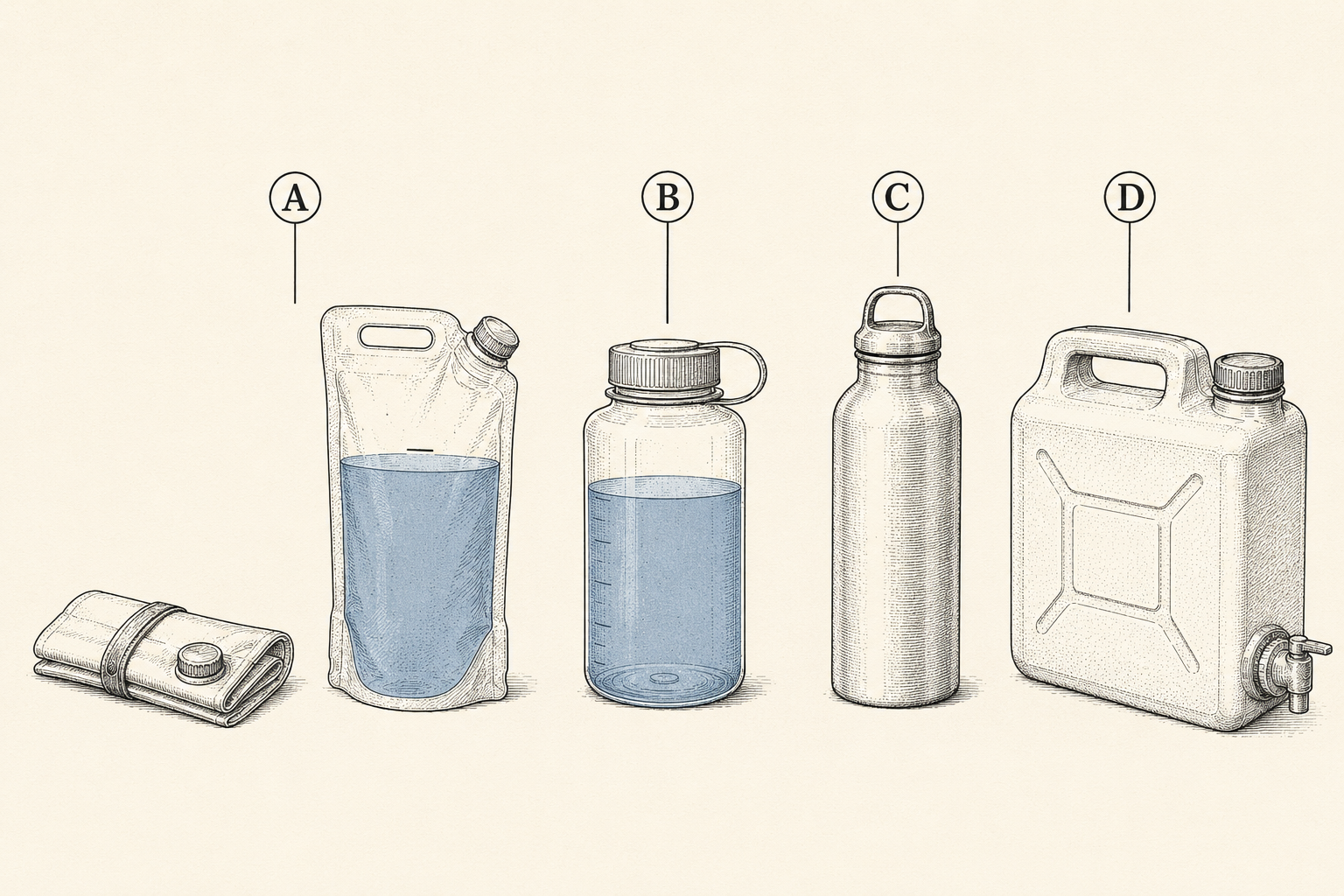
A folding water pouch gives a pocket kit the ability to hold a liter while weighing and costing almost nothing. It’s the single highest-value water item in the small layers. One ounce, one liter.
Treatment without a vessel is a chemistry set without a beaker, which is why the humble pouch outranks fancier gear. Modern soft bottles and pouches are laminated films with welded seams: rolled flat they vanish into a tin or wallet pocket, filled they stand duty as canteens. Their weaknesses are punctures and abrasion, so they ride inside kits, not clipped to packs, and the pack version gets retired at the first weeping seam.
Two craft notes earn their keep. Mark a fill line: pre-measure a quart or liter at home and score the pouch with permanent marker, so tablet dosing (one per liter) stops being a guess.
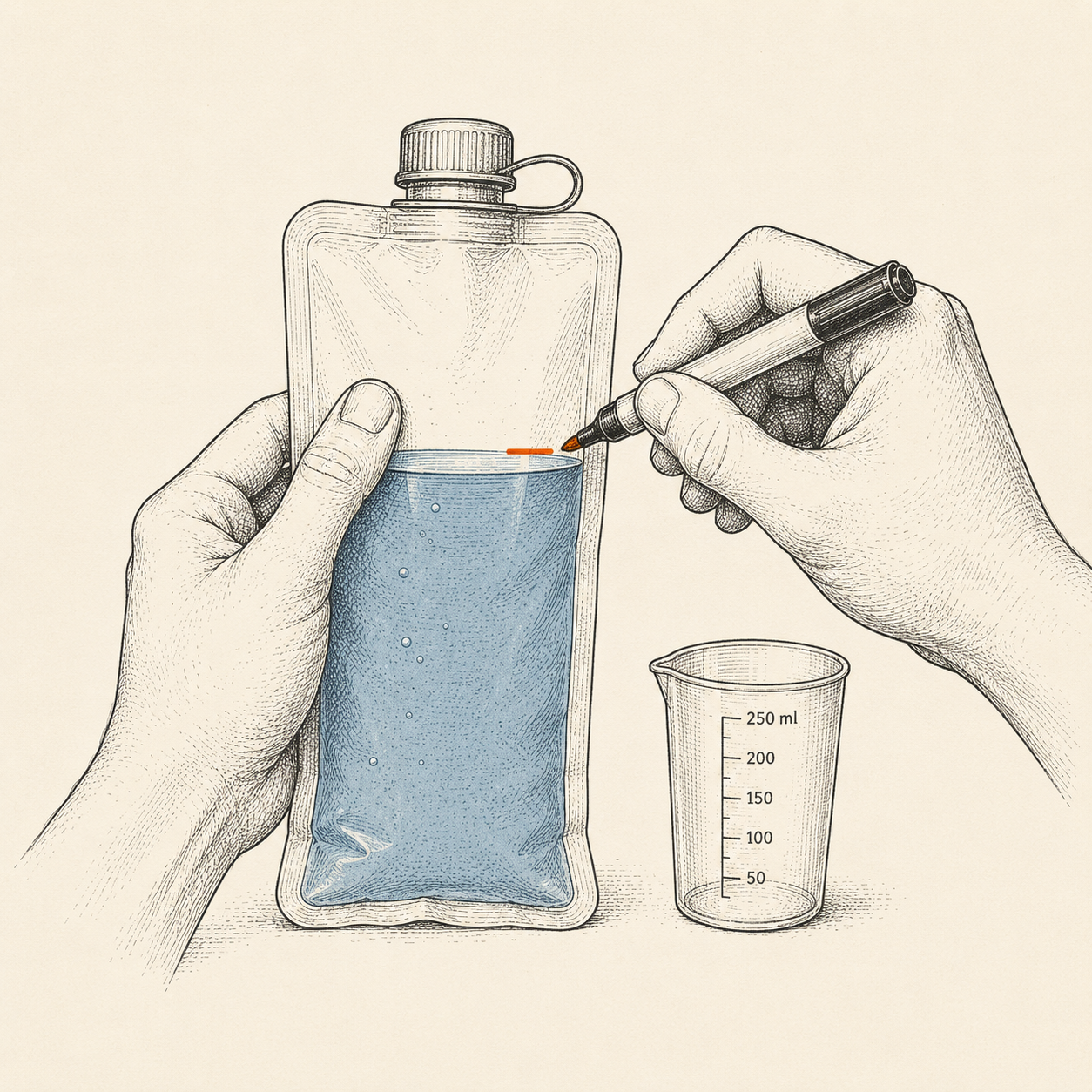
And carry two in bigger kits: dirty-marked for collection, clean for treated, which is Chapter 11‘s container discipline made physical. Heavier oven-style bags and zip freezer bags from Chapter 27‘s multi-use shelf improvise the same job when the purpose-made pouch is elsewhere.
Hard bottles: the daily workhorses
A single-wall plastic or metal bottle is the pack’s primary: indestructible in ordinary use, wide-mouthed for filling and filter-threading, and (metal, single-wall only) able to boil its own contents in a fire.
The single-wall metal bottle is quietly one of the most capable objects in this book: canteen, boiling vessel, snow-melter (Chapter 4), and hot-water bed warmer wrapped in a sock. Insulated double-wall bottles refuse all of that (the vacuum wall ruptures in fire) and freeze-protect your water instead; know which one you own before it meets flames. Hard plastic bottles skip the boiling résumé but win on weight and price. You can see through them too, which makes dosing and cleanliness visible.
Standardization pays again here: pick a common bottle-mouth size and your filter, cup (Chapter 15), and spares all interlock. In freezing weather, store any bottle upside down; ice forms at the top, which is now the bottom, and the threads stay free.
Bladders and hydration systems
Hose-and-bladder hydration systems excel at keeping you sipping on the move and annoy everyone at everything else: hard to fill, hard to clean, hard to see, and one bite-valve failure from soaking a pack.
The honest case for them is behavioral: people drink more when drinking is effortless, and steady sipping beats binge-drinking at stops. For long hikes that’s a real win. As emergency equipment they’re middling: you can’t easily boil into them, dose tablets by feel, or inspect their cleanliness, and in freezing weather the hose is the first casualty (blow it empty after each sip, or retire the system for winter).
The kit verdict: fine as the daily-carry comfort item on the pack you already hike with, never as a kit’s only water vessel. Every build in Part III that includes a bladder also includes a bottle, and the bottle is the one the emergency plan counts on.
Vehicle and home storage
Vehicles store water in rigid containers, partly empty to survive freezing, rotated twice a year. Homes store the two-week supply in food-grade containers, cool and dark, refreshed on the same calendar as everything else in Chapter 41.
The vehicle problem is temperature. Summer cooks water into plastic-flavored soup (unpleasant, and a reason to favor sturdy containers and rotation) and winter freezes it solid (a reason to fill containers to 90% or less, since ice expands, and to favor several medium containers over one large: they thaw faster against a heater vent). Single-serving retail bottles tolerate freezing well and hand out conveniently, making a flat of them a legitimate trunk answer despite the plastic waste.
Home storage is easier. Use sturdy food-grade containers, filled from the tap (municipal water stores well), kept off concrete and away from sun and solvents, dated, and rotated every 6–12 months. Two weeks for a household is a real volume (a family of four is looking at 56 gallons / 212 L), which is why Chapter 34 treats it as furniture: stackable containers with a corner of their own, not an afterthought under the sink.
Found containers and improvisation
In a pinch, water rides in anything clean, waterproof, and closable: zip bags doubled against pinholes, the trash-bag-lined daypack, a rain jacket hood, a boot in genuine desperation. Improvisation is a bridge to real containers, not a plan.
The improviser’s checklist is short: was it food-safe or at least chemical-free, can you close it, can you carry it without wearing the contents. Contractor bags (Chapter 27) line anything into a bucket. Condoms, the survival literature’s favorite party trick, genuinely hold a surprising volume inside a sock or sleeve for protection, and genuinely burst at a glance; treat the trick as trivia that occasionally matters. Better improvisations are usually lying around: every disaster scene is littered with discarded bottles, and a rinse plus treatment (Chapter 11) returns them to service.
What improvisation can’t fix is planning’s job: the reason your kit carries a folded pouch is so this section stays theoretical.
Managing water in the field
Drink your water and replace it at every opportunity; a full bottle at a source is storage, and your body is the right container. Drink it. Ration sweat before you ever ration water.
Chapter 4‘s desert doctrine generalizes: dehydration degrades judgment within a day (Chapter 2), and hoarded water helps no one from inside a bottle. The working rhythm: top off at every reliable source whether or not you’re thirsty, treat ahead so a clean liter is always finishing its wait, and schedule effort around heat instead of powering through it. Clear, pale urine is the gauge that needs no batteries; dark and scant means you’re already behind.
Cold weather hides the same problem under a coat: dry air and heavy breathing spend water invisibly, thirst arrives late, and cold-numbed drinking discipline fails quietly. Warm drinks (Chapter 15) solve hydration and morale in one cup, which is the kind of twofer this book exists to point out.
Pack This Chapter
- One gallon (3.8 L) per person per day is the planning baseline; heat, work, and kids raise it. Water weighs 8.34 lb/gal (1 kg/L), so carry some and treat the rest.
- Folding pouch in every small kit, marked with a fill line for dosing. Two vessels once size allows: dirty collection, clean treated.
- Single-wall metal bottle is the multi-tool of water carriage: canteen, boiler, snow-melter. Know single-wall from insulated before fire is involved.
- Vehicles: rigid containers at 90% full, rotated twice yearly. Homes: two weeks stored (56 gal / 212 L for four), dated, cool and dark.
- Drink and refill; hoarding dehydrates. Pale urine is the free gauge.
Where Kits Fail
- Treatment with no vessel. Tablets rattling next to nothing to dose. The one-ounce pouch is the fix nobody remembers.
- The insulated bottle in the fire. Double walls rupture over flame. One bottle in every kit must be honest single-wall metal.
- The trunk jug, frozen solid or sun-brewed. Stored full in November, undrinkable either way by the time it matters. Ninety percent full, rotated, several smaller containers.
- Bladder-only hydration. Unboilable, undoseable, and one bite valve from soaking the kit. A bottle backs up every hose.
Frequently asked
How much water should I keep in an emergency kit?
Carry what the layer can bear and store the rest: 1–2 liters in a day pack, 3 liters per person in a go-bag, gallons in the vehicle, and a three-day to two-week supply at home at one gallon (3.8 L) per person per day. Every layer also carries treatment, because stored water ends.
How long can you store water?
Municipal tap water in clean, food-grade, sealed containers stays safe for six months to a year stored cool and dark; commercial bottled water is best rotated by its date. Stored water doesn’t spoil so much as pick up taste and risk from its container. Date everything and rotate on the seasonal calendar.
What’s the best water container for a bug-out bag?
One hard bottle (single-wall metal if you want a boiler) plus one or two soft collapsible pouches per person. The hard bottle survives daily abuse and interfaces with filters; the pouches add cheap capacity for treating ahead and for the dirty-clean split that keeps treatment honest.
Can you drink melted snow?
Yes, once it’s actually melted; eating snow spends core heat you can’t spare (Chapter 4). Melt it in a single-wall metal vessel, and treat the result if you can, since snow is filtered through air rather than certified by anyone. Old, dirty, or pink-tinted snow gets treated, no debate.