What food belongs in an emergency kit?
Food that needs no cooking, survives storage abuse, and delivers dense calories: ration bars for kits, retort pouches and freeze-dried for bags and homes, and familiar pantry food for the two-week home supply. Buy for shelf life and zero preparation first, taste second, but never taste last.
Chapter 2 put food at the back of the priority line, and nothing here reverses that. What this chapter adds is the case for carrying it anyway: calories are heat in cold weather, fuel for the physical work every emergency demands, and the cheapest morale in the kit. A hungry person is a worse decision-maker, a colder body, and a gloomier companion. So food rides in every kit from the tin upward, sized to the kit’s duration (Chapter 4), chosen by rules this chapter makes explicit.
The rules compress to four: no-cook first (heat is never guaranteed), dense second (calories per ounce is the spec), durable third (heat, cold, crushing, years), and edible fourth, meaning something you’d actually eat, because appetite fails under stress and unfamiliar survival food fails it faster.
Ration bars: the kit food
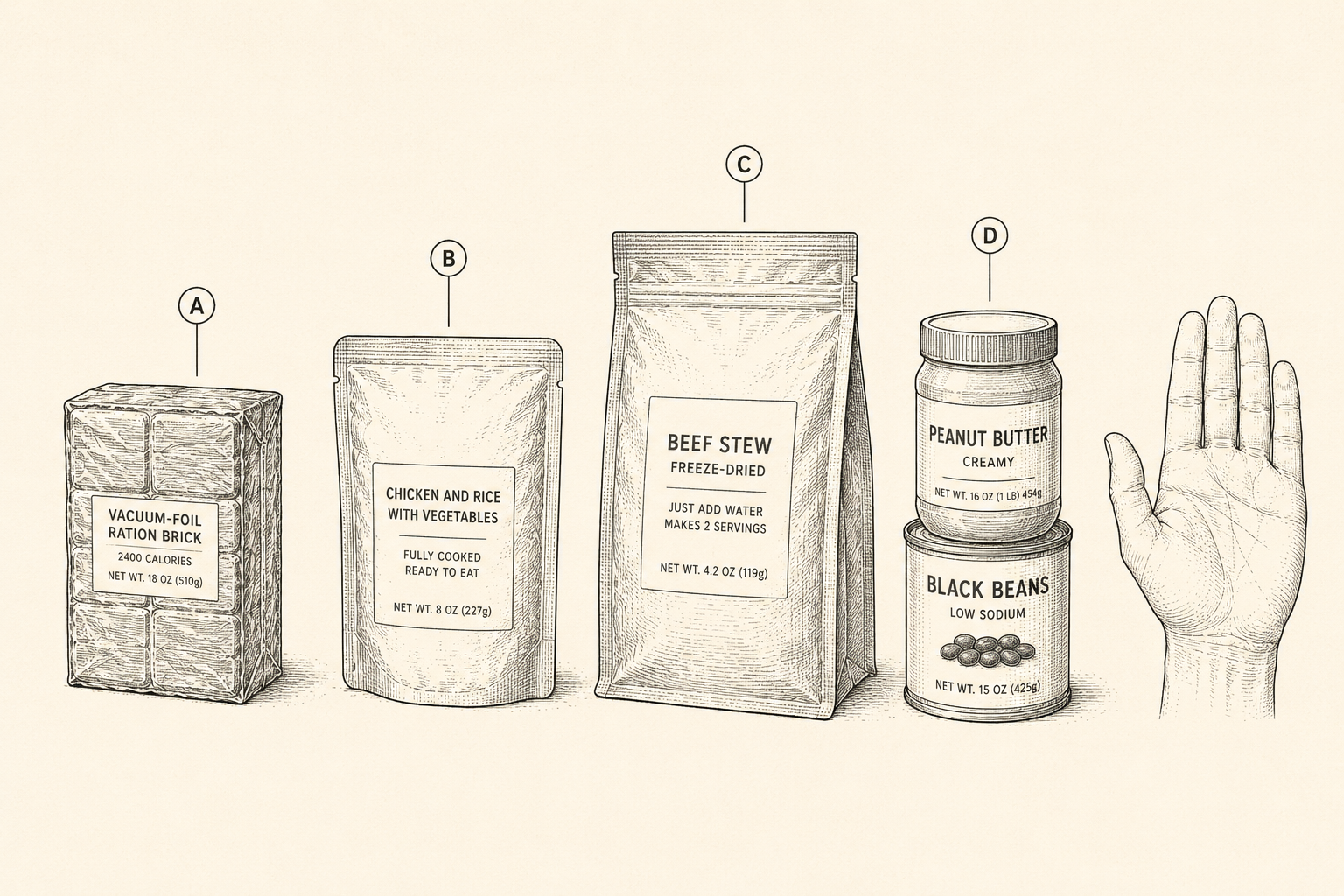
Lifeboat-style emergency ration bars are the kit-food benchmark: a vacuum-packed brick of 2,400 or 3,600 calories, a 5-year shelf life, and indifference to heat, cold, and rough handling. One brick is a person-day of survival eating.
These are the bars certified for marine lifeboats, which is exactly the pedigree you want: engineered for years in a hot locker followed by consumption in a crisis, no water or heat required, formulated not to provoke thirst. They taste like dense shortbread, which after the promises of this category counts as a pleasant surprise. The blocks score into segments for rationing, and the vacuum foil keeps everything inert until opened.
Their design constraints are the fine print: they’re survival calories, not nutrition (a few days of them is fine; a month is scurvy with extra steps), and their density makes them a brick in the pocket, which is why tins carry candy and bouillon instead while packs and vehicles carry the bricks. Buy the certified marine type from real suppliers (Chapter 6‘s counterfeit rules apply to food too), date them, and rotate at five years.
Retort pouches and MREs
Retort-pouch meals (the technology inside military MREs and grocery-store pouch entrées) are fully cooked, eat-cold-if-needed meals with a shelf life of roughly 3–5 years in cool storage. They’re the go-bag and vehicle upgrade: real food, zero preparation.
The military MRE is the famous version: entrée, sides, dessert, drink mixes, and a flameless heater in one impressively engineered (and impressively bulky) package. Civilian retort pouches deliver the same core benefit (a chemically sterilized, foil-sealed cooked meal) at grocery prices without the accessories. Both eat fine cold, better warm, and their shelf life obeys temperature above all: cool storage delivers the full 3–5 years, while a hot trunk can halve it and worse. That temperature sensitivity is the one operational fact to respect: vehicle-stored pouches rotate yearly, not aspirationally.
Weight is the honest cost. Retort food is wet food, so it carries its water everywhere it goes. For a vehicle that’s irrelevant; for a pack it’s the reason the next category exists. A middle path worth knowing: pouch entrées alone (no MRE accessories) deliver most of the value at half the bulk.
Freeze-dried: light now, water later
Freeze-dried meals are the lightest real food that exists (water removed, flavor mostly retained) with sealed shelf lives of 10–25 years or more by manufacturer rating. Their price is needing hot water, which makes them pack food for kits that carry a stove.
The technology removes nearly all the water while leaving structure and taste intact, which is why a two-serving dinner weighs like a paperback. For go-bags and home storage, #10 cans and pouches of freeze-dried staples are how two weeks of palatable eating fits on one shelf. For day-and-night kits, a meal or two adds hot-dinner morale at trivial weight.
The dependency is the design: no water and heat, no dinner (technically they rehydrate in cold water, slowly, as a morale-free paste). So freeze-dried slots in wherever Chapter 15‘s boiling capability already lives, and never as a tin kit’s food. Price per calorie is the other honest note: convenience-brand meals cost restaurant money, while staple ingredients in bulk cans cost pantry money. Chapter 34 leans on the second.
The pocket-kit food shelf
Tins and pocket kits carry morale-dense micro food: bouillon cubes, sugar or honey packets, tea or coffee, hard candy, and electrolyte powder. None of it is a meal; all of it changes an evening.
This shelf works because hot, sweet, and salty are the three flavors of recovery. Bouillon turns boiled water into soup and replaces sweat salt; sugar is immediate energy and makes iodine-adjacent water drinkable; caffeine papers over a rough night’s decision-making; hard candy occupies a worried mouth and meters out glucose. Electrolyte packets earn their gram everywhere heat or exertion lives (Chapter 4‘s desert doctrine and any hard-work scenario).
Everything on this shelf shrugs at storage: sealed sachets and wrapped candy tolerate years and temperature swings. The only real selection rule is the vacuum one: choose items whose wrappers survive compression in a packed tin, and re-bag anything papery.
The pantry method for homes
The home food supply isn’t survival food at all: it’s a deeper pantry of what you already eat, rotated through normal cooking, plus a modest no-cook reserve. Store what you eat, eat what you store.
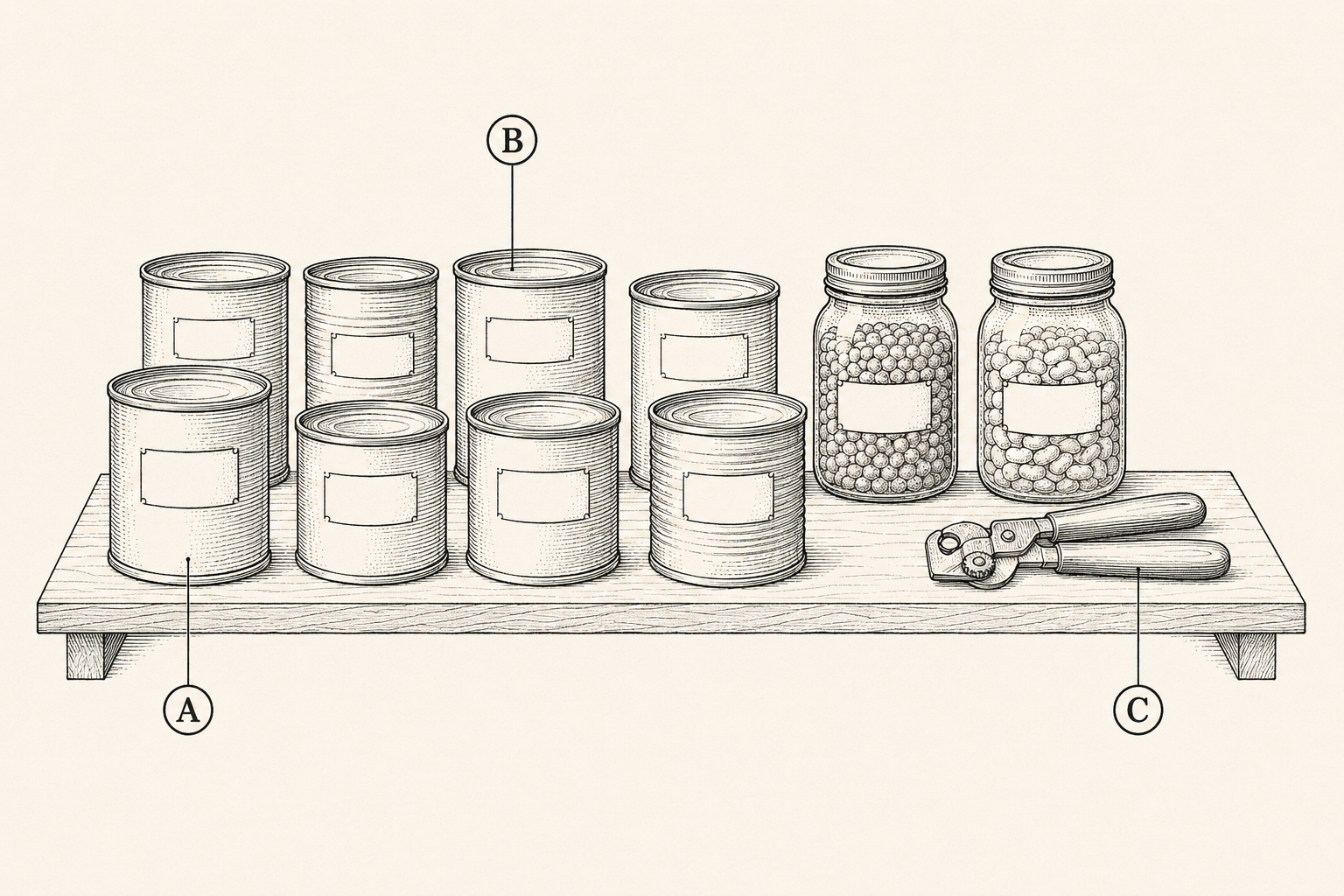
The two-week home target (Chapter 34 builds it fully) is best met with shelf-stable versions of your actual diet: rice, pasta, beans, canned proteins and vegetables, peanut butter, oats, oil, salt, coffee. Because the pantry rotates through daily meals, nothing expires unnoticed and nothing tastes foreign during a crisis, which matters when stress and picky children collide. The no-cook reserve (canned goods with pull tops, crackers, bars, shelf milk) covers the scenario where the stove is out too.
Two practical notes complete the method: a manual can opener stored with the cans (the electric one is a paperweight in the outage this pantry exists for), and Chapter 15‘s fuel math applied to whatever cooking you’re assuming, because a pantry that requires forty boil-hours needs a fuel plan to match.
Appetite, allergies, and the humans involved
Pack food people will actually eat under stress: familiar flavors, low chew-effort, no allergy landmines, and something for the picky and the young. Appetite failure is a real survival factor, not a character flaw.
Stress suppresses appetite while raising caloric need, an ugly combination. The countermeasures are choices you make at packing time: familiar beats novel (the granola bar brand from your normal life outperforms exotic survival cuisine), soft beats jaw-breaking (cold weather and dental luck both punish rock-hard food), and variety beats monotony across anything longer than a day. Sweet reliably survives appetite failure. Pack candy. That’s the serious argument hiding inside a silly sentence.
Allergies get engineering-grade respect: a nut-allergic family member makes half the survival-food aisle a hazard, so labels get read at purchase, not during the flood. Medications with food requirements, infant needs, and elder swallowing constraints all belong in the same audit, which is Chapter 39‘s whole subject.
Rotation without tears
Date everything at purchase with a fat marker, rotate by calendar rather than memory, and eat the retiring stock instead of ceremonially discarding it. Waste nothing; rotate everything. Food storage fails by neglect far more often than by spoilage.
The mechanics take minutes: purchase date and rated life written on every package as it enters a kit, oldest-first ordering in home storage, and the twice-yearly audit from Chapter 41 pulling anything within a season of its date into the kitchen. Most survival food remains perfectly edible somewhat past its rating (dates are quality promises more than safety cliffs, canned goods especially), but the kit rule stays strict because the kit exists for a day when “probably fine” is a lousy standard.
The eating part is the secret to sustainability: retired ration bars become hiking snacks, aging pouches become lazy dinners, and rotation becomes a habit with rewards instead of a chore with waste.
Pack This Chapter
- Food rules: no-cook first, calorie-dense second, storage-proof third, genuinely edible fourth.
- Ration bars (2,400/3,600 cal, 5-year) for packs and vehicles; micro-morale (bouillon, sugar, tea, candy, electrolytes) for tins.
- Retort pouches: real food, 3–5 years cool, heavy; rotate vehicle stock yearly. Freeze-dried: decades and featherweight, but hostage to hot water.
- Homes run the pantry method: deeper stocks of normal food, rotating through normal meals, plus a no-cook reserve and a manual can opener.
- Date everything, rotate by calendar, eat the retirees.
Where Kits Fail
- Cooking-dependent kit food. Freeze-dried dinners in a kit with no stove is packaging, not food. Match food to the kit’s heat reality.
- The trunk MRE, July edition. Heat halves retort shelf life and worse. Vehicle food rotates yearly or becomes a science exhibit.
- Exotic survival cuisine. Stress plus unfamiliar food equals uneaten food. Pack what your actual household actually eats.
- The undated stash. Five years of “recent” purchases, none labeled. A marker at purchase time is the whole fix.
Frequently asked
What food lasts longest in an emergency kit?
Certified ration bars hold five years anywhere; freeze-dried food in sealed cans claims decades in cool storage; honey, salt, and sugar are effectively immortal. The pattern: less water and less fat mean longer life, and cool storage stretches everything. Heat is the great shortener, especially for retort meals.
How long do MREs really last?
Plan on 3–5 years stored cool; the technology’s rating assumes roughly room temperature. Storage heat is the variable that matters: a consistently hot trunk can cut life to a year or so. Inspect before eating regardless: swollen, leaking, or off-smelling pouches retire immediately, whatever the calendar says.
How much food should be in a 72-hour kit?
About 2,000 calories per person per day is a working floor, so 6,000 per person for the bag, chosen entirely from no-cook items: ration bars, pouch meals eaten cold if needed, nut butters, bars, candy. Hungry-but-functional is acceptable for 72 hours; a stove is a bonus, never an assumption.
Is it worth buying expensive survival food buckets?
Sometimes, for the convenience of one purchase, but read the label math first: many buckets count thin drink-mix calories and assume ample cooking water. Bulk staples plus a rotating pantry deliver more calories per dollar, and familiar food beats bucket cuisine when stressed people actually have to eat it.