What’s the best emergency rescue device?
For most people who go beyond cell coverage a few times a year, a satellite messenger with an SOS button is the pick: two-way communication, tracking, and rescue dispatch for a device cost plus subscription. For pure set-and-forget emergency insurance, a personal locator beacon (PLB) wins: no subscription, five-year battery, one job done ferociously well.
This chapter didn’t exist a generation ago, and it changes the whole subject. Every signaling method in Chapter 16 hopes someone is looking; a satellite device tells someone, with coordinates, in minutes, from anywhere on the planet with sky. Search-and-rescue’s own data tells the story plainly: incidents involving satellite alerting resolve faster, with searchers going straight to a point instead of sweeping a probability area.
None of it replaces the whistle and mirror (electronics fail, and Chapter 16‘s tools guide the last hundred yards of any rescue), but for backcountry, offshore, and remote-road life, a satellite device is the single highest-impact purchase in this book. The rest of the chapter is choosing among three good options.
Personal locator beacons: the fire alarm
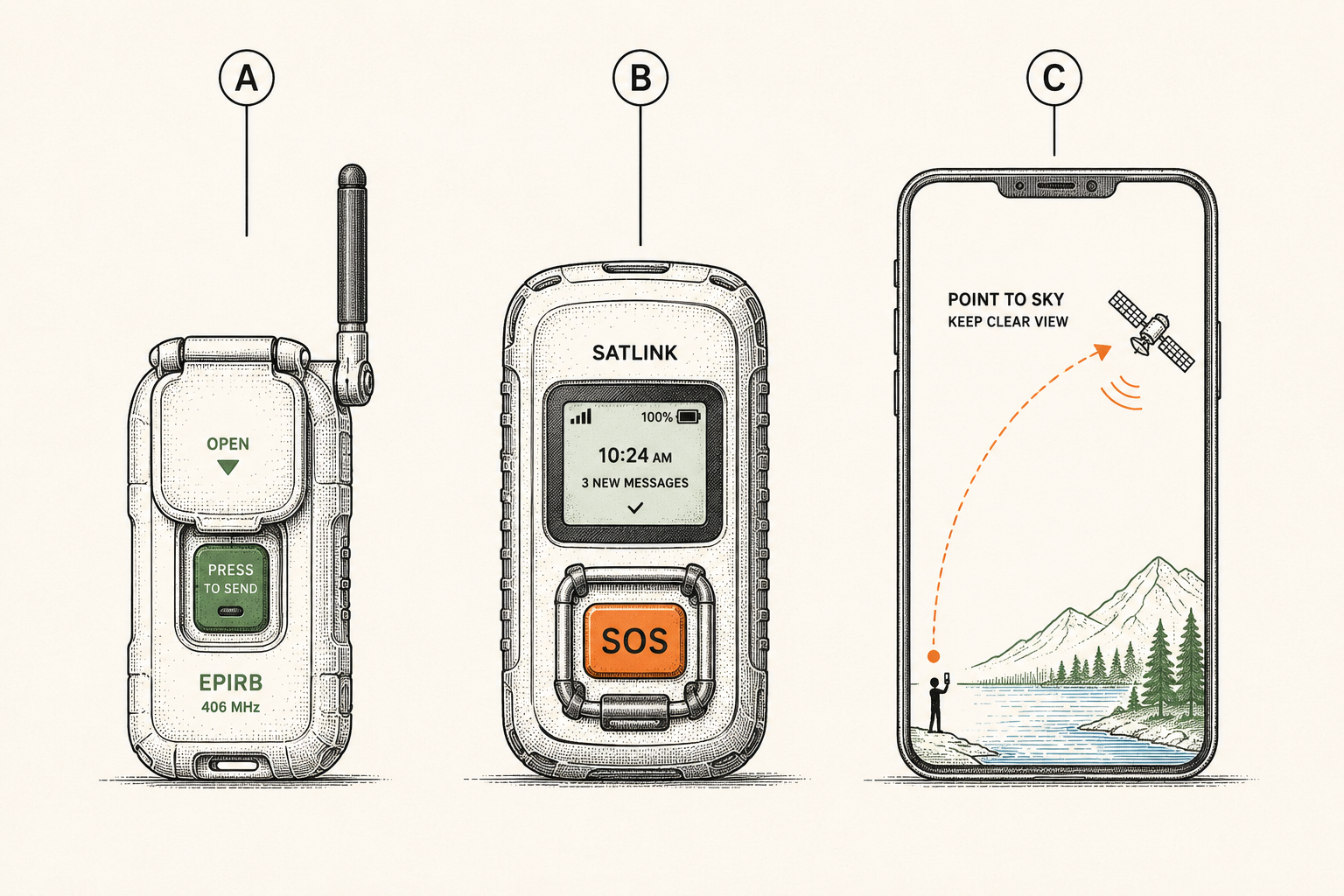
A PLB is a one-button distress radio: press it, and a 406 MHz signal reaches the international COSPAS-SARSAT satellite system, which relays your registered identity and GPS position to rescue authorities. No subscription, batteries rated five-plus years, transmission power that punches through weather and canopy.
The PLB is the category’s mature, government-integrated backbone. It has one job. Registration is free (in the U.S., with NOAA) and matters: your beacon’s ID maps to your name, emergency contacts, and trip details, so responders launch with context. The transmitter is strong (multiples of a messenger’s output), the homing signal guides aircraft the final miles, and the battery does nothing for years and then everything at once. That’s the design.
What a PLB doesn’t do defines its personality: no messaging, no “I’m fine, just late” option, no tracking for family, no cancel-and-explain. It’s a fire alarm: silent for years, then one loud unambiguous word. For sailors, hunters, and anyone who wants insurance without a monthly bill, that’s exactly right.
Satellite messengers: the conversation
A satellite messenger adds two-way text over commercial satellite networks: SOS with a live dialogue to a response center, check-ins to family, tracking breadcrumbs, and weather. The cost is a subscription and a battery you must manage.
The two-way part changes the kind of rescue you get, beyond its speed. Responders can ask “what’s the injury?” and “can you move?”, tailor the response (a helicopter for a broken femur, a walking team for a sprain), and tell you help’s timeline, which transforms a night of unknowns into a night of waiting. The non-emergency tier matters as much in practice: “running late, all fine” texts prevent a meaningful share of searches from ever starting, since worried families trigger many of them.
The costs are structural. Subscriptions lapse. Batteries need Chapter 10‘s calendar. And messengers carry slightly less transmission brawn than a PLB (modern networks and devices make this mostly academic under open sky; dense canopy and slot canyons still favor the PLB’s power). Buy from the established players, keep the firmware current, and learn the interface before the trip, not during the femur.
Phone satellite SOS: the layer you already own
Recent phones can text emergency services by satellite with no cell coverage: a genuine, already-in-your-pocket rescue channel. Treat it as the excellent backup it is, not the dedicated device it isn’t.
Since roughly 2022, flagship phones (Apple first, Android following) added satellite SOS messaging, and it has real saves to its name. Know its shape: it wants open sky and patient aiming (the phone walks you through pointing at a satellite), it’s messaging-based (slow exchanges, not a beacon’s shout), availability varies by model, region, and service terms, and it runs on the same battery as your map, light, and camera, which Chapter 10 already taught you to ration.
The doctrine this book recommends: know your phone’s capability today (check it in settings now, not on a ridgeline; it takes two minutes), treat it as the always-carried backup layer, and let anyone with real backcountry habits still carry a dedicated device. The phone made everyone safer; it made dedicated devices obsolete for almost no one who actually leaves the road often.
Choosing among the three
Match the device to your exposure: how often you’re beyond coverage, whether family needs contact, and whether a subscription will actually get paid. Here’s the decision in one table:
| You | Best fit | Why |
|---|---|---|
| Beyond cell a few times a year, family worries | Satellite messenger | Two-way SOS plus the check-ins that prevent searches |
| Rarely remote, want insurance without bills | PLB | No subscription to lapse; five-year battery; strongest signal |
| Weekly backcountry, solo habits | Messenger + PLB both | The professional’s stack: conversation plus unkillable alarm |
| Never past the suburbs | Phone SOS + this chapter’s knowledge | Your exposure may not justify hardware; your travel someday might |
| Offshore, aviation | EPIRB / ELT class + PLB | Vessel-class beacons are their own regulated world; the PLB rides the life vest |
Two honest notes under the table. A lapsed messenger subscription is a dead SOS button, so the PLB’s no-subscription virtue is really a personality question about future-you and autopay. And shared family devices fail the moment two people hike different trailheads; rescue electronics are personal equipment, like boots.
Strobes and electronic visual signals
An electronic strobe or beacon light makes you findable at night for miles: the visual companion to the radio devices, and standard equipment on PFDs and in vehicle kits. Modern LED versions run all night on small cells.
The strobe’s job is the last mile: satellites bring rescuers to coordinates, but a helicopter at night or a ground team in brush still needs eyes-on, and a flashing light outperforms every passive signal after dark. Marine-style personal strobes clip to life vests and jackets; some headlamps include a strobe mode (check yours; it’s the mode nobody reads the manual to find); and Chapter 9‘s lightsticks are the no-battery understudy.
Vehicle-kit versions earn double duty: LED road flares (pucks with magnet bases) mark a stranded car to traffic, which is rescue signaling against the most statistically real threat this book covers: other cars. Classic pyrotechnic flares still burn brighter and remain aboard for that reason plus fire-starting, with the fire discipline of Chapter 16 attached.
Radios: the neighborhood layer
Handheld radios (FRS/GMRS walkie-talkies, and weather receivers) cover the middle distance: party-to-party contact where cell fails, and one-way information when infrastructure staggers. Neither summons rescue; both make groups smarter.
FRS radios (license-free, blister-pack familiar) keep a hunting party, convoy, or storm-scattered family in touch across terrain-dependent miles; GMRS versions add power and range for a trivial license. Their kit role is coordination: the group that can talk doesn’t multiply its emergencies. The weather receiver (a pocket radio pulling NOAA broadcast, often bundled with crank charging and a flashlight) is the home-and-vehicle kit’s information channel when cell networks and power both stagger, feeding the decisions Chapter 34 cares about: shelter or evacuate, which road, how long.
Amateur (ham) radio sits past this book’s scope with a respectful nod: enormous capability, real license, real learning curve, and a hobby community that doubles as emergency infrastructure. If the radio layer appeals to you, that’s the deep end, and it’s worth it.
Doctrine: file first, then press buttons
Every device in this chapter works better inside the oldest system there is: tell someone where you’re going and when you’ll be back. The trip plan is the signal you send before trouble, and it costs nothing.
A trip plan is two sentences to a reliable person: route, vehicle and trailhead, party, return time, and the agreed hour at which silence means “call county rescue.” It shrinks every search before it starts and backstops every battery. Pair it with device habits that survive stress: SOS procedures learned at home, devices carried on the body (the pack floats away in Chapter 3‘s creek; the beacon in it too), batteries topped on the calendar, and the check-in message sent at the trailhead, not from the couch afterward.
Then the field rhythm: when trouble starts, signal early. The satellite message sent while you’re mobile and warm beats the one composed hypothermic at midnight (Chapter 2 explained who composes badly at midnight). Rescue distance is measured in hours; give them daylight ones. Signal early. Always.
Pack This Chapter
- Satellite alerting is the highest-impact purchase in the book for anyone who leaves coverage: messenger for most, PLB for subscription-averse insurance, both for heavy users.
- PLB: 406 MHz, free registration, no fees, five-year battery, one loud word. Messenger: two-way SOS, check-ins that prevent searches, subscription and charging to manage.
- Phone satellite SOS is the backup you already carry: verify your model’s capability today.
- Strobe for the last dark mile; FRS/GMRS for party coordination; weather radio for the information layer.
- File a trip plan, carry devices on-body, signal early. Registration current, batteries calendared, false alarms reported immediately.
Where Kits Fail
- Coverage assumed. “There’s always signal now” is the sentence before every modern search story. Check a coverage map against where you actually go.
- The lapsed subscription. An SOS button attached to an expired plan is a worry stone. Autopay, or buy the PLB personality instead.
- The beacon in the floating pack. Rescue electronics ride on the body, full stop.
- Devices met during the emergency. Menu-fumbling with cold hands is a bad first date. Every button gets pressed at home first (test modes exist for this).
Frequently asked
Is a personal locator beacon worth it?
If you ever travel beyond cell coverage, yes: a PLB is a few hundred dollars once, no subscription, with a five-year battery and the strongest signal in the category. It converts “missing” into “rescue en route to coordinates.” For frequent backcountry users, it’s the cheapest life insurance that actually summons help.
What’s the difference between a PLB and a satellite messenger like an inReach?
The PLB does one thing: a powerful, subscription-free, government-network distress alert. The messenger adds two-way texting, tracking, weather, and family check-ins over commercial satellites for a subscription and charging discipline. Choose the messenger for communication, the PLB for pure insurance, both if you’re out weekly.
Do I still need a beacon if my phone has satellite SOS?
Occasional day-hikers with a capable phone have a real safety layer and might reasonably stop there. Regular backcountry users still want dedicated hardware: stronger transmission, physical buttons that work wet and gloved, batteries that aren’t also running your map and camera, and no dependence on model-and-region service terms.
Do PLBs and messengers work everywhere?
Effectively yes for the PLB (global satellite constellation) and near-globally for major messenger networks, with the shared requirement of sky view: canyons, dense canopy, and indoors block or slow everything. Registration, an active subscription where applicable, and open sky are the three conditions that make “global” true in practice.