How much cordage should a kit carry?
Fifty feet (15 m) of genuine 550 paracord at pack scale, 10–20 ft (3–6 m) wound flat in pocket kits, and a hundred feet-plus (30 m+) in vehicles, supplemented by finer line for fine jobs. Cordage is the connective tissue of every other chapter: shelters, repairs, rescue, food, and fire all assume string.
Count the assumptions this book has already made: Chapter 20‘s ridgelines and guy-outs, Chapter 14‘s fishing and snares, Chapter 16‘s signal panels staked and hung, Chapter 27‘s repairs waiting ahead, splints and slings in Chapter 25‘s territory, bear-bagging food, replacing laces and straps, and the hundred lash-this-to-that moments that define field work. No single item in the kit is used more often for more different jobs, and none is easier to underpack, because rope feels optional until the third time in one evening you need it.
The chapter’s work: what real paracord is (and how fakes lie), what else deserves cordage space, the handful of knots that make it all usable, and where it rides in each layer.
Real 550 and the seven strands
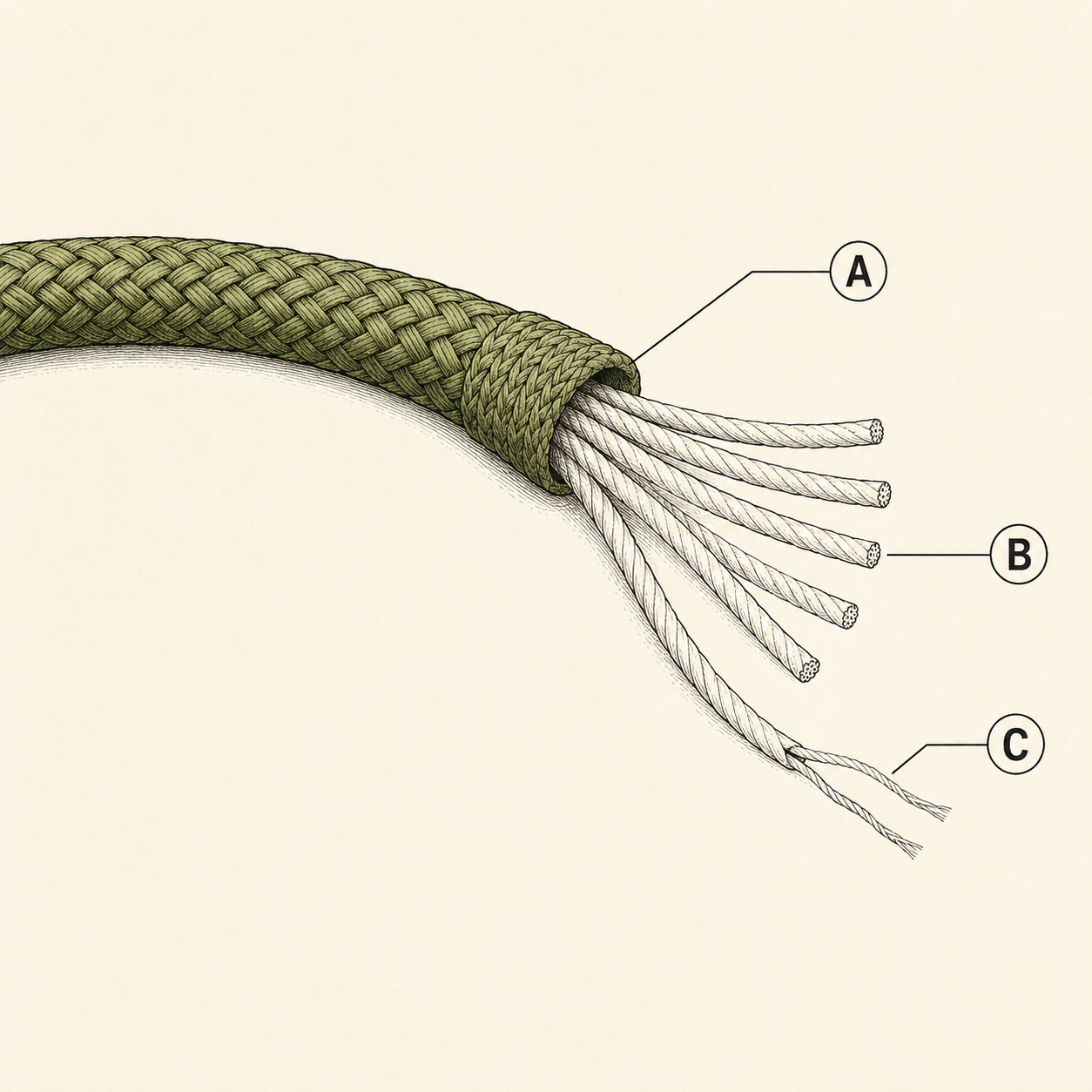
Genuine 550-class paracord is a braided nylon sheath around seven two-ply inner yarns, rated to 550 lb (250 kg). The construction is the point: one cord that disassembles into a sheath plus fourteen fine plies is a cordage system, not a rope.
The disassembly math is the famous party trick with real value: gut a 10 ft (3 m) length and you hold the emptied sheath (still strong, still lashing-grade) plus seven 10 ft inner strands, each splitting into two plies: over 150 ft (45 m) of fine line from ten feet of pocket weight. The inner strands sew packs and tarps, whip fraying rope ends, hang food, rig Chapter 14‘s fishing droppers, and tie the small tight jobs where fat cord fumbles.
Counterfeits, per Chapter 6‘s tells: open an end. Fuzzy batting or hollow nothing instead of distinct removable yarns means decorative craft cord wearing the name, strong enough for bracelets and nothing else. Melt-seal every cut end (nylon frays enthusiastically; a lighter kiss stops it), and buy from suppliers who state the construction rather than the number alone.
Bank line and the supporting cast
Tarred bank line (the traditional twisted nylon of trotlines) packs more usable feet per ounce than paracord and holds knots better; a spool of #36 belongs beside the paracord in any pack with room. Fine line, wire, and duct tape complete the flexible-attachment shelf.
Bank line’s case: at roughly 300 lb (136 kg) test for #36, it’s plenty for shelter and camp jobs, its tarred twist grips knots that slick paracord sheds, it cuts into usable lengths without melt-sealing, and the same weight buys several times the footage. Many experienced kit builders run bank line as the volume cordage and keep paracord for the jobs wanting its strength and its guts. This book’s packs carry both without apology.
The rest of the shelf, cross-referenced: 24-gauge wire (Chapter 14) for attachments that must not stretch, slip, or burn (pot hangers over fire, hard mechanical fixes); fishing line (Chapter 14) as the finest tier; duct tape (Chapter 27) as the no-knot fastener; and zip ties (same chapter) as instant one-way lashings. Cordage doctrine is really attachment doctrine, and the kit carries the whole spectrum from wire to tape.
The five knots that carry it all
Five knots cover ninety-plus percent of field cordage work: the bowline (fixed loop), the taut-line hitch (adjustable tension), two half hitches (tie-off to things), the trucker’s hitch (mechanical-advantage tensioning), and the sheet bend (joining unequal lines). Learn them to the fingers-only standard.
Why these five, in one line each. Bowline: a loop that won’t slip closed and unties after loading; harnesses, anchors, the loop for everything. Taut-line: a hitch that slides to tension and holds; every guy-line on every tarp. Two half hitches: the fast, reliable “tie this to that tree”; start of most jobs. Trucker’s hitch: a rough 3-to-1 pull for ridgelines drum-tight and loads cinched; the one that makes people think you’re a professional. Sheet bend: joins your paracord to the found baler twine; also ties into tarp corners that have no grommet (pebble in the fabric, sheet bend around it: an improvised tie-out, and worth the price of this chapter on its own).
The fingers-only standard means practiced past thought: eyes closed, cold hands, behind your back.
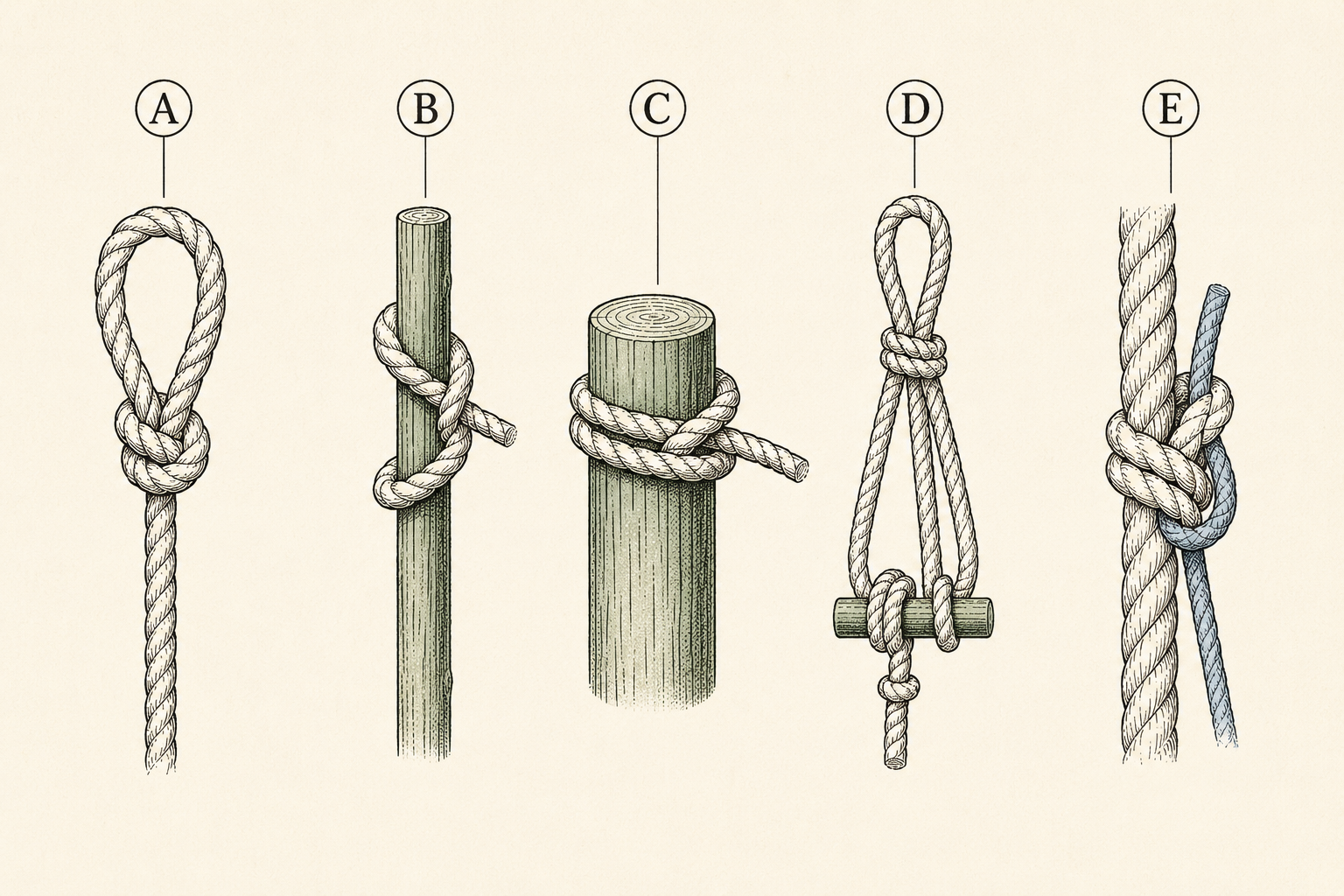
A yard of cord living beside the couch converts television time into this competence in a week (Chapter 40 makes it official). Diagrams live in every knot reference and app; the learning lives in the hands.
Winding, storage, and deployment
Cordage stored as a loose coil becomes a puzzle; wind it flat on cards and bobbins in small kits, in climbing-style butterfly hanks at pack scale, and in dedicated spools in vehicles. Deployment speed is a storage decision made weeks earlier.
The methods by layer: pocket kits wind cord on flat cards (an old gift card, notched) or sewing bobbins, which also kills the rattle; packs carry hanks (the doubled figure-eight wrap that pays out without kinks) or purpose winders; vehicles keep the spool the cord came on plus a working hank. The paracord bracelet from Chapter 5 remains honorable Layer 1 storage: 8–10 ft (2.4–3 m) you cannot forget, unwoven in a minute when the day demands it.
Working habits that keep cordage alive: cut long rather than knot-extending short pieces (then reclaim; knots weaken and shorten), melt ends the moment you cut, retire line that’s fuzzed through its sheath from load-bearing to lashing duty, and dry wet cordage before storage (nylon shrugs off water, but the mildew smell of a wet-stored hank outlives civilizations).
Improvised cordage: the skill behind the supply
When carried cordage runs out, the world provides: inner strands you saved, clothing sacrificed in strips, wire, cables, and plant fibers twisted by the oldest craft there is. Improvised cordage is slow, which is exactly why the kit carries real string.
The practical inventory, in descending convenience: the guts of paracord you already used (save every offcut); shoelaces, belts, and pack straps reassigned; fabric torn in strips and twisted (a T-shirt yields yards of serviceable tie); vehicle scavenge (seat-belt webbing cuts into powerful flat lashing, wiring looms into wire ties); and finally natural fiber (inner bark of dead trees, tough grasses, root lengths) twisted into cord by the two-strand reverse-twist method that predates history and rewards one afternoon’s practice (Chapter 40‘s list again).
The doctrine point isn’t romance; it’s arithmetic. An hour of decent natural cordage buys perhaps ten feet; the pack’s fifty feet cost four ounces. Improvise proudly when needed; pack so it isn’t.
Allocation by layer
Cordage per layer, as the Part III builds will pack it:
| Layer | Cordage loadout | Notes |
|---|---|---|
| Layer 1 pockets | Bracelet (8–10 ft / 2.4–3 m) or none | Plus the laces you’re wearing |
| Layer 2 tin/pouch | 10–20 ft (3–6 m) paracord on a flat card + inner-strand hank | Card kills rattle; guts pre-pulled from an offcut |
| Layer 3 pack | 50 ft (15 m) paracord + a spool of #36 bank line | The tarp’s ridgeline lives here |
| Vehicle | 100 ft+ (30 m+) mixed + ratchet strap or two | Straps do what knots shouldn’t (Chapter 35) |
| Home | The junk-drawer spectrum, honestly inventoried | Chapter 34‘s audit will find the gaps |
The table’s quiet lesson repeats the book’s oldest one: capability inward. The fifty feet in the pack is splendid; the ten feet that’s actually in your pocket ties the splint at the trailhead.
Pack This Chapter
- Cordage is the connective tissue: shelters, repairs, food, signals, and splints all assume string. Underpacking it is the default error; don’t.
- Real 550: braided sheath, seven two-ply guts, 550 lb (250 kg) new-and-straight. Open an end to catch fakes; melt every cut.
- Bank line buys more feet per ounce and better knot grip; run both at pack scale. Wire, fishing line, tape, and zips complete attachment doctrine.
- Five knots to fingers-only: bowline, taut-line, two half hitches, trucker’s hitch, sheet bend (plus its pebble-corner trick).
- Wind flat in kits, hank in packs, spool in vehicles. Never life-safety loads on paracord.
Where Kits Fail
- String assumed, not packed. The tarp arrived; its ridgeline didn’t. Cordage is a line item, not an ambiance.
- The decorative fake. Craft cord in paracord costume, discovered under load. The guts check takes five seconds at purchase.
- Knotless ownership. Fifty feet and two granny knots is a tangle subscription. Five knots, fingers-only, couch-learned.
- The rappel temptation. Paracord over an edge with a person on it. Its rating was never about that, and the margin is your spine.
Frequently asked
What makes real 550 paracord different from cheap cord?
Construction: a braided nylon sheath over seven distinct two-ply inner yarns, rated 550 lb (250 kg) new and straight. The guts triple its usefulness (fine line for sewing, fishing, whipping) and their absence is the counterfeit tell. Craft-store lookalikes hide fuzzy batting and quit under real load.
What are paracord’s inner strands for?
Everything fine: sewing pack and tarp repairs, fishing droppers and snoods, food hangs, whipping rope ends, trap triggers, dental-floss-grade lashing. Gut a short length and ten feet becomes over 150 ft (45 m) of usable line. Save every offcut; pre-pull one hank of guts into the tin kit.
Is bank line better than paracord?
For volume camp cordage, often: #36 tarred bank line packs several times the footage per ounce, grips knots better, and handles shelter and lashing jobs at ~300 lb (136 kg) test. Paracord keeps the strength-and-guts jobs. The experienced answer is both: bank line for feet, paracord for muscle.
What knots should I actually learn?
Five: bowline (fixed loop), taut-line hitch (adjustable guy-lines), two half hitches (tie-off), trucker’s hitch (tensioning ridgelines and loads), and sheet bend (joining lines, plus tying to grommetless tarp corners over a pebble). Practiced to eyes-closed standard, they cover nearly all field cordage work.